
The Magnifying Glass for Cross Stitch: Buy the Clip, Not the Glass
The stitchers' own favorite isn't the handheld glass you searched for, it's a clip-on that mounts to your frame and leaves both hands free. Useful magnification is only about 2x to 3x, and watch out for the little inset lens most of them can't stand.
 Ray Ostrander · Updated July 24, 2026 · how I decide
If you buy through a link here, the site earns a little. It's never why anything gets picked.
The thing to buy isn’t the handheld glass you typed into the search box, it’s a clip-on magnifier that mounts to your frame or lap stand, because you need both hands free to stitch. The stitchers who love theirs love the mount, not the lens. Useful magnification for needlework is only about 2x to 3x, and the shelf genuinely tops out at 3X, so ignore anything promising more. Two things worth knowing before you buy: light and magnification are separate purchases, and there’s a little inset lens on many of these that most stitchers can’t stand.
Let me say up front that I have never cross-stitched a thing in my life. What I know is lenses, and I went and read what the stitchers themselves say about theirs, because their advice is far better than any product page. So this isn’t me telling you how to stitch. It’s me passing along what the people at the hoop actually keep on their frames, and translating the part that’s about the glass.
What's on this page
First, this isn’t about your eyes
I want to clear one thing out of the way, because a lot of pages on this topic quietly slide into it. This isn’t a page about eyesight, and I’m not going to make a single claim about your vision, your eye health, or what magnification does or doesn’t do to your eyes. Some blogs on this shelf do exactly that, and they’re hobby writers, not anyone qualified to say it, so I’m leaving all of it out.
Here’s what’s actually happening when you can’t see your stitches, and it has nothing to do with your eyes. You’re working on cloth that might have 25 or 28 threads packed into every inch. A single strand on high-count linen is simply smaller than what any human eye resolves comfortably at reading distance, a twenty-year-old with perfect vision included. That’s a property of the fabric, not of you. So the magnifier isn’t a crutch. It’s the right tool for looking at something genuinely tiny, the same way you’d reach for one to read a coin’s date.
Buy the mount, not the lens
Here’s the surprise, and it comes straight from the stitchers. When I read what they actually use and keep, the winner wasn’t the handheld magnifier or even the fancy floor lamp. It was the humble clip-on, the kind that clamps onto your frame, lap stand, or Q-Snap and hovers the lens right over your work. Three different stitchers in the same conversation used almost the identical words about theirs: couldn’t do without it. One who stitches on 25-count fabric said the same. What they’re praising isn’t really the glass, it’s that the thing holds itself in place and leaves both their hands free to stitch.
That’s the whole insight, and it’s the craft version of something I say about telescopes all the time: the stand is the product. A magnifier you have to hold, or that hangs and wobbles, fights you. A magnifier that clips to the frame you’re already using disappears into the work. So shop for the mount first. How does it attach to your setup, and will it stay put where you put it? The lens is almost secondary.
That annoying little lens
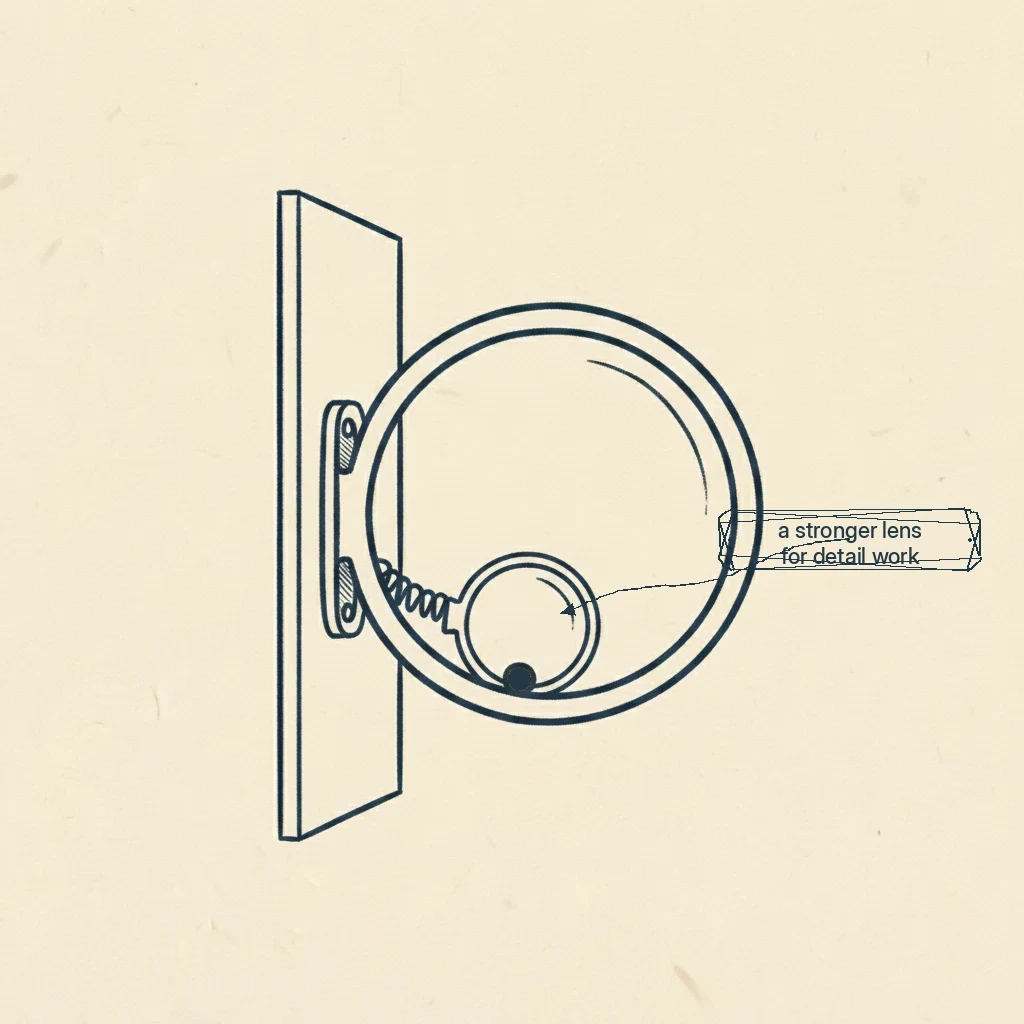
Now the single most useful thing on this page, and you won’t find it on one product listing. Three of six stitchers in that conversation complained, completely unprompted, about the exact same thing: a little lens set inside the big lens. One called it that annoying little lens in the big one. Another just said she hated that extra lens in the middle. None of them knew what it was.
Here’s what’s actually happening. That little circle is a second, much stronger lens deliberately built into the main one, meant for dropping down onto a tiny bit of detail. On the lamps where it’s specified, it’s often a 5x insert set into a roughly 2.25x main lens. For someone painting a single eye on a miniature, that strong little circle is a feature. For a stitcher moving continuously across a piece, it’s maddening, because every time your eye crosses that circle the view lurches between two different magnifications on the same piece of glass.
So the buying rule writes itself: for cross stitch, look for a single-power lens with no little circle in the middle. That’s a spec you can check in ten seconds from any product photo, and it’s the difference between a magnifier you keep and one you resent.
Light and magnification are two different things to buy
This one trips people up, so keep the two apart in your head. A magnifier makes the stitches bigger. A light makes them brighter. They’re not the same purchase, though sometimes they come in the same object. One stitcher with a clip-on magnifier she loves noted that it doesn’t have a light, and she was off shopping for a clip-on light to go with it.
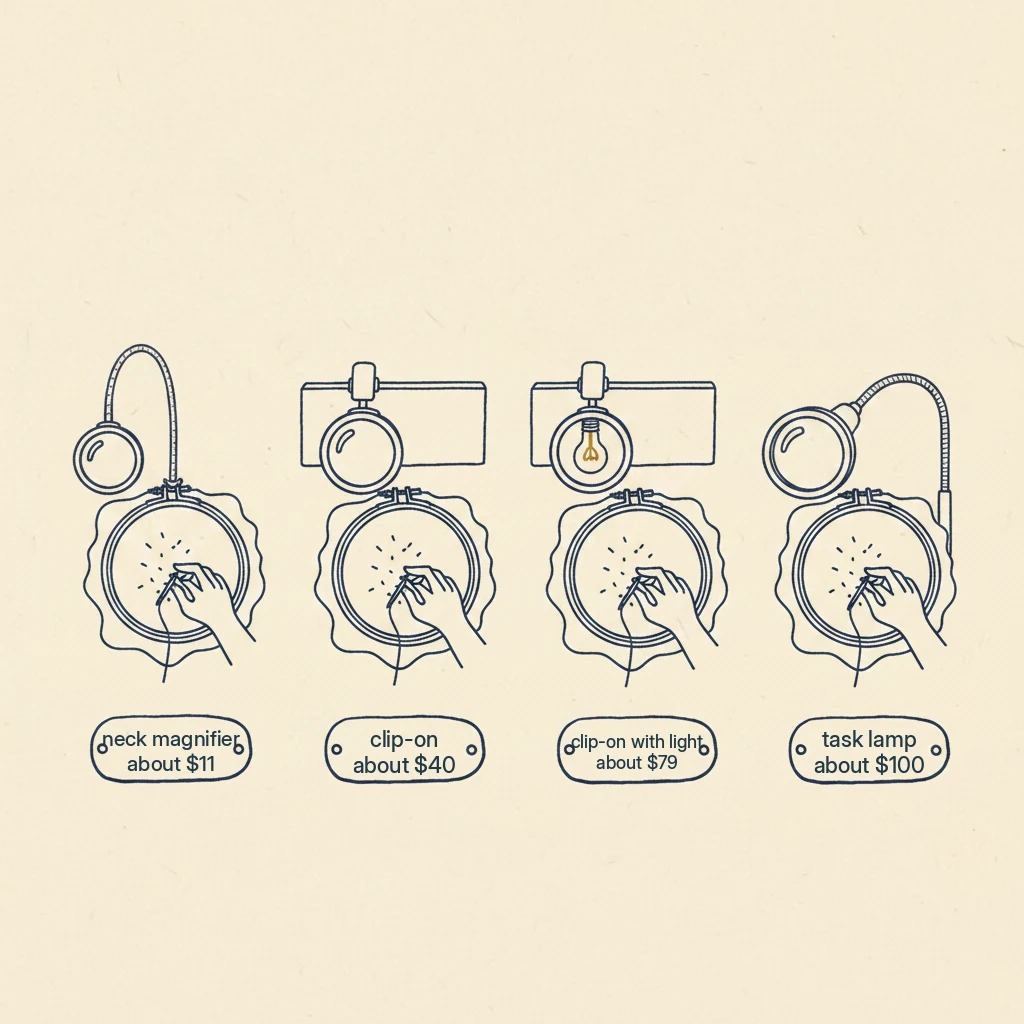
You can see the choice right on the price tags. A plain 3X clip-on magnifier runs about $40, and the same maker’s clip-on with a light built in, the kind that pairs with a Q-Snap, runs about $79. That roughly $39 difference is, essentially, the light bulb. So here’s the fork: if you already stitch under a good daylight lamp, buy the cheaper magnifier and skip paying for light twice. If your stitching corner is dim, the combined lit unit is worth the extra, and you buy the light and the lens as one.
The shelf, cheapest first
All researched, none of it stitched under by anyone here, which the About page says plainly. Prices are rounded to what I’m seeing on a needlework retailer as I write this.
- A hands-free neck magnifier, about $11, at 2.5x. It hangs around your neck and rests on your chest. Most stitchers who tried one didn’t get on with it, saying it wobbles when you move. But one stitcher likes hers just fine and calls it easy, convenient, and inexpensive, so it isn’t worthless. It’s an $11 gamble, and being wrong costs you $11.
- A small clip-on magnifier, about $25, at 3x. The budget version of the crowd favorite.
- A 3X clip-on, 4 by 6 inches, no light, about $40. A bigger lens on the same clip idea. Pair it with a lamp you own.
- A free-standing 3X magnifier, about $40, if clamping to your frame doesn’t suit your setup.
- A lit clip-on Q-Snap combo, about $79. The $40 clip-on plus a built-in light, for a dim corner.
- A magnifying task lamp, about $100, the floor or desk lamp with a big lens in the ring. Fine, with one catch below.
The cheapest useful thing on the whole shelf is a $6 ruled bar magnifier, a plain strip you lay across the pattern to keep your place, which is a different job but worth knowing exists. And notice the ceiling on all of it: 3X, over and over. That’s not the retailer being stingy. It’s the same physics that caps every magnifying lens, a workbench solder lamp included. Past about 3x the lens has to sit so close to the cloth there’s no room to get a needle under it. When a listing shouts a bigger number, it’s describing something you can’t actually stitch beneath.
The catch on the floor lamp
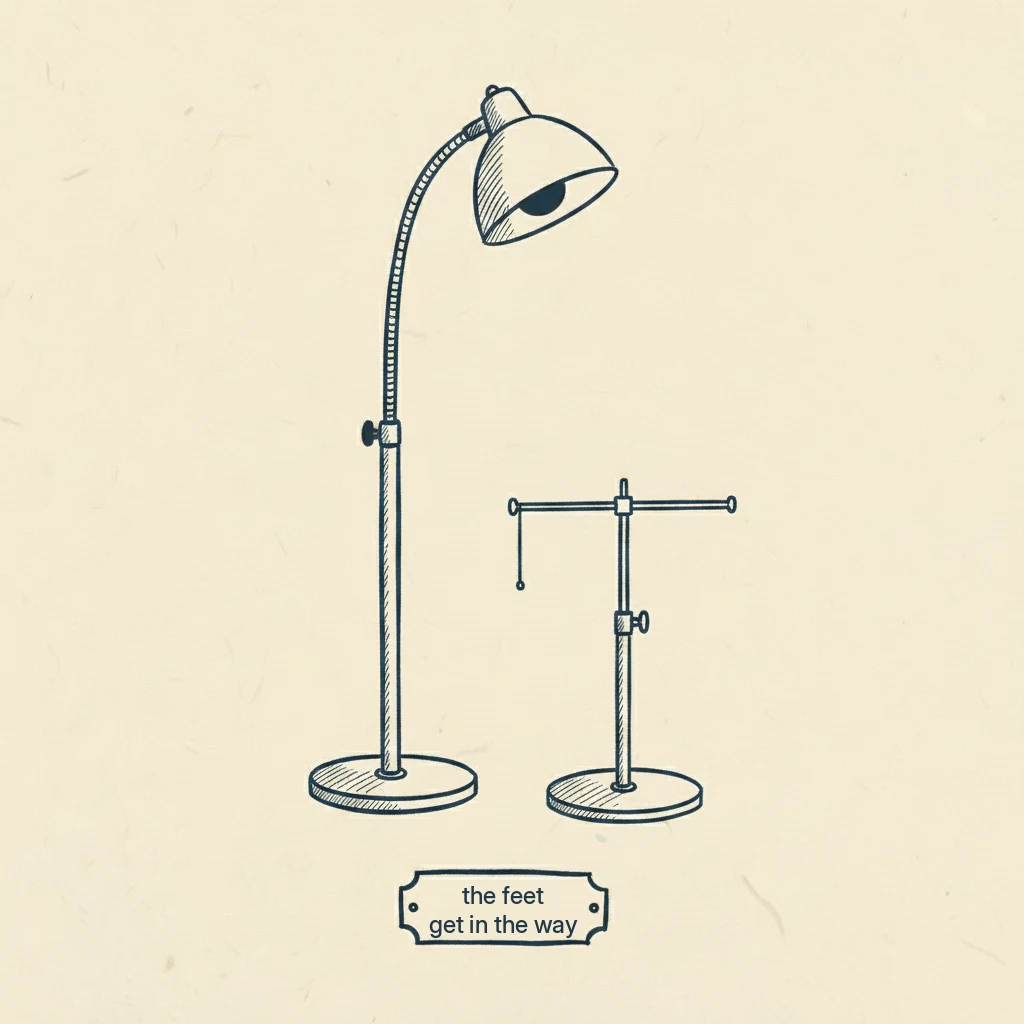
One warning that saves a hundred dollars, and again it comes from a stitcher, not a catalog. If you work on a floor-standing frame, be careful with a floor-standing magnifier lamp, because the lamp’s base and the frame’s base fight each other for the same floor. One stitcher found her floor lamp fine for hand-held stitching but awkward with her floor frame, because, in her words, the feet get in the way. No product page will tell you that. If you use a floor stand, a clip-on that rides on the stand itself sidesteps the whole problem.
Questions people actually ask
What magnification do I need for cross stitch?
Not much, and not what the listings shout. Useful needlework magnification is roughly 2x to 3x, and the whole craft shelf tops out at 3X for a good reason: past that, the lens has to sit too close to the fabric to fit a needle underneath. The finer your fabric count, the more you’ll appreciate being near the top of that small range, but you’re choosing within 2x to 3x, not chasing bigger numbers.
Do I want a magnifying lamp, a clip-on, or the kind you wear?
The clip-on is the stitchers’ own favorite, because it mounts to your frame or lap stand and leaves both hands free. A magnifying lamp adds a big light source but its base can clash with a floor stand. The wearable neck type is cheap and divisive: most people find it wobbly, a few love it. Start with a clip-on that fits your setup, and add light separately if your corner is dim.
What’s that little lens inside the big lens?
It’s a second, stronger lens built into the middle for fine detail work, sometimes around 5x set into a 2.25x main lens. Handy if you occasionally drop onto one tiny spot, but a lot of stitchers find it maddening for normal work, because your view jumps whenever your eye crosses it. For cross stitch, look for a single-power lens with no little circle in it.
Do I need a light too, or just a magnifier?
They’re two separate things. If you already stitch under a good daylight lamp, a plain magnifier is all you need, and you can save the roughly $39 that a built-in light adds. If your stitching spot is dim, buy the combined lit magnifier so you get brightness and magnification in one unit. Match the purchase to the corner you actually stitch in.
What I’d actually reach for
If it were my hoop, I’d get a single-power clip-on that mounts to the frame or stand I already use, skip anything with a little inset circle in the lens, and only pay for a built-in light if my stitching corner were dim. Buy the mount that holds itself over your work, keep the magnification modest at 2x to 3x, and let the crowd’s hard-won advice save you from the wobble, the feet, and that little lens.
A related page you might want next:
- Doing fine detail work with a brush instead of a needle? That page is coming; the short answer is the same lamp-first law as here.
Ray Ostrander
Ray spent three decades explaining the sky to twelve-year-olds and their parents, and every January, hearing which Christmas telescopes ended up in the closet. He doesn't own a wall of gear and won't pretend to. He reads everything, tells you what owners agree on, and flags what's just his judgment. His goal is simple: no more January closets.