
Microscope for Jewelry: The Tool the Trade Actually Uses Costs $17
For looking at a ring, the trade's tool isn't a microscope, it's a 10x triplet loupe, and it costs about seventeen dollars. Ten times is the grading standard because above it the focus gets too shallow to hold a stone in. A microscope earns its place only when you need more magnification, both hands free, or a screen. No magnifier tells you if a stone is real or what it's worth.
 Ray Ostrander · Updated July 24, 2026 · how I decide
If you buy through a link here, the site earns a little. It's never why anything gets picked.
Here’s the honest answer, and it may surprise you. For looking at a piece of jewelry, a ring, a hallmark, a stone you want to inspect, the tool the trade actually reaches for isn’t a microscope at all. It’s a 10x triplet loupe, a small piece of glass that costs about seventeen dollars. Ten times is the professional standard, and it’s not because stronger glass doesn’t exist. It’s because above 10x the focus gets so shallow you can’t hold a stone in it. A microscope earns its place only when you genuinely need more magnification than that, or both hands free to work, or a screen to photograph what you found. And one thing to say plainly up front: no magnifier of any price will tell you whether a stone is real or what it’s worth. That’s a different job entirely.
What's on this page
- Two people ask this, and they need opposite tools
- Here's what's actually happening: why the trade stops at 10x
- What the loupe actually shows you, and what it doesn't
- How to actually hold a loupe
- What to actually buy
- When you actually want a microscope
- Questions people actually ask
- What I'd put in a drawer
Two people ask this, and they need opposite tools
Before anything else, let me sort out which one you are, because there are two very different people typing “microscope for jewelry” and they should walk away with two different things.
Most people asking this have a piece of jewelry in hand, inherited, secondhand, or newly bought, and they want to see it. The hallmark stamped inside a band. The tiny marks. Whether that little speck is a chip or just dust. If that’s you, “microscope” is simply the word for “the thing that makes small things big,” and it’s a perfectly good word. Your answer is the loupe, and the rest of this page is for you.
The other person is a maker, someone setting stones or soldering at a bench, who wants a microscope to work under, with both hands free. That’s a real need, but it’s a different tool, a stereo bench microscope, and a different page. If that’s you, skip ahead to the microscope section and I’ll point you the right way. For everyone else, let’s talk about the loupe.
Here’s what’s actually happening: why the trade stops at 10x
This is the part worth understanding, because it explains the whole shelf.
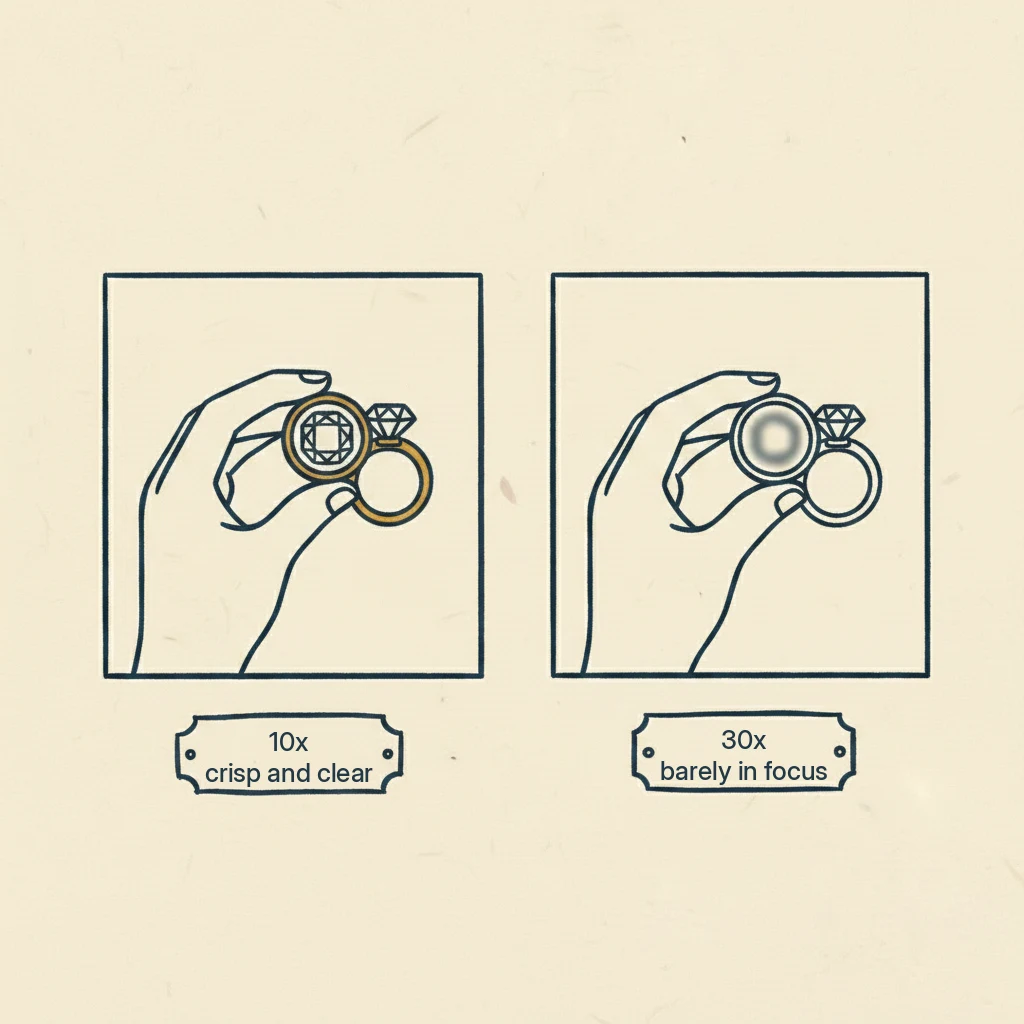
You’d think a jeweler would want the strongest magnifier money can buy. They don’t, and here’s the physics of why. The more you magnify, the thinner the slice of space that stays in focus at any one moment, what the opticians call depth of field. At 10x, a useful chunk of the stone is crisp. Push to 20x or 30x and the in-focus zone shrinks to a paper-thin sliver, with everything in front of it and behind it a blur, and every tiny wobble of your hand thrown up huge. As the International Gem Society puts it, you’ll find more powerful loupes, but “the depth of field (the area that’s in focus) is so small above 10X that they’re hard to use.” The tool stops working before the number stops climbing.
That’s why 10x is the standard, and the biggest name in the business enforces it. GIA states flatly that every diamond is evaluated under 10x magnification, and that clarity, polish, and symmetry grading can only be finalized using a 10x loupe. Their whole grading scale, in their own words, runs under 10x magnification. So when a shelf tries to sell you a 30x or a 60x pocket loupe as the “better” one, it’s selling you past the point the entire trade agreed to stop at.
What the loupe actually shows you, and what it doesn’t
The gem authority lists exactly what a 10x loupe reveals, and it’s worth reading the whole list, because the list is also the honest limit of the tool. You’ll see fractures and inclusions, the little internal marks and voids. You’ll see polish quality, surface scratches and pits. You’ll see facet alignment and sharpness, color zoning and banding, and any damage to the culet, the point at the bottom of a cut stone.
Now notice what’s not on that list. Nowhere does it say the loupe tells you whether the stone is genuine, or what it’s worth. That absence is the whole ethical point of this page. A loupe shows you the physical features of a stone. Reading those features to decide what a stone is, or what it should cost, is a gemologist’s job, done with training and often with equipment far beyond a magnifier. So I’m going to tell you exactly what you can see, and I’m not going to pretend a seventeen-dollar piece of glass can appraise your grandmother’s ring, because it can’t, and anyone who tells you otherwise is selling something.
How to actually hold a loupe
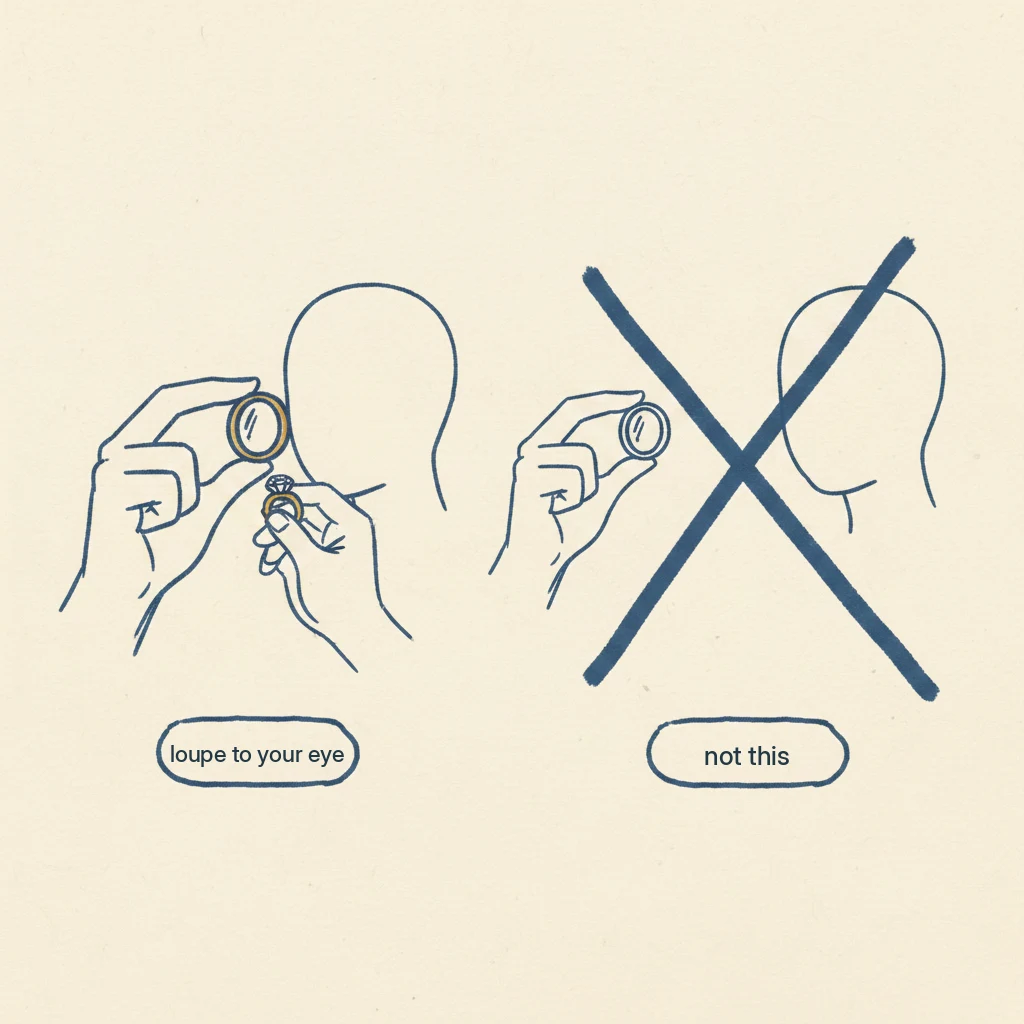
The single most common mistake is holding a loupe out at arm’s length like a cartoon detective. That’s not how it works. Here’s the technique the trade teaches.
Put your index finger through the opening in the loupe’s cover so the cover becomes a little handle. Bring the loupe right up to your eye, almost touching it. Brace that hand against your cheek so it’s steady, and keep both eyes open, which feels strange for a second and then feels natural. Then move the ring or stone toward and away from the glass until it snaps into focus. The loupe comes to your eye; the object comes to the loupe. That, oddly, is the exact same technique a serious coin collector uses at their bench, two unrelated hobbies arriving at the same small motion.
One more free trick, about light. To see the surface, scratches and polish, put your light above the stone shining down. To see what’s inside it, the inclusions, put the light behind the stone instead. Same loupe, two completely different views, just by moving the lamp.
What to actually buy
Here’s the part that makes this an easy, cheap decision.
A GemOro Hastings Triplet 10x runs about $17. And that word “triplet” matters: it means three lenses working together to cut the edge distortion a single cheap lens gives you, and it’s exactly the kind of loupe the gem authority describes as the grading standard. Generic 10x triplets run roughly $14 to $24, and a top-of-the-line branded 10x optical-grade loupe reaches about $52. That’s the whole honest range. The tool a diamond grader uses costs less than a large pizza.
You don’t need to spend up. The gem authority says it directly: beginners need not buy the expensive models with the fanciest triplet and color-correction features to start. A plain 10x triplet does the job. What you should not do is chase the big number. There’s a common trap on the shelf, a 30x-and-60x two-pack for about $27, that looks like more magnifier for your money and is in fact two loupes you’ll struggle to hold steady, both of them past the point the trade stops at. Spend $17 on the one a grader would recognize, not $27 on two you can’t use.
One honest warning for your first minute with it: nothing will seem to stay in focus, and you’ll wonder if you bought junk. You didn’t. That’s the shallow depth of field doing exactly what we talked about, and the fix is the technique above, brace against your cheek, both eyes open, and move the stone slowly. Give it two minutes and it clicks.
When you actually want a microscope
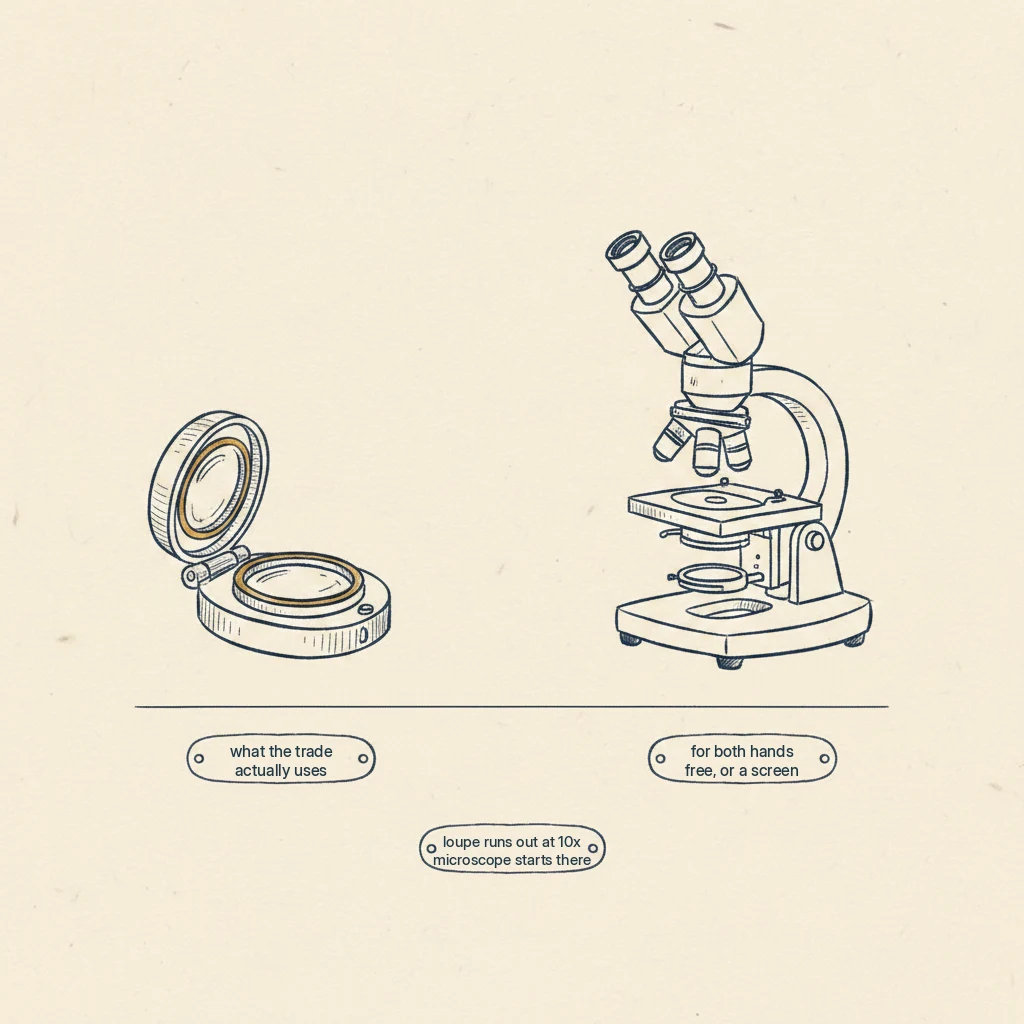
Now, for the reader who really does want a microscope, here’s the honest line. The gem authority’s own advice is to use a microscope when you need higher magnification than the loupe can comfortably give. Beyond that, a microscope makes sense for two practical reasons a loupe can’t cover: you need both hands free to work on the piece, or you want a screen to photograph a hallmark or an inclusion to keep or share.
If it’s the making you’re after, setting stones, soldering, working at a bench, the tool is a stereo microscope. Those start around $156 and give you a low-power, three-dimensional view with room to work underneath. That’s the right instrument for a jeweler’s bench, and the wrong one for someone who just wants to look at a ring.
There’s also a whole shelf of digital, screen-based scopes running from about $35 to $160, and here I have to be straight with you. Their boxes advertise numbers like 100X, 1200X, even 1500X, and the trade, remember, works at 10x. Those numbers are measured differently, an image blown up on a screen rather than viewed through an eyepiece, and I’m not going to improvise an explanation of exactly how those screen numbers translate, because I don’t have a solid source for it and I’d rather not guess at optics. What I can tell you plainly is this: the professional standard for looking at a stone is 10x, and a “1200X” figure on a screen scope isn’t 120 times more useful than a jeweler’s loupe. Buy a screen scope if you want a screen, not because a big number promises a better look.
Questions people actually ask
What magnification do I need to look at jewelry?
Ten times. That’s the trade standard, used for grading diamonds, and it’s the standard because above 10x the depth of field gets too shallow to keep a stone in focus. Stronger loupes exist, but the professionals don’t use them for general inspection. A 10x triplet loupe is the right and complete answer for looking at a ring.
Do I need a microscope or a loupe for jewelry?
For looking at a piece, a loupe, a 10x triplet, about $17. A microscope only earns its place when you need more magnification than a loupe gives comfortably, both hands free to work on the piece, or a screen to photograph a detail. If you’re a maker setting stones at a bench, that’s the microscope case; if you just want to see your ring, it isn’t.
Can a loupe or microscope tell if a diamond is real?
No. A magnifier shows you the physical features of a stone, its inclusions, polish, facets, and any damage, but it doesn’t tell you whether the stone is genuine or what it’s worth. Identifying and valuing a stone is a gemologist’s job, done with training and specialized equipment. Any tool sold on the promise of spotting fakes is overselling what magnification can do.
Why do jewelers use 10x and not higher?
Because of depth of field, the thin slice of space that stays in focus. At 10x a useful part of the stone is sharp; past it, the in-focus zone shrinks to almost nothing and every hand tremor is magnified too. The gem authority says stronger loupes are simply hard to use, and GIA finalizes grading only at 10x. The trade settled where the tool still works.
What I’d put in a drawer
So here’s where I’d land, plainly. If you want to look at your jewelry, buy a 10x triplet loupe, spend about seventeen dollars, and skip everything with a bigger number on it. Learn the little motion, loupe to your eye, ring to the loupe, light above for the surface and behind for the inside, and you’ll see genuinely more than most people ever do of something they own. Reach for a microscope only if you’re working on pieces and need your hands free or a screen. And if the real question underneath is whether something is genuine or what it’s worth, that’s a gemologist’s chair, not a magnifier, and the honest thing I can do is point you there rather than pretend a lens can answer it.
If you’re curious how the very same tool serves a different collector, a magnifying glass for coins walks the coin trade’s version, and a microscope for coins covers when that hobby reaches for a scope. If you’ve decided you do want a real microscope, a microscope for adults is the honest buyer’s guide, and if a shelf ever waves a huge number at you, the truth about 5000x microscopes explains why the big number is the tell.
Ray Ostrander
Ray spent three decades explaining the sky to twelve-year-olds and their parents, and every January, hearing which Christmas telescopes ended up in the closet. He doesn't own a wall of gear and won't pretend to. He reads everything, tells you what owners agree on, and flags what's just his judgment. His goal is simple: no more January closets.