
The Best Microscope for Kids: 40 to 400x, Real Glass, and Skip the '2000x' Lie
For a kid, buy 40x to 400x with real glass optics and a metal frame. That shows bugs, cells, and pond life, which is everything a child wants. A stereo scope suits little kids, a compound suits ages 8 and up.
 Ray Ostrander · Updated July 24, 2026 · how I decide
If you buy through a link here, the site earns a little. It's never why anything gets picked.
For a kid, buy 40x to 400x with real glass optics and a metal frame. That range shows bugs, cells, and pond water swimming with life, which is everything a child actually wants to see. Ignore the “1000x” and “2000x” numbers screaming from the box, because they’re empty. A stereo scope suits little kids, a compound suits ages 8 and up, and a good kids kit like an AmScope 120x set runs about $45.
I ran the science fair for thirty-one years, so this is the counter I know in my bones. Let me help you buy the scope that makes a kid gasp at a bug’s eye, not the one that ends up in the closet with the wobbly telescopes.
What's on this page
The big number on the box is the lie
It’s the same con the telescope aisle runs with magnification. A cheap microscope shouting “2000x!” isn’t showing you more than a good 400x scope. It’s showing you less, badly. To reach those numbers, the makers pair a big claim with poor lenses, so what you get at 2000x is a blurry, dim blob you can’t make sense of.
The useful range for a kid is 40x to 400x, and that’s not a compromise, it’s the honest sweet spot. Everything a child gets excited about lives in that range: the hairs and eyes on an insect, the cells scraped from their own cheek, the tiny animals darting through a drop of pond water. Optical quality, good lighting, and clean contrast matter far more than the zoom number. When you’re comparing scopes, chase clarity, not the biggest figure on the label.

Stereo or compound? Match it to the kid
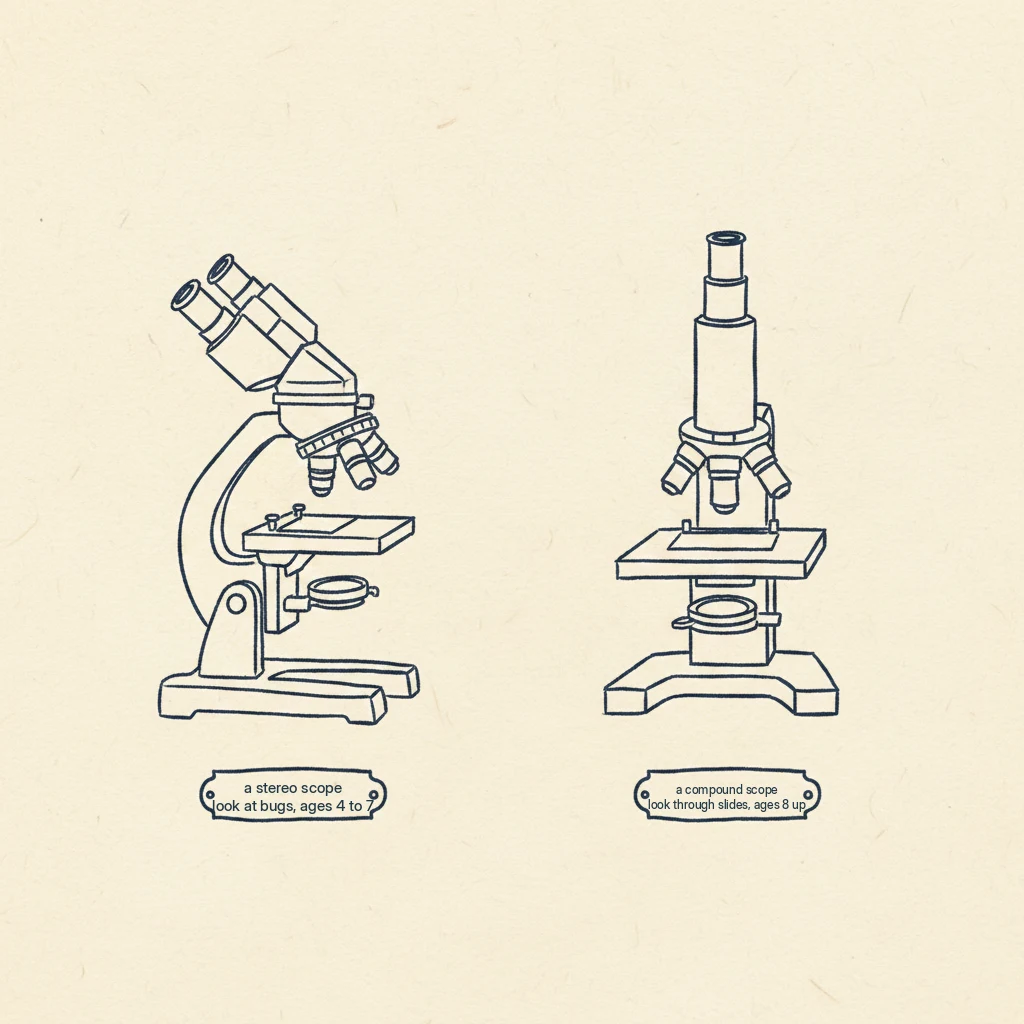
There are two kinds of microscope, and picking the right one matters more than any spec. A stereo microscope is low-power and shows things in 3D. It’s for looking at whole objects: a beetle, a coin, a leaf, a rock. A compound microscope is higher-power and looks through thin, flat slides at things too small to see any other way: cells, pond drops, fibers. One looks at, the other looks through.
Age is the easy guide. Little kids, roughly 4 to 7, do best with a stereo scope, because they want to drop a bug under it and see it huge and real. Kids around 8 to 12 are ready for a compound, where prepared slides and pond samples open up the invisible world. Teens can handle a compound or a digital scope that shows the image on a screen. If you’re buying for a five-year-old who loves beetles, don’t hand them a high-power compound. Hand them a stereo, and watch them light up.
Durability is the spec that actually matters
Forget the magnification race. On a kid’s microscope, the spec I’d chase is whether it survives a nine-year-old. Look for a metal frame instead of all-plastic, a non-slip base so it doesn’t skate across the table, a smooth focus knob that a small hand can work without a fight, and real glass optics rather than the cloudy plastic in toy scopes. Dual LED lights, one from above and one from below, with adjustable brightness, make a real difference in what a kid can actually see.
That combination, glass and metal and smooth focus, is what separates a real instrument from a toy that frustrates a child into quitting. You don’t need to spend a fortune to get it, but you do need to spend past the flimsiest plastic toys.
The kids microscope shelf
All researched, none tested by anyone here, and you’ll find that said plainly on the About page. Prices are rounded to what I’m seeing as I write this.
- Celestron Kids Pocket Zoom, about $18. A pocket toy for a curious little one, fine as a stocking stuffer.
- AmScope 120x beginner STEM kit (52 pieces), about $45. The classic first kit: metal body, glass optics, and a case full of slides and tools. Its box lists up to 1200x, but you’ll live happily at the low end, and the build and the accessories are why it’s the popular pick.
- Celestron Labs S20 angled stereo, about $50. A proper 3D stereo scope for a bug-loving 4 to 7 year old.
- Celestron Kids 28-piece kit, about $55, a gift-ready starter with everything in the box.
- AmScope IQCREW 85-piece with color camera, about $60, if you want the screen-and-camera angle for a slightly older kid.
- Celestron Labs CM800 compound, about $150, a real student scope for ages 8 and up.
- AmScope M150C all-metal compound (40x to 1000x), about $115, a sturdy step-up that grows with a serious young scientist.
- Celestron LCD digital microscope, about $300, for a teen who wants to capture and share what they see on a screen.
For most kids, a $45 to $55 kit or a $50 stereo scope is the right first buy. Spend up to a $115 to $150 compound only when the interest is clearly real.
Questions people actually ask
What magnification does a kid’s microscope need?
40x to 400x, and no more. That range shows bugs, cheek cells, and pond life, which is everything a child wants to explore. Microscopes advertising 1000x, 1600x, or 2000x pair those numbers with poor lenses, so you get a blurry blob instead of more detail. Buy for glass quality and a metal frame, and ignore the big magnification claim entirely.
What kind of microscope is best for a young child?
For ages 4 to 7, a stereo microscope. It’s low-power and shows objects in 3D, so a child can drop a beetle or a coin under it and see it big and clear. Compound microscopes, which look through thin slides at cells, are better for kids 8 and up. Match the type to what the child wants to look at, and a little one almost always wants whole things.
Is a cheap kids microscope worth it?
A well-built one around $45 to $55 is absolutely worth it, and it’s the right call, not a compromise. What you want to avoid is the flimsy plastic toy with a huge magnification claim, which frustrates kids with cloudy, shaky views. A real kit with glass optics and a metal frame at a modest price delivers genuine wonder and survives rough handling. Step up only if the interest sticks.

What I’d tell a parent in the hallway
For a little one who loves bugs, a stereo scope around $50, or a good 52-piece starter kit around $45 with glass optics and a metal body. For a kid 8 or older, a real compound scope in the $115 to $150 range. Whatever you do, ignore the “2000x” on the box, because a clear view at 400x is worth more than a blurry one at any number. A kid’s curiosity that shows up for a science unit or a rainy afternoon is real curiosity, and it deserves a real instrument.
A few things you’re probably also wondering:
- Buying a telescope for the same curious kid? See best kids telescope.
- Is your child a little too young for a microscope yet? See star projector for kids.
Ray Ostrander
Ray spent three decades explaining the sky to twelve-year-olds and their parents, and every January, hearing which Christmas telescopes ended up in the closet. He doesn't own a wall of gear and won't pretend to. He reads everything, tells you what owners agree on, and flags what's just his judgment. His goal is simple: no more January closets.