Best Binoculars for Yellowstone: The Park's Own Rule Decides This
The park requires you to stay 100 yards from bears and wolves, so binoculars aren't a luxury, they're how you're allowed to watch. An 8x42 is the all-day pick, a 10x42 for open valleys. But wolves sit 300 yards out, which is scope range. And you can rent.
 Ray Ostrander · Updated July 24, 2026 · how I decide
If you buy through a link here, the site earns a little. It's never why anything gets picked.
The park legally requires you to stay 100 yards from bears and wolves and 25 yards from everything else, so binoculars here aren’t a luxury, they’re how you’re allowed to watch at all. An 8x42 is the comfortable all-day pick, and a 10x42 earns its keep glassing the wide-open valleys. But here’s the part the shopping lists skip: the wolves and grizzlies most people drive here to see sit 300-plus yards out, which is spotting-scope range, not binocular range. And you can rent either one for a few dollars a day.
A lot of people arrive at this page half-suspecting they’re about to be sold something, and honestly, on most of the pages that rank for this, they are. So let me do the opposite. I taught earth science for thirty-one years, and a trip to Yellowstone is geology and ecology laid open, right in my wheelhouse even though I’ve never watched a wolf myself. What I can do is take the park’s own rules and the working guides’ own words and turn them into a straight answer, including the parts that don’t sell a binocular.
What's on this page
- The park makes the decision for you
- 8x42 or 10x42? Where you're standing decides
- The thing the shopping lists won't tell you: the wolf is out of range
- Why the "premium long-range" pairs are a trap
- The honest answer nobody's affiliate link wants: rent it
- If you do want to own a pair
- Questions people actually ask
- What I'd tell a parent in the hallway
The park makes the decision for you
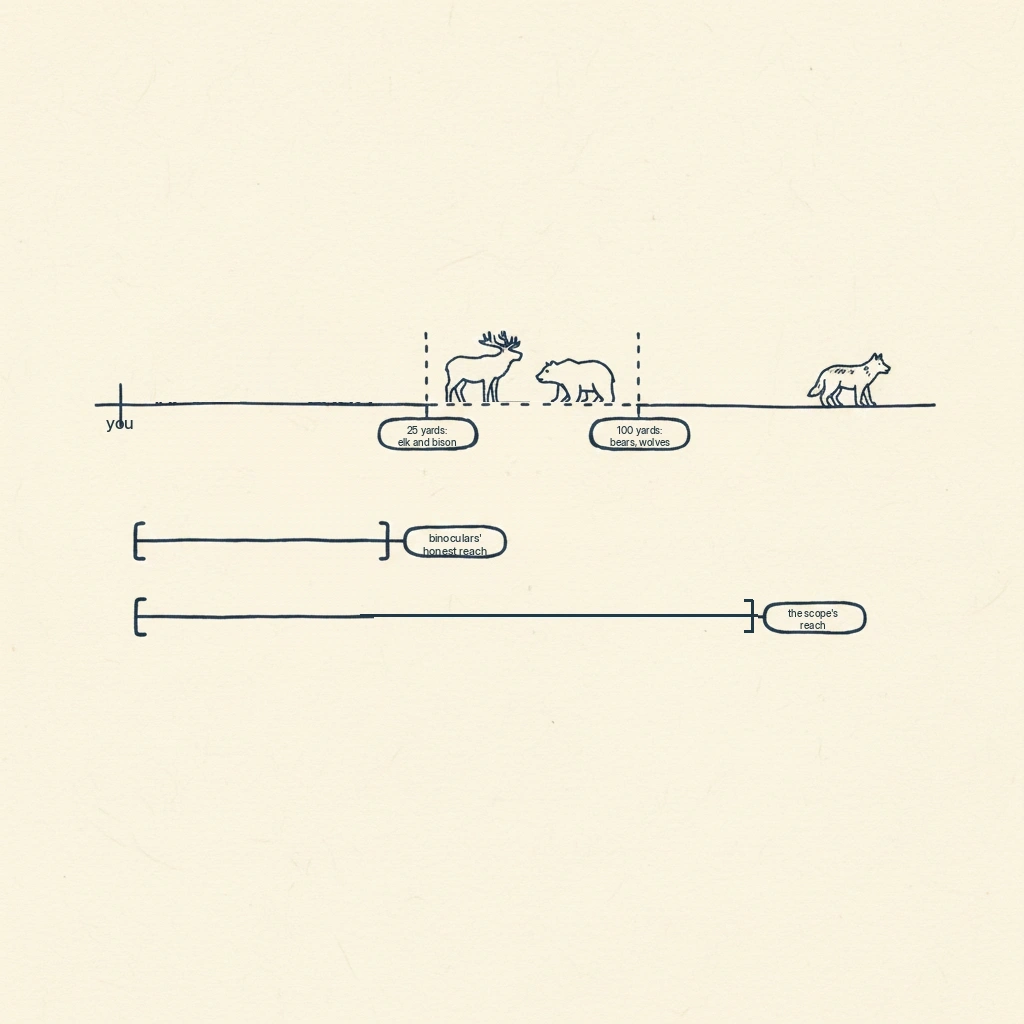
Start with the fact that outranks every opinion on every listicle, because it’s not an opinion, it’s the law of the place. The National Park Service is explicit: always stay “at least 100 yards (91 m) away from bears, wolves, and cougars”, and “at least 25 yards (23 m) away from all other animals, including bison and elk.” Those distances aren’t suggestions. The Park Service says plainly it’s your responsibility to maintain them, and that if an animal moves toward you, you back away.
Now read what the Park Service itself says about how to watch from that distance, because it settles the whole question: “Binoculars and telephoto lenses always give you a better view than approaching the animal would.” That’s the highest authority you could ask for, telling you the binocular isn’t an upgrade to the experience. From a hundred yards back, it’s the only lawful way to have the experience at all. So you’re not really choosing how much you want to see. You’re buying your way across a distance the park won’t let you walk.
I’ll add one hard line and then leave it alone: everything I just said about distances is quoted straight from the Park Service, and I’m not going to improvise past it. For what to actually do in a close encounter, bear spray, any of that, get your guidance from the rangers and the official park materials, not from an optics page.
8x42 or 10x42? Where you’re standing decides
This is the live argument, the one people actually type into the search box both ways, so let me resolve it instead of dodging. Both are 42mm binoculars; the only difference is the magnification, and it’s a real trade.
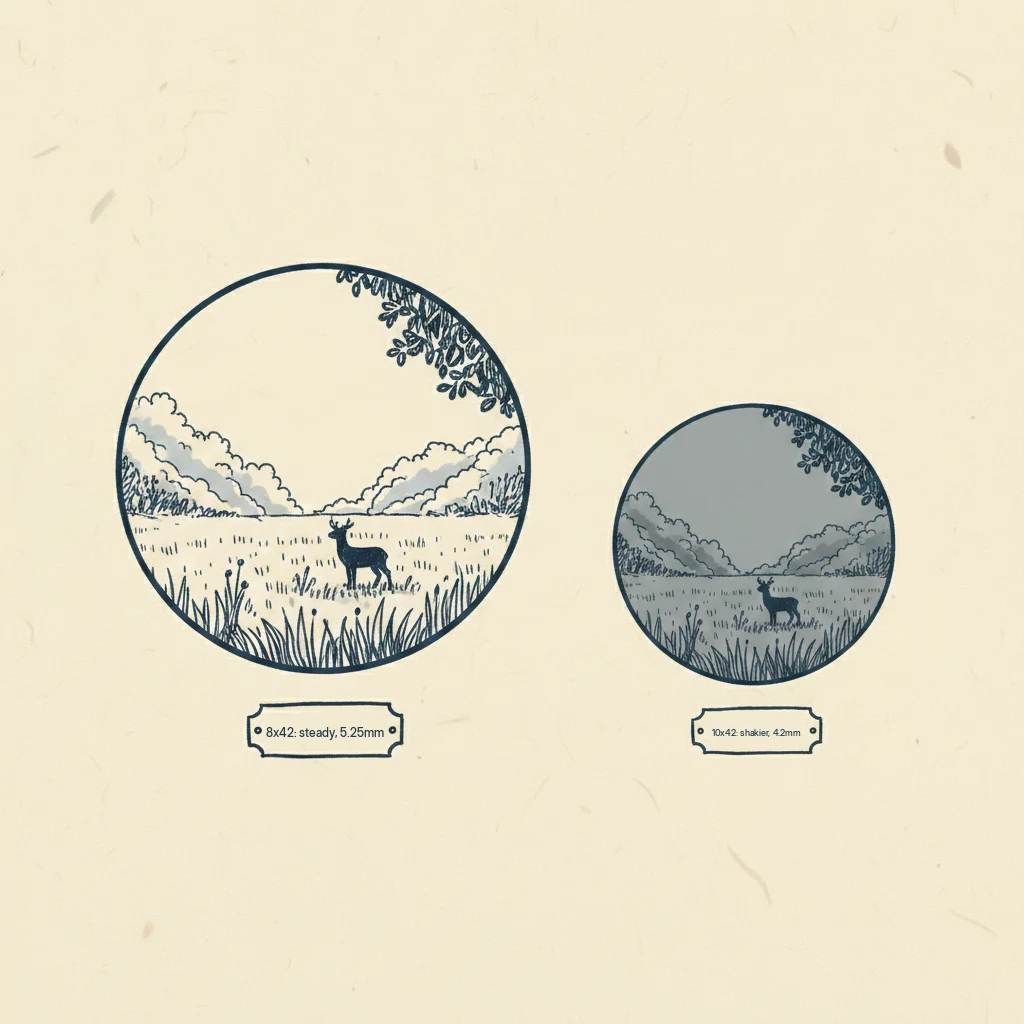
The working Yellowstone and Teton guides, the people who do this every day all season, reach for an 8x42 as a good bet for all-purpose wildlife and bird watching. Some like a bit more magnification, a 9x45, but the honest trade for it’s weight. That trade is the whole 8x-versus-10x story. Here’s what’s actually happening as magnification climbs: the view gets tighter and, crucially, shakier, because every little tremor in your hands gets magnified right along with the animal. There’s also a brightness difference you can check with simple arithmetic. Exit pupil, the circle of light reaching your eye, is the lens divided by the power: an 8x42 gives 5.25mm, a 10x42 gives 4.2mm. The lower-power pair is a bit brighter and a bit steadier.
So the honest resolver isn’t a ranking, it’s where you’re standing, and in Yellowstone you’ll be in both places in one day:
- Glassing a wide valley from a roadside pullout, good light, elbows braced on the car roof? The 10x42 earns its keep. Lamar and Hayden are exactly that terrain, and the extra reach helps pick detail out at distance.
- Everything else, a boardwalk, a trail, the low light of morning and evening when the animals actually move, handing them to a kid or a spouse, wearing them around your neck all day? The 8x42. Steadier, brighter, lighter, more forgiving.
If you can only own one and you want the honest, professional answer, it’s the 8x42, because that’s what the person who does this for a living reaches for all day.
The thing the shopping lists won’t tell you: the wolf is out of range
Here’s the fork that matters most, and almost no page that ranks for this will say it, because it doesn’t sell a binocular. The animals split into two groups by how far away they actually are.
From the field experience the guides describe, bison and elk are commonly under 25 yards, black bears around 75 yards or more, and, the big one, grizzlies and wolves at 300 yards and beyond. That draws the honest instrument line: binoculars will usually suffice for bison, elk, black bears, coyotes, and birds, but you’ll usually want a scope to see a grizzly or a wolf. The working guides agree, reaching for a spotting scope up to 50x for wolves and grizzlies from afar.
Put that next to the park rule and you get the sentence nobody prints: you’re required to stand 100 yards back, and the wolf is at 300 anyway. The binocular is exactly right for the animals you’ll actually get close to, and it simply can’t reach the one you may have driven across the country for. Wolf-watching, as one guide puts it, means taking a chair and some coffee and hanging out for quite a while. It’s not a glance, it’s a vigil, and you can’t hold a 10x steady for a vigil. That’s a tripod’s job, and a scope’s.
Why the “premium long-range” pairs are a trap
Because the wolf is far, the fancy end of the shelf tries to sell you your way to it with magnification, big 15x and 12x binoculars praised for long-distance prowess. Skip them for this. I’m flagging that not from a Yellowstone-specific test but from the general rule this whole hobby runs on: the maximum magnification for almost all hand-held use is about 8x, and by 15x the shake is so bad you can’t hold a steady picture at all. So the person reaching for a big-magnification binocular to close a 300-yard gap ends up with an expensive pair he can’t hold, and still can’t see the wolf, because the answer was never more magnification. It was a tripod. Those big binoculars are fine instruments. They’re just the wrong prescription for this.
The honest answer nobody’s affiliate link wants: rent it
Now the part that saves you the most money, and it’s the most Yellowstone thing I can tell you. For a five-day trip, you may not want to buy at all. In the gateway towns you can rent good optics by the day. A Vortex Diamondback 10x42, which happens to be one of the exact binoculars the listicles push you to buy, rents for about six dollars a day near the park. Five days of it’s thirty dollars. That same binocular runs around $330 at list price to own. For a once-in-a-decade trip, renting the recommended pair costs less than a couple of breakfasts.
And here’s the real gift of renting: the scope, the instrument that actually reaches the wolf, rents too, for around fifty dollars a day at a shop minutes from the entrance. That’s the only realistic way most people will ever look through a good spotting scope, and it’s the tool for the one animal a binocular can’t deliver.
Let me be plain about why this matters, because it’s the wound this whole site was built around. A telescope bought in a rush for Christmas ends up in a closet by January. A $330 binocular bought in a rush for five days in September is the exact same object in a different month, thrilling to buy, unused by Thanksgiving. Renting sidesteps that entirely. You get the trip without the closet.
If you do want to own a pair
Plenty of people will want their own, and that’s fine, especially if you’ll use them at home too. All researched, none of it looked through by anyone here, prices rounded to what I’m seeing as I write this. The evidence points at a plain, well-made 8x42 or 10x42 in the hundred-to-hundred-fifty-dollar range, not a luxury pair:
- Vortex Triumph HD 10x42, about $98, the open-valley budget answer.
- Nikon PROSTAFF P3 8x42, about $150, which is right at the guide’s recommended spec.
For contrast, the models the travel lists steer tourists toward run a good deal more, a Vortex Diamondback HD 10x42 lists around $330 and a Nikon Monarch M7 10x42 around $550. Those are genuinely nice binoculars, but for most of your Yellowstone days a $100 to $150 pair, or a $6-a-day rental, does the same honest job. Don’t let the trip talk you into the expensive one.
Questions people actually ask
Do you actually need binoculars for Yellowstone?
Yes, and the park itself says so. You’re legally required to stay 100 yards from bears and wolves and 25 yards from other animals, and the Park Service states plainly that binoculars give you a better view than approaching would. Without them, you’re either too far to see much or too close to be legal. You don’t have to buy, though, you can rent a good pair near the park for about six dollars a day.
Is 8x42 or 10x42 better for Yellowstone?
Both work; it depends where you’re standing. A 10x42 shines when you’re glassing a wide-open valley from a pullout with braced elbows. An 8x42 is better for everything else, walking, trails, dawn and dusk, all-day wear, and handing to a kid, because it’s steadier, brighter, and lighter. The working park guides recommend the 8x42 as the all-purpose pick, and if you’re buying one, that’s the safe call.
Do I need a spotting scope to see wolves in Yellowstone?
Usually, yes. Wolves and grizzlies typically sit 300 yards or more away, which is beyond what any hand-held binocular meaningfully reaches. Guides use a spotting scope on a tripod for exactly these animals. The good news is you don’t have to own one, shops near the park rent scopes for around fifty dollars a day, which is how most visitors get their look at a wolf.
What magnification do I need to see wolves?
Not as much as you’d think, and not from a binocular. Chasing wolves with a big 15x binocular backfires, because past about 8x you can’t hold the image steady by hand, so you get a shaky view and still no wolf. The real answer is a spotting scope, around 20x to 50x, mounted on a tripod so it stays rock-steady for the long wait. Magnification without a tripod just buys you a headache.
What I’d tell a parent in the hallway
Don’t buy the expensive “long-range” binocular the trip guides push. Get, or better yet rent, a plain 8x42, which is what the working guides carry all day, and use it on the elk, bison, and bears you’ll actually get near. If seeing a wolf is the dream, rent a spotting scope for a day in Lamar Valley, bring a chair and some coffee, and settle in. You’ll come home with the trip instead of a $330 binocular in a drawer.
A few things you’re probably also wondering:
- Not sure whether to bring binoculars on any trip at all? See best binoculars for alaska cruise.
- Want the full 8x-versus-10x argument for open country? See best binoculars for safari.
- Serious about that wolf? Start pricing scopes at best spotting scope for the money.
- Wear glasses? See binoculars for glasses wearers.
- Watching most of your wildlife at dawn in the trees? See compact binoculars for bird watching.
Ray Ostrander
Ray spent three decades explaining the sky to twelve-year-olds and their parents, and every January, hearing which Christmas telescopes ended up in the closet. He doesn't own a wall of gear and won't pretend to. He reads everything, tells you what owners agree on, and flags what's just his judgment. His goal is simple: no more January closets.