
Best Binoculars for Safari: What Dawn and Dusk Really Ask For
Take 10x42 for open plains from a vehicle, 8x42 for dense bush, dawn and dusk light, or a shared and shaky hand. Bring one pair per person. A sighting lasts seconds.
 Ray Ostrander · Updated July 24, 2026 · how I decide
If you buy through a link here, the site earns a little. It's never why anything gets picked.
You already know you need binoculars, so let me just answer the number you came here to settle. Take 10x42 if you’ll be on open plains, glassing long distances from a vehicle in good light. Take 8x42 if the bush is dense, if your hands aren’t rock steady, or if you’ll be out at dawn and dusk when the animals actually move. And bring one pair per person, not one to share, because a sighting can last a few seconds.
That’s the whole decision. Everything after this is the why behind it, so you can trust the call when you’re standing at the airport with a bag to pack.
I taught earth science for thirty-one years, and I haven’t been on a game drive, so I’m not going to pretend I have. What I can do is the thing the safari outfitters leave out. They have been in the vehicle and they will tell you binoculars are the most important thing you bring. They usually won’t explain the optics. That part is mine. When owners and outfitters agree, I’ll say so. When they argue, and on this question they genuinely do, I’ll show you both sides.
What's on this page
The real question: 8x42 or 10x42
Here’s the honest part the ranked lists bury. The experts don’t agree on this, and the disagreement isn’t noise. It’s the answer.
The 10x side is led by the people who run the trips. The outfitters who spend their lives in the vehicle argue that 10x42 is the ideal marriage of magnification and aperture for wildlife, and that at 10x the hand-shake barely troubles most people. The reasoning holds: on open plains you want reach, you want to pick a lion out of the grass at distance, and from a vehicle you aren’t carrying the weight on a strap all day.
The 8x side is led by the physics and by owners who have already made the mistake. A lower magnification gives you a wider view, so you find the moving animal faster. It gives you a steadier image, because the more you magnify, the more your hand’s own unsteadiness comes along for the ride. And it gives you a brighter image in low light. The owner pattern is telling: people downsize. One went from 12x56 to 10x42 to 8x32 and called the last one “so lightweight and easy.” Nobody makes that trip in reverse. There’s one lone source claiming 12x is still easy to hold steady, and it’s a single voice against both the physics and every owner who sold their big pair.
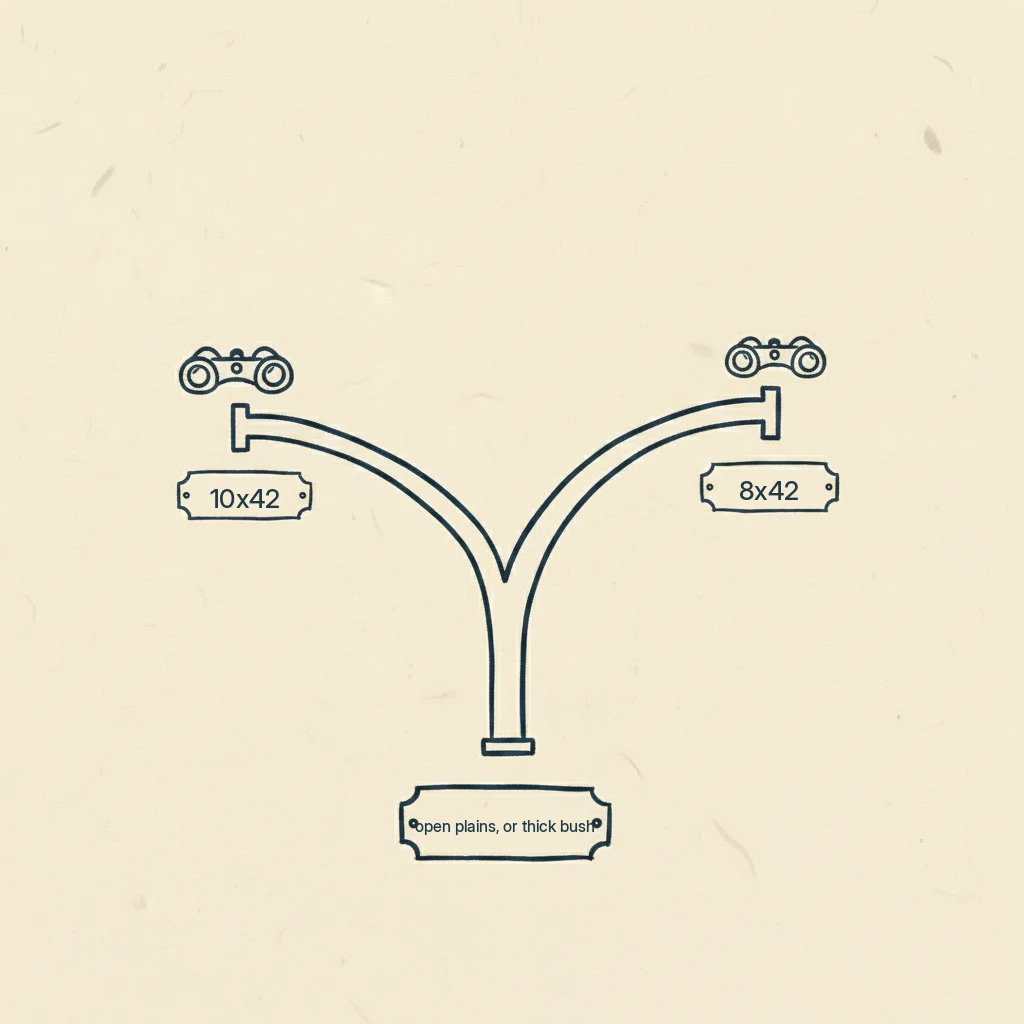
So the answer is a rule with an exception. Open country, from a vehicle, in good light, take the 10x. Dense terrain, like the deep forest of a place such as the Congo, and the outfitters themselves steer you to a lower-powered pair. Bad light, a long day on foot, or a spouse sharing the glass, take the 8x. Nobody on the shelf states it that cleanly, because a conditional answer is bad for a top-ten list and good for you.
Why it’s always 42, and why that number decides your leopard
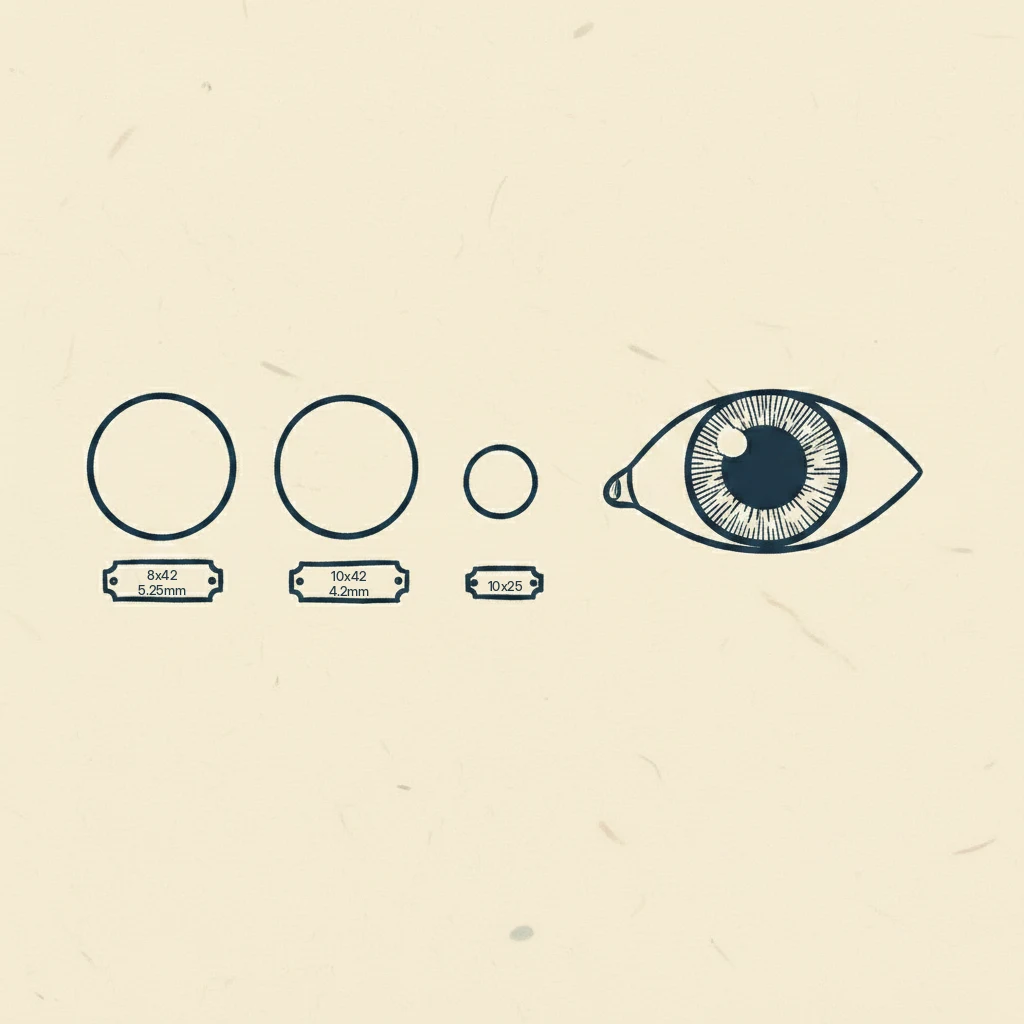
Notice both good answers end in 42. That’s the objective, the width of the big front lenses, and it does real work here.
Split the objective by the magnification and you have the exit pupil, the coin of light that lands in your eye. An 8x42 works out to 5.25mm, a 10x42 to 4.2mm, a pocket 10x25 to just 2.5mm. The wider that coin, the more your dark-opened pupil can drink, so a 42mm front isn’t a spec-sheet flex. It’s brightness held back for the moment you need it.
And on safari, you need it at exactly the wrong time. Game drives run at dawn and at dusk, because that’s when the animals come out, and that’s precisely when the light is dying. A dim pair at that hour is the difference between seeing a leopard and seeing a shape. That’s the whole reason the objective matters more here than almost anywhere else, and it’s the thing no page on this shelf bothers to explain.
The tip that matters more than the brand: one pair each
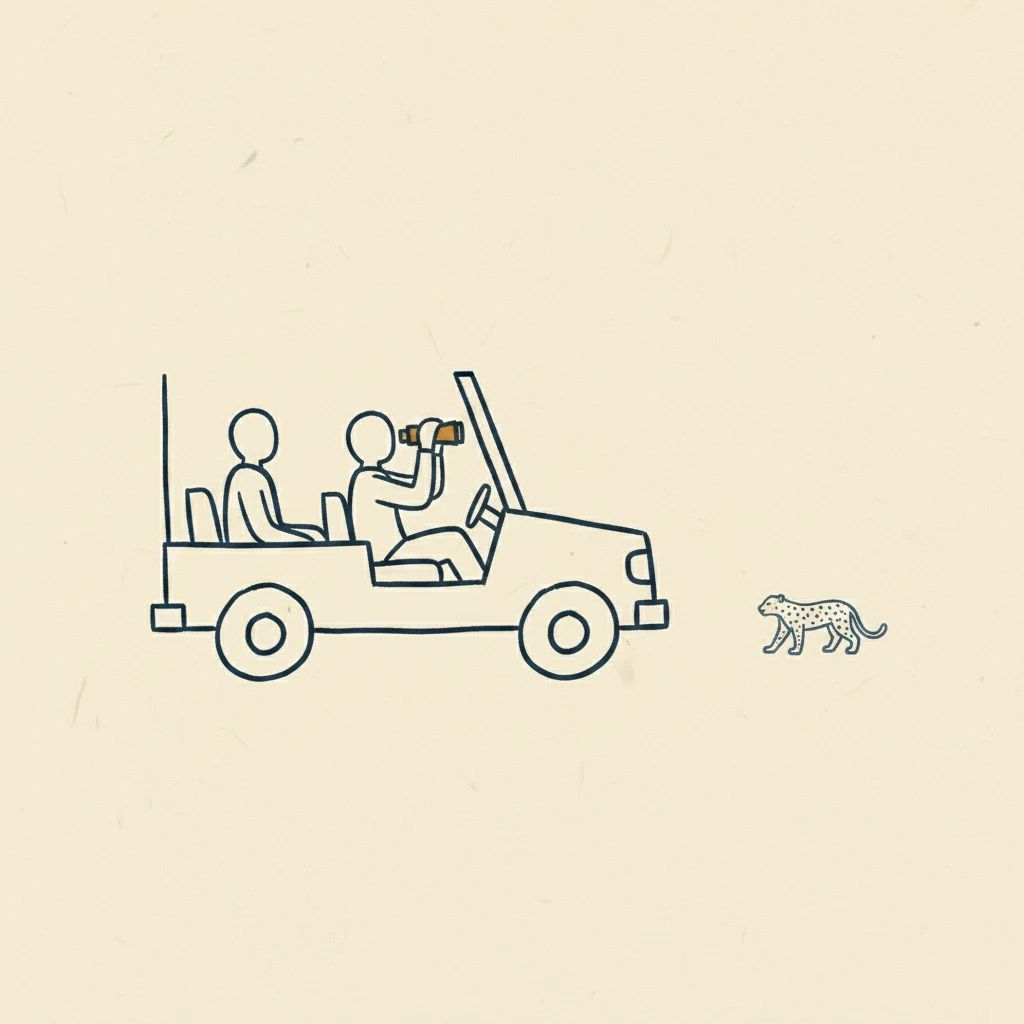
This is the single most useful sentence I can give you, and it comes straight from the people who run the drives: bring at least one good pair per couple, and one pair per person if you can, so that neither of you misses out.
Feel the mechanic. A sighting can be over in a handful of seconds. If two of you’re sharing one pair, then for half of every sighting one of you is watching the other person watch the leopard. On a trip this size, that’s a real loss, and it costs nothing in gear to avoid. I’ll be straight that buying two pairs happens to be good for anyone selling binoculars, including a site with affiliate links like this one. I’m telling you because it’s true, not because it sells a second pair. It’s never why I pick things.
What to actually buy
The expert reviewers I trust name their top safari picks, and interestingly all three of their winners are compact 8x32 pairs from the premium end, a Swarovski, a Hawke, and an Opticron. I’m not going to slap a made-up price on those, because the honest number isn’t in front of me, and a made-up price is worse than none. Notice the tension, though. The reviewers’ favorites lean 8x and smaller, while the outfitter pushes 10x42. Both are defensible. That’s the argument, alive on your exact question, and I’d rather you see it than have me hide it behind a single pick.
For a pair you can actually price today, the good news is you don’t need the premium end to be well armed. Here’s the priced shelf, all researched, and nobody here has looked through these.
| pair | rough price as I write this | why it’s here |
|---|---|---|
| Vortex Triumph HD 10x42 | about $98 | the honest floor for the 10x reach |
| Bushnell H2O Xtreme 10x42 | about $120 | budget 10x reach |
| Nikon PROSTAFF P3 8x42 | about $150 | the steadier 8x at a fair price |
| Celestron Nature DX 8x42 | about $160 street | wide, bright, generous eye relief |
| Celestron Nature DX ED 8x42 | about $200 street | a step up in glass |
| Nikon Monarch M5 10x42 | about $297 | the top of the sensible range |
A solid safari pair runs somewhere from about $98 to about $300. Set that against the trip. This is a once-in-a-lifetime journey that costs many thousands, and the binoculars are one of the cheapest things on the whole invoice. I’m not assuming you’re rich. I’m saying that of everything you’ll spend on for this trip, the glass is where a little more buys a lot, and it’s a small line on a big bill.
One quick note if you wear glasses, which I do. You want enough eye relief, the distance the image sits back from the lens, to see the whole view with your glasses on. The Celestron 8x42 pairs above all sit around 17mm, comfortably past the roughly 16mm a glasses wearer needs. I dig into that whole question at binoculars for glasses wearers.
Where people go wrong
The main trap on this trip is buying too much magnification. The shelf keeps whispering “more reach,” and it’s seductive, but past 10x a handheld image starts to shake and swim, and the owners who tried it downsized. Resist the upsell to 12x and beyond for a pair you’ll hold in your hands.
The second trap is the tiny pocket pair. A 10x25 compact sounds perfect for travel, small and light, and for daytime sightseeing it’s fine. But do the exit-pupil math: a 10x25 gives you only 2.5, the dimmest option there is, at the exact hour the animals appear. If you want a compact, buy it as the second pair or the daytime pair, not as your one and only. A pocket 8x25 or a nice 10x25 in the $35 to $100 range does that job. Just don’t send it out to do the dawn work.
I’ll also tell you what I can’t tell you. People assume a safari page should hand you a big argument about dust and sealing. I don’t have a source I trust on that for safari, so I’m not going to invent one and pass it off as tested fact. If a seller makes a dust claim, take it as the seller’s claim, not mine.
Questions people actually ask
Are 8x42 or 10x42 binoculars better for safari?
Both are right, for different trips. Take 10x42 for open plains and long sightlines from a vehicle in good light. Take 8x42 for dense bush, for dawn and dusk, for older or shakier hands, or when you’ll carry them all day on foot. The outfitters lean 10x, the reviewers and the physics lean 8x, and the tiebreaker is your terrain and your light.
What magnification is best for safari?
Stay between 8x and 10x, and stop there. Below that you lose reach on the plains. Above 10x the image shakes in your hands and gets dimmer, and owners who bought 12x and up almost all downsized. If you’re unsure, 8x42 is the more forgiving default and the harder pair to regret.
Do I really need my own binoculars, or can we share one pair?
Bring one per person if you possibly can. Outfitters recommend one pair per couple as the minimum and one each as the ideal, because sightings are short and a shared pair means someone is always waiting their turn while the moment passes. It’s the cheapest way to make sure nobody misses the leopard.
Are compact pocket binoculars good enough for safari?
For daytime and for travel, they’re fine. For the dawn and dusk drives when the animals actually move, a compact 25mm pair is the dimmest choice at the worst possible hour. Carry one as a light second pair if you like, but let a 42mm pair do the real work at first and last light.
What I’d tell you before you fly
Here’s the plain version, one recommendation. If your itinerary is open plains and game drives from a vehicle, buy 10x42. If it’s dense country, a lot of dawn and dusk, or you just want the safer, steadier, brighter pair, buy 8x42. Either way, in the roughly $100 to $300 range you’re well equipped, and either way, bring a pair for each traveler. Then get the strap around your neck before the vehicle rolls, because the first good sighting won’t wait for you to dig in the bag.
If packing weight is your worry, the compact trade-offs live at binoculars for travel. The trip-buyer’s sibling page is best binoculars for an Alaska cruise. If yours is specifically a hunting safari, the register and the rules are different, and that’s binoculars for hunting. And if you want the value question answered across every use, start at best binoculars for the money.
Ray Ostrander
Ray spent three decades explaining the sky to twelve-year-olds and their parents, and every January, hearing which Christmas telescopes ended up in the closet. He doesn't own a wall of gear and won't pretend to. He reads everything, tells you what owners agree on, and flags what's just his judgment. His goal is simple: no more January closets.