
The Best Microscope for Soldering: Ask for the Working Distance, Not the Magnification
For soldering with your hands under the lens, buy a stereo microscope, not a digital screen one. Insist on at least 100mm of working distance so the iron fits, and a 7x to 45x zoom. A screen scope is for inspecting, not soldering.
 Ray Ostrander · Updated July 24, 2026 · how I decide
If you buy through a link here, the site earns a little. It's never why anything gets picked.
For soldering with your hands under the lens, buy a stereo microscope, not a digital screen one, because you need a real-time three-dimensional view with no lag. Insist on at least 100mm, about 4 inches, of working distance so the iron and your fingers fit, and a 7x to 45x zoom covers the actual work. Plan on a cheap 0.5x Barlow lens, which the vendor guides say roughly doubles that working distance. A screen microscope is a fine inspection tool, but it’s for looking at a board, not soldering under one.
If you got here from the magnifier page, this is the other half of that story. Over there, the rule was that above about 2.25x a lens sits too close to work under, and a stereo microscope takes over. Here’s the thing to understand first: the microscope doesn’t escape that trade, it just moves it. You still choose working distance first, and I’ll be honest up front that microsoldering sits at the edge of what I know well. I can explain the dial and the specs and what the people who sell these things admit in print. I’m not a bench tech, and I’ll point you to the folks who are where it matters.
What's on this page
The fork nobody selling you a scope will draw
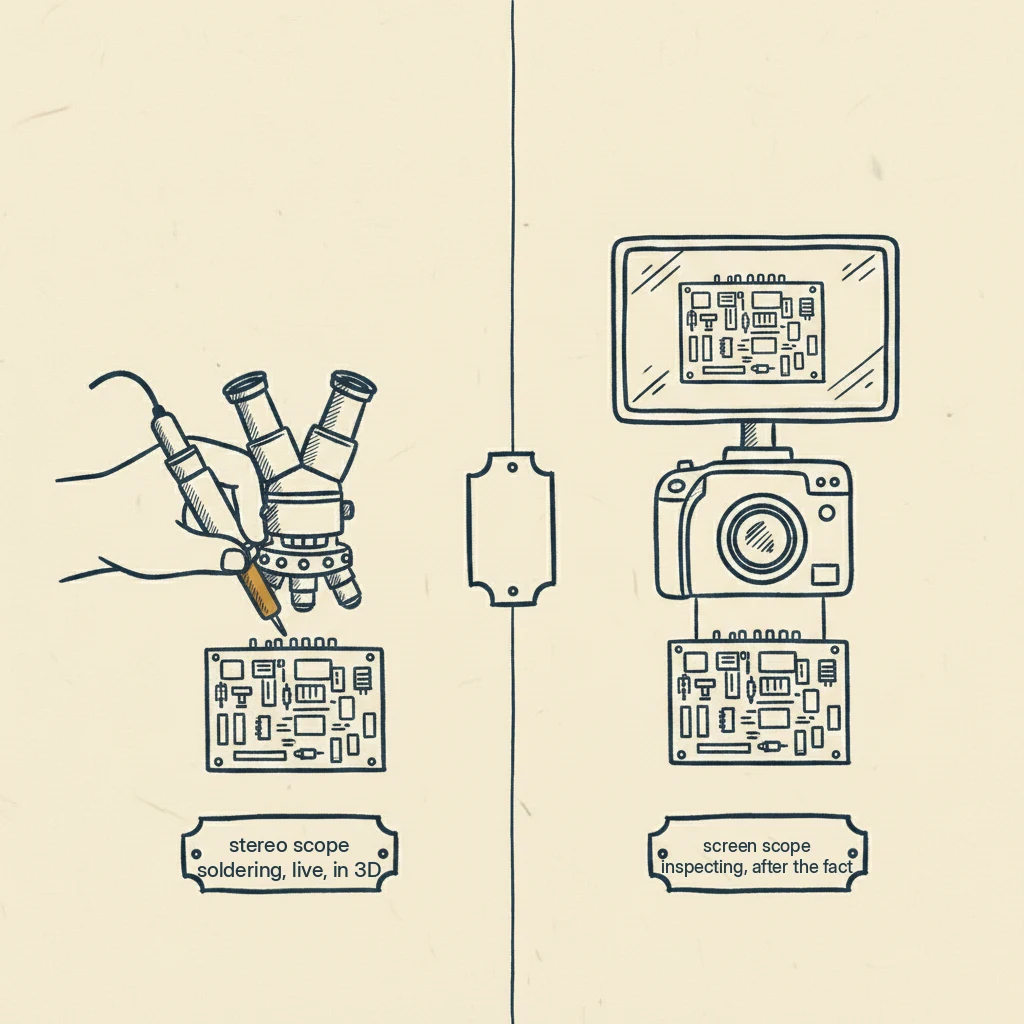
Every buying guide on this topic is published by a company that sells one of the two answers, so let me draw the line they all blur. The real question isn’t “stereo or digital, which is better quality.” It’s simpler and more useful than that: are your hands going to be under this thing while it’s on?
Because two makers who sell opposite products agree on the split, which is how you know it’s real. A stereo microscope, the kind with two eyepieces you look down into, gives you zero lag and genuine three-dimensional depth, the maker of the screen scopes admits this in its own guide. That’s what soldering needs, because you’re moving a hot iron and a wire in real time and you need to see depth. A digital microscope, the kind that shows the board on an LCD screen, has potential for video lag and a flat image, and even its own makers call it more suitable for inspection than real-time soldering. What it’s genuinely good at is letting you sit up straight, look at a monitor instead of hunching over eyepieces, and photograph what you find.
So: hands under the lens, working live, means stereo. Looking at a board you’ve already worked on, or documenting a repair, means digital. If you buy the pretty screen scope to solder under, you’ve bought an inspection tool, and that’s the single most expensive mistake in this corner of the hobby.
The number that actually matters is measured in millimeters
Here’s the spec to shop on, and it’s not magnification. It’s the working distance: how much open air sits between the bottom of the lens and the board. The vendor guides set the floor at 100mm, about 4 inches, and one of them shows a scope captioned with 118mm “for pcb rework.” That gap is what lets you fit a soldering iron, tweezers, and probes under the lens and still see what you’re doing. Less than that and you’re back to the problem the magnifier had.
Now here’s what’s actually happening on the shelf, and it’s worth catching. One vendor’s own guide tells you to look for a minimum 100mm working distance, a specific number, and then describes its own flagship soldering scope as having a “long working distance over circuit boards of any size,” with no number at all. I’m not going to call that dishonest. I’m just going to do the thing this whole site is built on: ask for the number. If a microscope is sold for soldering, its working distance is a measurement in millimeters, and if that measurement isn’t printed on the page, that absence is itself your answer. Make them tell you the number.
There’s one accessory worth planning for from the start. A small, inexpensive add-on called a 0.5x Barlow lens screws onto the front, and the guides say it can roughly double your working distance. On a scope that’s a hair too close for comfort, that’s the cheapest fix there is, so budget for one.

What magnification, and why the big numbers are noise
Magnification does matter, just far less than the listings suggest, and the honest range is small. The vendor guides don’t even agree with each other: one says a 7x to 45x zoom is the industry standard, another says 2.5x to 20x is plenty, a third recommends 5x to 50x. Three sellers, three ranges, so I’ll give you the spread rather than pretend there’s one magic number. What they roughly agree on is the shape of it: around 5x to 10x to position a component, 10x to 30x for the actual soldering, 30x to 50x for inspecting your work afterward. For most surface-mount soldering, one guide pins the sweet spot at 10x to 25x.
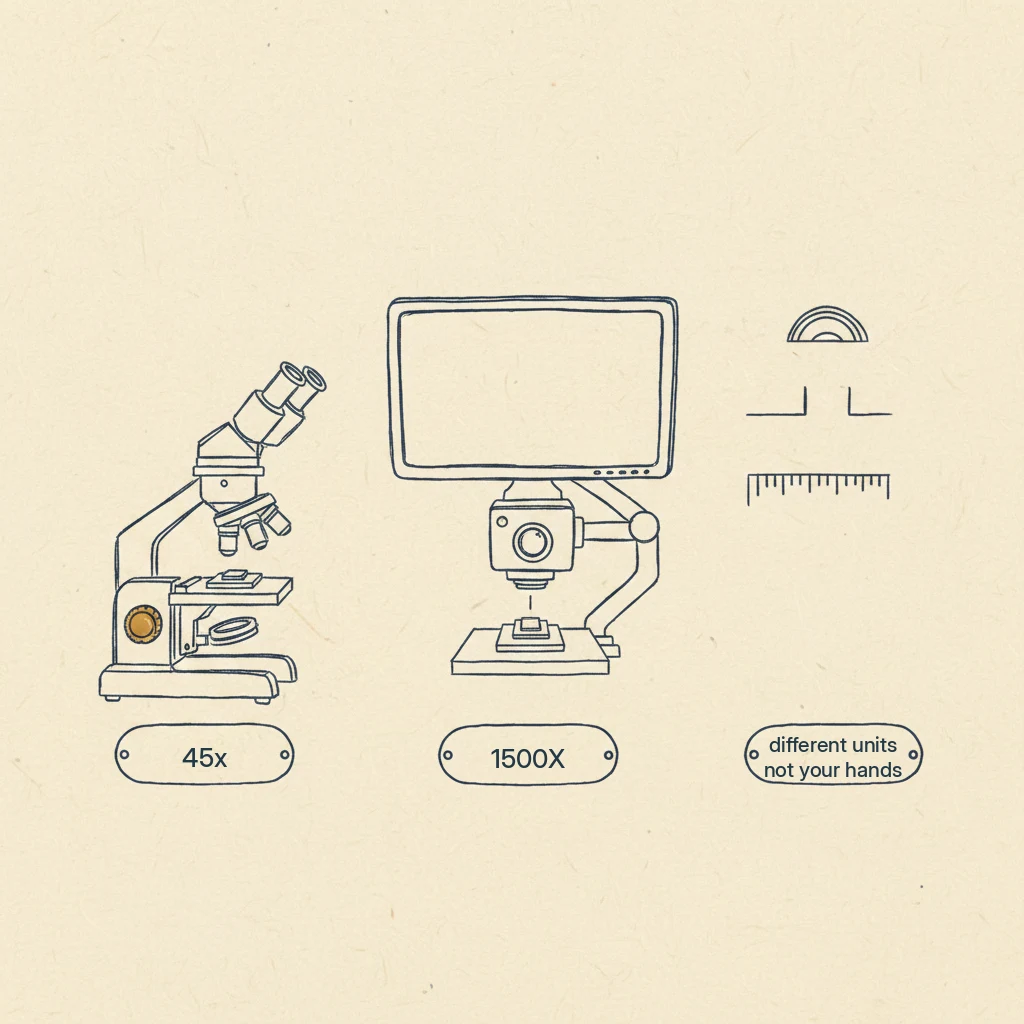
Now hold that 7x-to-45x range next to the digital screen scopes, which advertise numbers like 100X, 1200X, even 1500X right in their titles. Something is clearly off, but I want to be careful about exactly what. A digital scope’s magnification is measured to its screen, and a stereo scope’s is measured through an eyepiece. Those are two different units, so I’m not going to tell you a “1500X” screen scope equals some smaller eyepiece number, because I genuinely can’t convert one to the other honestly. The point is simpler and it’s the same point this whole site keeps making: the giant number on the box is measured in a way that makes it useless for choosing. Ignore it, and shop the working distance and the honest zoom range instead.
The prices, and the honest hole in them
All researched, none of it touched by anyone here, which the About page says plainly. And I have to be straight about a gap: the class I’m recommending is the one I can’t cleanly price.
The digital screen scopes are easy to find and priced openly. They run from about $35 for a tiny pocket unit up through roughly $95 to $210 for the larger HDMI screen models, with a dedicated flexible-arm soldering version around $320. If your job is really inspection and documentation, that’s your shelf, and the sit-up-straight comfort is genuine.
The stereo scopes, the ones the evidence actually recommends for hands-on soldering, are the frustrating part. The biggest name on this shelf hides its catalog behind a wall my research can’t read, so I don’t have a clean, dated stereo-scope price to hand you, and I’d rather admit that than quote a stale one. What I can tell you is what to demand when you shop: a boom stand, at least 100mm of working distance, a 7x-to-45x zoom, and a 0.5x Barlow in the cart.
What the owners say
I’ll be honest about the evidence here, because that’s the deal on this site. The forum where the people who actually do this argue it out was closed to my research, so most of what’s above comes from the companies’ own buying guides rather than from a room full of hobbyists. I trust the parts where a company admits something that costs it a sale, like a digital-scope maker praising stereo depth, because that’s an admission against interest. But I don’t have a wall of owner voices to point you at yet.
One fair thing the makers do disagree on is comfort. Stereo eyepieces, used for long hours without being fitted to you, can cause neck and shoulder strain, which a digital-scope maker is quick to point out, and they have a point. That’s a real bench-ergonomics trade, the same kind of sit-versus-hunch decision as the visor-versus-lamp choice one page over. It’s about your posture, not your eyesight, and I’ll leave any actual eye questions to someone qualified for them.
What about watch repair?
The watchmaker’s question is the same fork wearing a different hat, so a quick word on it. Fixing a watch splits the same way coin and jewelry close-up work does: a hand loupe for quick, portable, close inspection, and a stereo microscope on a stand for detailed bench work where you need both hands and steady depth. The loupe is the traditional horologist’s tool for a look; the stereo scope earns its place when the work gets fine enough that you want magnification you don’t have to hold. The same rules apply as for soldering: shop the working distance, ignore the giant magnification claims. If you’re weighing a loupe against a scope, the microscope for coins page walks through that exact loupe-versus-scope decision.
Questions people actually ask
Stereo or digital microscope for soldering?
Stereo, if your hands go under the lens while you solder. It gives you real-time depth and no lag, which live soldering needs, and the makers of digital scopes admit as much. Digital screen scopes are better for inspecting a finished board and documenting repairs, because you sit up straight and can photograph the work. Buy digital only if inspection, not soldering, is really your job.
What working distance do I need for a soldering microscope?
At least 100mm, roughly 4 inches, so an iron, tweezers, and your fingers all fit under the lens with room to move. More is better. This one spec matters more than magnification, and it’s the one cheap listings often leave off. If a scope sold for soldering doesn’t state its working distance in millimeters, treat that silence as a red flag and shop elsewhere.
What magnification do I need to solder under a microscope?
Not the huge numbers on the box. The guides land roughly at 5x to 10x for positioning parts, 10x to 30x for the soldering itself, and up to 50x for inspecting afterward, with 10x to 25x the sweet spot for most surface-mount work. Ignore any “1200X” or “1500X” screen number entirely; it’s measured differently and doesn’t tell you what you need.
Do I even need a microscope, or will a magnifier do?
For ordinary through-hole soldering and general repair, a magnifying visor or lamp is usually plenty, and a microscope is overkill. The microscope earns its keep on fine surface-mount and microsoldering work, where you genuinely need more than about 2.5x and the working distance under a plain lens gets too tight. If you’re not sure, start cheaper with a visor, covered on magnifying glass for soldering.
What I’d actually buy
If your work is genuinely fine, surface-mount or microsoldering, get a stereo zoom microscope on a boom stand with at least 100mm of working distance, a 7x-to-45x range, and a 0.5x Barlow lens, and don’t pay a nickel for a magnification number over about 45x. If you’re really just inspecting boards or shooting photos of your repairs, a digital screen scope is the comfortable pick. And if you’re soldering ordinary parts, save your money and use a visor. Buy for the room under the lens, not the number on the box.
A few things you’re probably also wondering:
- Not sure you need a microscope at all? Start at magnifying glass for soldering.
- Wondering why every instrument’s box number lies? See the number on the box.
Ray Ostrander
Ray spent three decades explaining the sky to twelve-year-olds and their parents, and every January, hearing which Christmas telescopes ended up in the closet. He doesn't own a wall of gear and won't pretend to. He reads everything, tells you what owners agree on, and flags what's just his judgment. His goal is simple: no more January closets.