
The Magnifying Glass for Soldering, and Why 10x Is the Wrong Number
Pick a soldering magnifier by working distance first, magnification second, because they're the same dial pulling opposite ways. The usable bench range is about 1.5x to 3.5x, not 10x. Headband visor if you move your head, clamp lamp if you don't.
 Ray Ostrander · Updated July 24, 2026 · how I decide
If you buy through a link here, the site earns a little. It's never why anything gets picked.
Pick a soldering magnifier by working distance first and magnification second, because on a lens they’re the same dial pulling in opposite directions. The usable range at a workbench is roughly 1.5x to 3.5x, not the 10x the cheap listings shout about, because you need enough room under the lens to fit the tip of the iron and both of your hands. Use a headband visor if you like to move your head while you work, a clamp-on lamp if you’d rather sit still, and a microscope only once you need more than about 2.25x.
I’ll be straight with you: magnifiers are working knowledge for me, not my home bench. I’m not a solder tech and I’ve never reworked a circuit board. But the thing tripping up almost everybody who shops for this is a physics relationship nobody explains, and explaining the dial is exactly the job. Let me do that.
What's on this page
The one thing nobody tells you: the two numbers are connected
Here’s the question that opens the whole subject, taken word for word from the top result when you search for this. A fellow asks for magnified glasses for solder work on small electronics, and says it would be nice to find a pair with, in his words, 10x magnification and a minimum focal distance of about two feet.
Here’s what’s actually happening, and why he’ll never find that pair no matter how long he looks: on a magnifying lens, the more you magnify, the closer the lens has to sit to the thing you’re looking at. Higher magnification and longer working distance aren’t two features you shop for separately. They’re one dial, and turning up the one turns down the other. He’s not being foolish. Nobody ever told him the two numbers are joined at the hip, so he asked for the two ends of the same dial at once.
The relationship isn’t a matter of opinion, it’s arithmetic. Magnifier strength is often sold in “diopters,” and the plain conversion is diopter divided by four, plus one, equals magnification. More usefully, here’s what each strength does to the gap between the lens and your work:
| lens strength | magnification | working distance |
|---|---|---|
| 3 diopter | about 1.75x | about 13 inches |
| 4 diopter | about 2x | about 10 inches |
| 5 diopter | about 2.25x | about 8 inches |
| 8 diopter | about 3x | about 5 inches |
| 11 diopter | about 3.75x | about 3.75 inches |
| 16 diopter | about 5x | about 2.5 inches |
| 20 diopter | about 6x | about 2 inches |
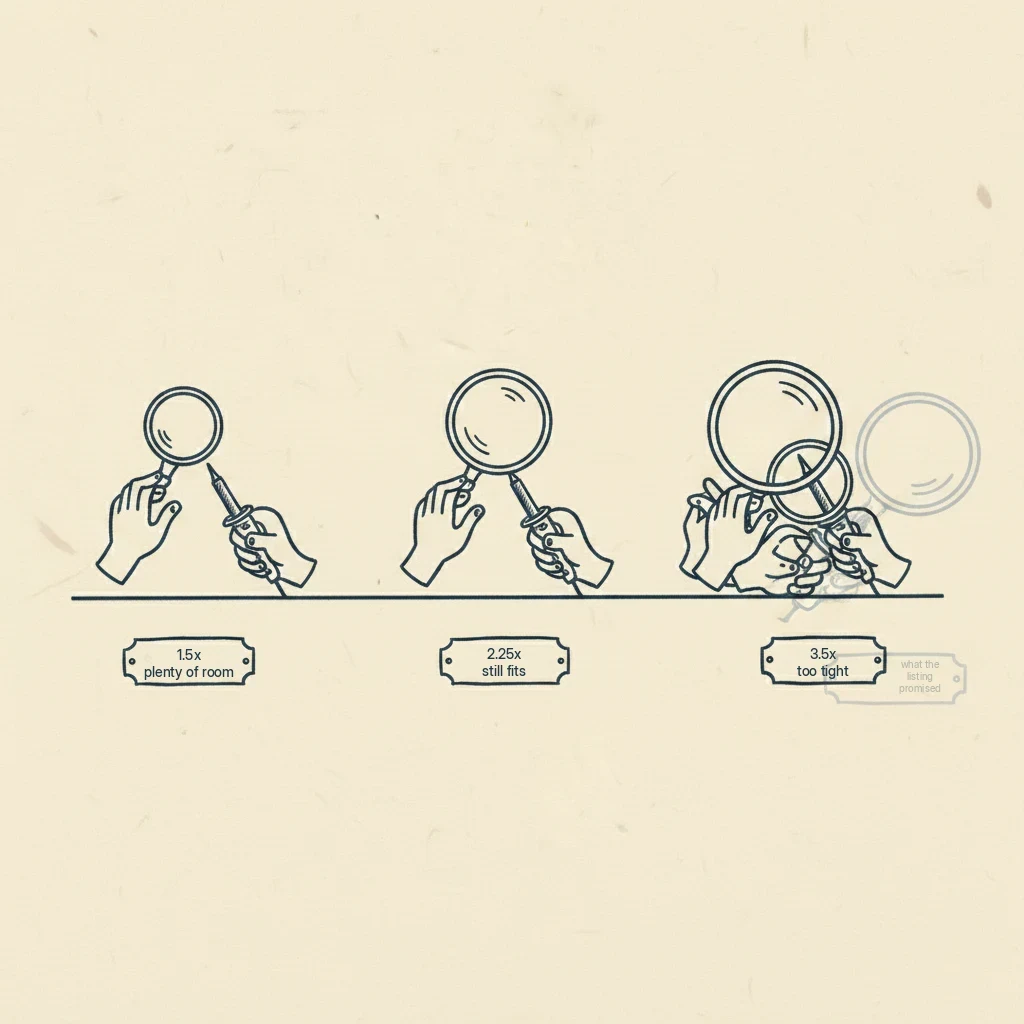
Read that bottom row again. Six times magnification puts the lens two inches off the board. Your soldering iron is longer than that. So the honest ceiling for actually soldering under a lens is around 3.5x, and everything stronger is a magnification you can look through but not work under.
Why “10x for soldering” is the same lie as “600x” on a telescope box
That gap between the number on the listing and the number you can actually use is the whole reason to read this page before you buy. A magnifier advertised at 10x or 20x or 30x for soldering is describing a distance you can’t solder at, because at those strengths the lens is jammed right down against the board.
If you’ve spent any time around telescopes, this will sound familiar, and it’s the exact same trick. A cheap telescope box shouts “600x,” a number four or five times past anything the instrument can usefully deliver. A cheap magnifier shouts “10x,” a number well past anything you can get a soldering iron underneath. Same lie, different aisle: the number printed for marketing and the number you can actually work with are two different numbers. That whole pattern gets its own page over at the number on the box, and a soldering magnifier is just one more place it shows up.
The manufacturers who are honest about it prove the point with their own product line. The best-known headband visor is sold as a single unit with six interchangeable lens plates, and the only thing that changes between them is that same pair of numbers: the longest-reach plate gives about 1.5x at 20 inches, and the strongest gives 3.5x at four inches, which is closer than your iron. There’s no 10x plate, because there’s no way to solder at one.
The real decision: visor, lamp, or microscope
Once you accept you’re choosing in the 1.5x-to-3.5x range, the actual choice is what the magnifier is attached to. There are three answers, and the right one depends on how you work, not on which is “best.”
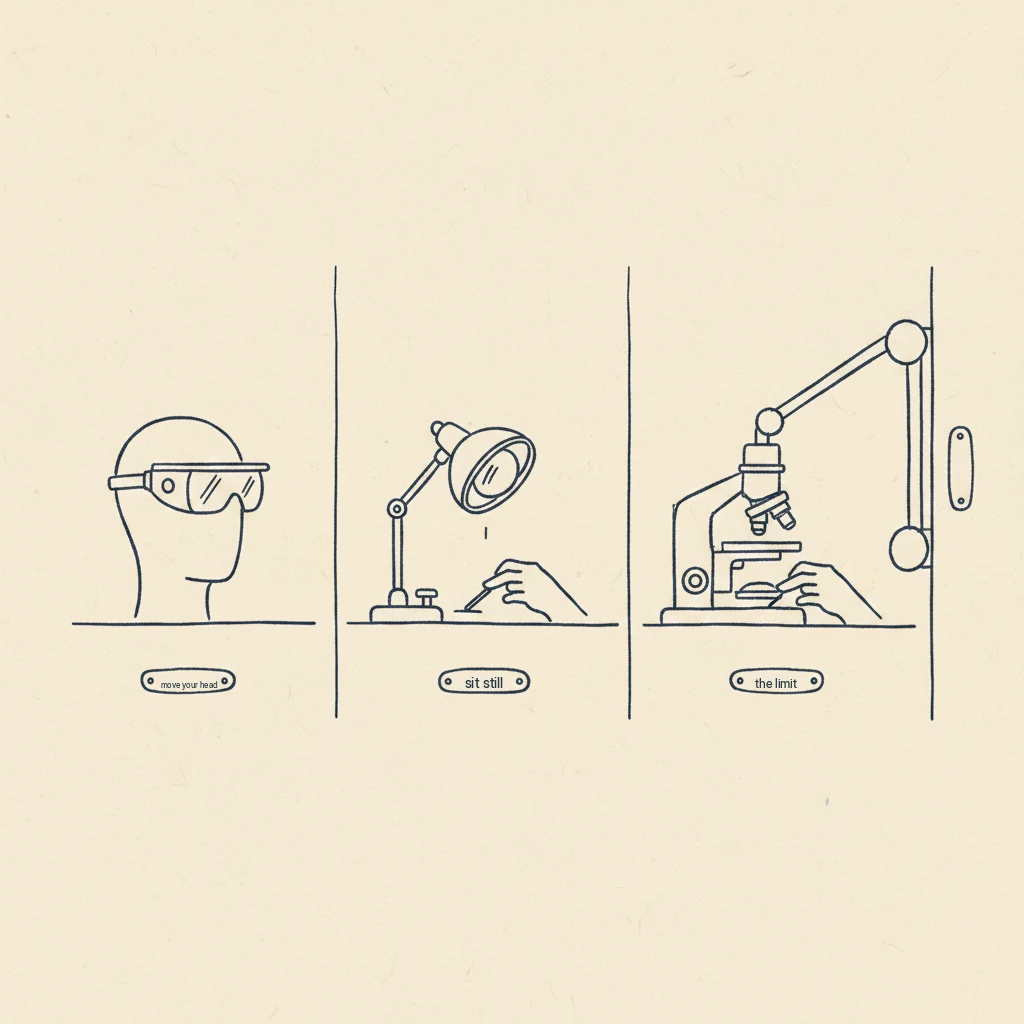
A headband visor. This is the one I’d start most people on, and it’s the answer the repair folks themselves keep giving. You wear it like a welder’s visor, it leaves both hands free, it gives you natural three-dimensional depth, and, the big one, you can move your head. On a long soldering session that matters, because with a visor you lean and tilt to see around things, while a fixed lens locks you into one position. The quality version uses real glass lenses; simpler LED-lit ones do the same optical job for less.
A clamp-on magnifying lamp. This is the swing-arm lens on a bright ring light that clamps to your bench. It buys you two real things a visor doesn’t: a big bright lens and a lot of light on the work. The trade is that your head is now locked to wherever the lamp is aimed. The bench standard here’s a 5-diopter lens, which is that 2.25x at about 8 inches from the table above. Pick the lamp if you sit still and want the light; pick the visor if you move around.
A microscope, but only past a point. Here’s the clean line where a magnifier stops being the right tool, and it’s a cited one: above about 5 diopter, roughly 2.25x, the working distance drops under 8 inches, and stereo microscopes are recommended for rework from there up. So if you’re doing tiny surface-mount work that genuinely needs more than about 2.5x, you’ve walked past what any magnifier can do and into microscope territory. That’s not a failure, it’s a different tool for a smaller job, and I cover it on best microscope for soldering.
The shelf, and what the prices tell you
All researched, none of it touched by anyone here, which you’ll find said plainly on the About page.
The professional lamp shelf is priced firmly, so here’s what it actually costs as I write this. A solid 5-diopter LED magnifying lamp starts around $150. Step up to one with UV or adjustable color temperature and you’re at about $270 to $300. A specialty inspection lamp can run $575. These are real bench tools and the light is genuinely better than a hobby unit.
The visor, my usual first recommendation, is the frustrating one to price, and I’d rather tell you that than make a number up. A simple LED headband magnifier runs somewhere in the ballpark of ten to twenty dollars, and the quality glass-lensed version around thirty to forty-five, going by current hobby-shop listings. But I don’t have a clean first-party price to stand behind on it yet.
Two more honest notes on the shelf. You’ll see “ESD-Safe” on the pricier lamps, which is a static-discharge spec that matters on a professional bench. I’ll name it, but I’m not going to pretend to know whether a home hobbyist soldering the odd project needs it, because that’s a bench-tech judgment I don’t have. And watch the dates on any “best magnifier” list you read: one of the long-standing American magnifier-lamp makers, Dazor, closed its doors for good in the spring of 2026, so a listicle still steering you to their lamps is stale, and stale is a warning about the whole list.
A note on your eyes
I want to be clear about one thing this page is not. This is a page about fitting a tool to a workbench, not a page about eyesight. Some visor makers advertise that their product reduces eye strain, and that’s their claim to make. I’m not making any claim about your eyes, your vision, or eye health, because that isn’t what this page is for and it isn’t a subject I’d speak on lightly. Choose the magnifier that fits your work and your bench, and take any eye questions to someone qualified to answer them.
Questions people actually ask
What magnification do I need for soldering?
Less than you’d think: about 1.5x to 3.5x for most bench work, and it’s chosen backward from what you’d expect. Start with the working distance you need to fit your iron and hands under the lens, and take whatever magnification comes with it. For general through-hole soldering, roughly 2x to 2.5x at a comfortable arm’s reach is the sweet spot. Only fine surface-mount work needs to push higher, and that’s really microscope territory.
Why can’t I find a strong magnifier with lots of working distance?
Because it can’t exist. On a magnifying lens, higher magnification always means a shorter distance between the lens and the work, and that’s fixed physics, not a gap in the market. A magnifier strong enough to give big magnification sits only an inch or two off the board, with no room for your iron. That’s why bench magnifiers top out around 3.5x, and why a “10x” soldering listing is describing a position you can’t actually solder in.
Is a magnifying visor or a magnifying lamp better for electronics?
Neither is simply better; they fit different habits. A headband visor keeps both hands free and lets you move your head, which the repair crowd prefers for long jobs. A clamp-on lamp gives you a bigger lens and much more light, but locks your head into one position. If you fidget and lean while you work, get the visor. If you sit still and want the brightest possible view, get the lamp.
Do I need a microscope instead of a magnifying glass?
Only if your work genuinely needs more than about 2.5x, which mostly means small surface-mount components. Past roughly 5 diopter the lens sits under 8 inches from the board, too close to work under comfortably, and a stereo microscope is the right tool from there up. For ordinary soldering, a visor or lamp is plenty, and a microscope is more setup than the job needs.
What I’d actually set up
If it were my bench, I’d start with an inexpensive headband visor around 2x to 2.5x, spend the saved money on a good light instead of a fancy lamp, and only move up to a microscope if I found myself doing work too small to fit an iron under the lens. Buy for the distance you need to work at, take the magnification that comes with it, and ignore any number on the box that promises both at once.
A few things you’re probably also wondering:
- Doing work too fine for a magnifier? See best microscope for soldering.
- Wondering why every instrument’s box number lies? See the number on the box.
Ray Ostrander
Ray spent three decades explaining the sky to twelve-year-olds and their parents, and every January, hearing which Christmas telescopes ended up in the closet. He doesn't own a wall of gear and won't pretend to. He reads everything, tells you what owners agree on, and flags what's just his judgment. His goal is simple: no more January closets.