
The Best Telescope to See Saturn, and What Its Rings Really Look Like
A 60mm telescope at 50x already shows Saturn's rings clearly. The Celestron AstroMaster 70AZ at about $150 to $200 is the honest Saturn pick. Step up to 100mm only when you want the Cassini Division and the moons.
 Ray Ostrander · Updated July 24, 2026 · how I decide
If you buy through a link here, the site earns a little. It's never why anything gets picked.
Good news, and it saves you money. A 60mm telescope at 50 times magnification already shows Saturn’s rings clearly, in the little “hat” shape everyone recognizes. The honest pick for most people is the Celestron AstroMaster 70AZ at about $150 to $200. You only need to spend more if you want to split the fine gap in the rings and count Saturn’s moons.
That’s the surprise of this whole page. Saturn is one of the easiest wins in the sky. People come in braced to spend a fortune, and the rings show up in the cheapest honest scope on the shelf.
What's on this page
What Saturn really looks like through a small telescope
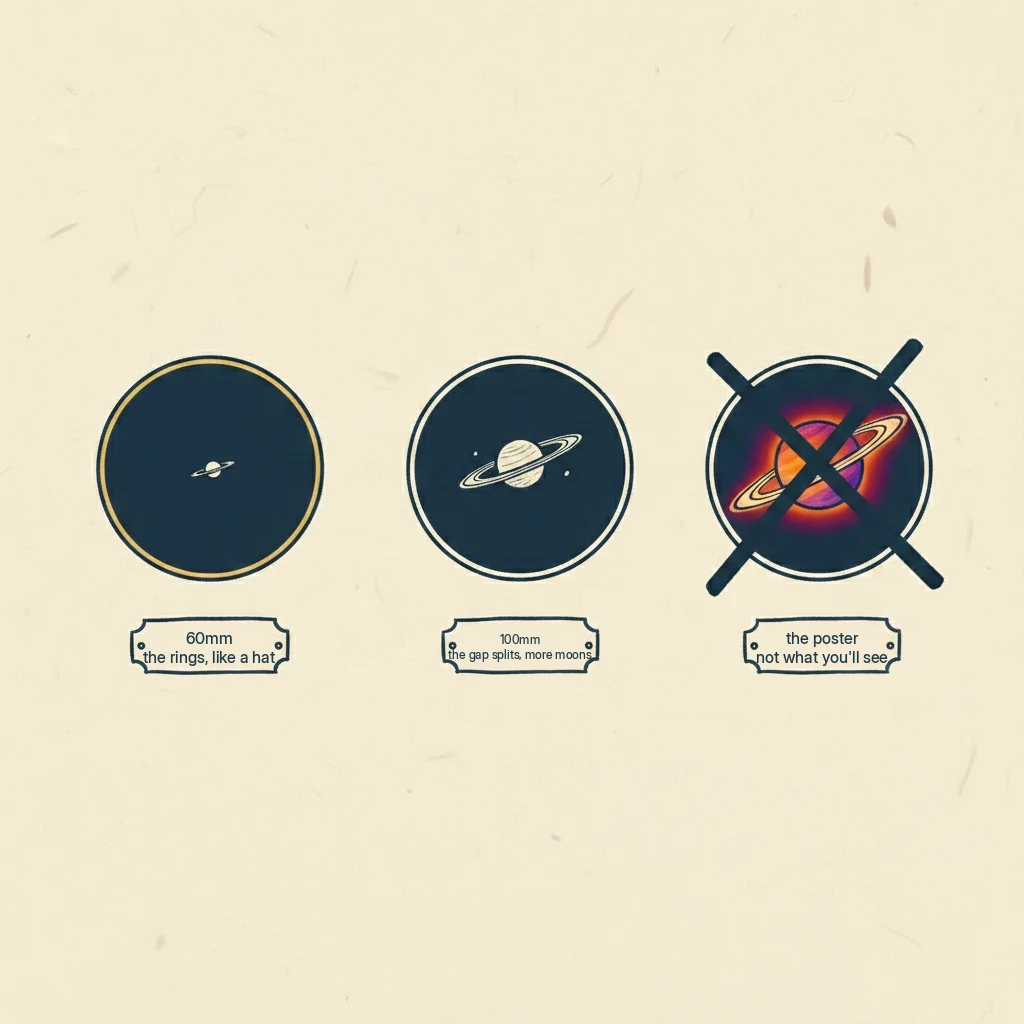
Let me set the picture before you buy, because this is where the poster does the damage. Through a small first scope, Saturn is a bright bead with a thin bright ring wrapped around it, small and sharp and unmistakably there. Owners describe it as a tiny hat, or a bead on a wire. Titan, its big moon, sits nearby looking like a faint star.
Here’s the part I never got tired of explaining to a twelve-year-old. That faint light landing in your eye is a real photon that left Saturn about eighty minutes ago, and your backyard is where its trip ends. It’s small, and it’s real, and I’ve never once seen a kid disappointed that it wasn’t poster-sized. Real beats the poster, every time, because it’s actually there.
How much telescope you actually need for Saturn
Start with the good news about Saturn and magnification. Seeing the rings at all takes very little: the honest minimum is a 60mm scope at 50x, and any 60mm at that power shows the rings clearly. That’s it. That’s the whole entry ticket.
The next step up is the Cassini Division, which is just the dark gap inside the rings. That’s the detail that separates a cheap scope from a serious one. Splitting that gap takes a 100mm scope or bigger, at about 150x, on a steady night. At that size you also start seeing a cloud belt on the planet, the ring’s shadow falling on the globe, and three or four moons instead of one.
So the ladder is short and honest. Rings: about 50 to 75x, cheap. The Cassini gap and the moons: 100mm and up at 150 to 200x. And you can’t cheat it by cranking the power. Useful magnification is capped by the width of the light-gathering end, not the dial, so a little scope wound up to 200x just hands you a big dim blur. Aperture is what buys you the detail.
Why 2026 looks a little thinner
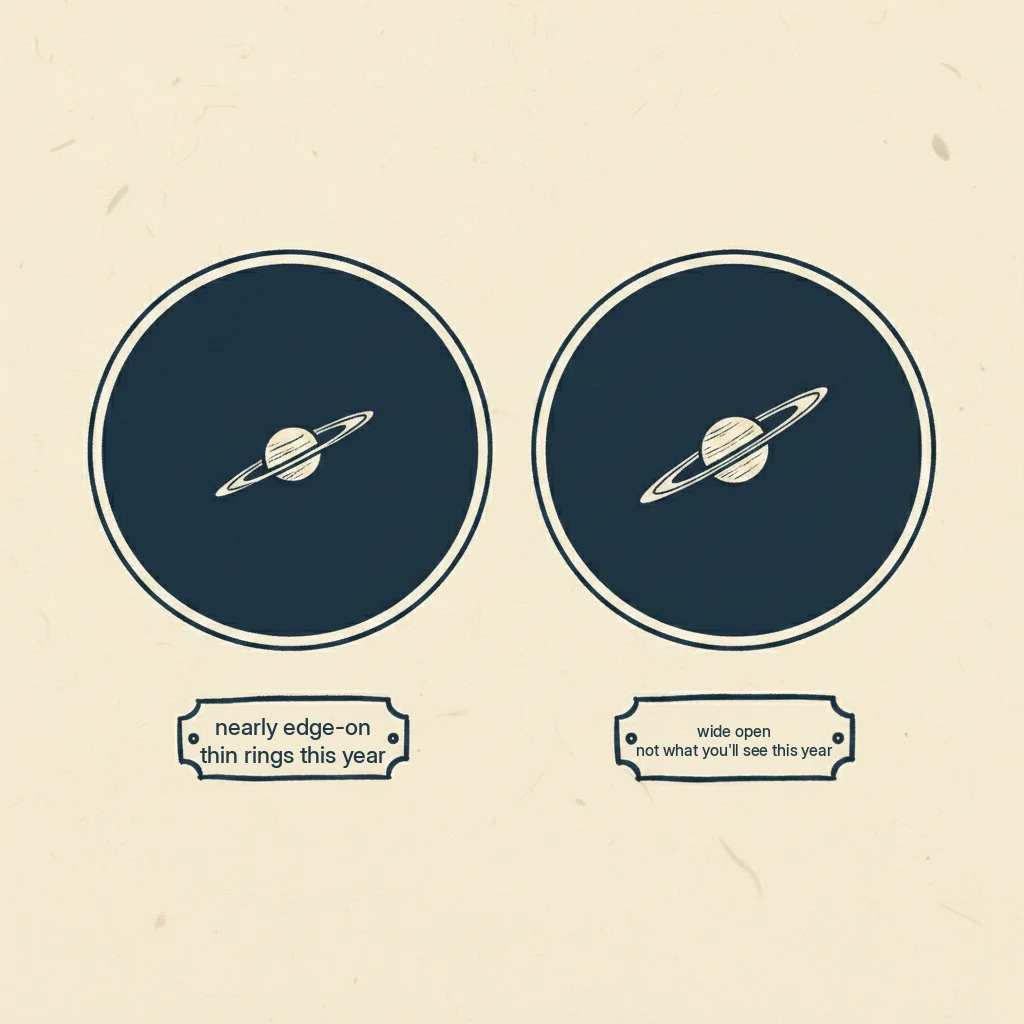
One fair thing to flag, because it’s this year’s asterisk. Saturn’s rings passed nearly edge-on to us in 2025 and are only opening back up now. Around opposition in 2026 they’re tilted only about 7 degrees from edge-on, which is thinner than the wide-open rings in most photos. They’re still perfectly visible, and the little hat is still there. But this is a year where a bit more aperture pays off, since the thinner presentation gives the eye less to grab. Saturn is at its best and brightest at opposition on October 4, 2026, so if you can time a first look, aim near then.
The Saturn shelf, cheapest first
All researched, none of them tested by anyone here, and you’ll find that said plainly on the About page. Prices are rounded to what I’m seeing as I write this.
- Celestron AstroMaster 70AZ, about $150 to $200. At 91x the rings are clear and distinct. It shows the rings and Titan. It won’t split the Cassini gap, and that’s honest, not a downgrade. For most first buyers this is the one.
- Sky-Watcher Skymax 102, about $300, sometimes on sale from a higher sticker. A long, planet-leaning design called a Maksutov that gives high-contrast views of exactly this kind of target.
- Sky-Watcher Heritage 150 tabletop reflector, about $355. The 150mm of aperture is where the Cassini gap starts splitting cleanly. It needs a solid table to sit on.
- Celestron NexStar 4SE, about $650. A compact computerized 4-inch that points itself, good for a planet-focused viewer who wants help finding things.
- Celestron NexStar 8SE, about $1,500. Serious observers widely consider the 8-inch the best all-around planetary scope there is. It’s also more scope than a beginner reaches for, so buy it when you’re ready, not first.
One honest note that runs against my usual advice. On most pages I tell families to buy binoculars before a telescope, because they’re cheaper and more useful day to day. Not for Saturn. Binoculars can’t show the rings: you need about 30x to see them at all, and binoculars don’t get there. If the rings are the whole point, a small telescope is the real floor.
The trap on this page: over-buying
The mistake I most want to steer you around here isn’t buying too little. It’s buying too much. People read “Saturn” and reach for the biggest, most expensive scope on the shelf, when a $150 scope already delivers the moment they came for. Buy for the detail you actually want. Rings are cheap. The Cassini gap and the moons cost more. Don’t pay for 100mm of aperture to chase a gap you may not care about once the rings themselves take your breath.
The other honest flag is the night itself. Fine detail needs steady air, what observers call good seeing. On a turbulent night even the right scope shows a shimmering Saturn, and that’s the atmosphere, not a defect in your gear. Try again on a calm night before you blame the telescope.
Questions people actually ask
What’s the smallest telescope that can see Saturn’s rings?
A 60mm telescope at about 50x shows the rings clearly, in that little hat shape. That’s the honest floor. You don’t need a big or expensive scope to see the rings themselves. You need aperture and steady focus, and a scope like the AstroMaster 70AZ at about $150 to $200 clears that bar with room to spare.
What telescope shows Saturn’s rings clearly, with the gap in them?
To split the Cassini Division, the dark gap inside the rings, you want a 100mm scope or larger at about 150x, on a steady night. A 150mm tabletop reflector around $355 does it. Below that you’ll see the rings plainly but read them as one solid band, which is still a genuinely lovely view.
What’s the best telescope for Jupiter and Saturn together?
The same modest scope serves both. A 70mm to 100mm scope shows Saturn’s rings and, on Jupiter, the cloud belts and up to four moons in a line. Both planets are easy, reliable targets that shrug off city light. Buy for aperture and a steady tripod, and you’ve bought for both at once.
Do I need a big telescope to see Saturn from the city?
No. The planets shrug off light pollution almost entirely. Saturn’s rings look the same from a city backyard as they do out in the country. It’s the faint galaxies and nebulae that need a dark drive out of town, and Saturn isn’t one of those. A small scope on a clear city night does the job.
What I’d tell a parent in the hallway
Buy the cheapest honest scope that shows the rings, which is a 70mm around $150 to $200, and tell the kid ahead of time that Saturn will be a small, bright hat and not a poster. They’ll love it anyway. Spend up to a 150mm only if you specifically want to split the gap in the rings and count the moons.
A few things you’re probably also wondering:
- Want the whole planet lineup, not just Saturn? See telescope to see planets.
- Comparing scopes overall before you decide? See best telescope.
- Chasing Saturn on a tight budget? See best cheap telescope.
- Wondering what all this runs? See how much does a telescope cost.
Ray Ostrander
Ray spent three decades explaining the sky to twelve-year-olds and their parents, and every January, hearing which Christmas telescopes ended up in the closet. He doesn't own a wall of gear and won't pretend to. He reads everything, tells you what owners agree on, and flags what's just his judgment. His goal is simple: no more January closets.