
How Much Does a Telescope Cost? What You'll Really Spend
A telescope worth owning starts around $150 to $300. Below about $100 you're mostly buying frustration. Budget another $80 to $150 the first year for the eyepieces and extras that actually make it work.
 Ray Ostrander · Updated July 24, 2026 · how I decide
If you buy through a link here, the site earns a little. It's never why anything gets picked.
Here’s the honest short answer. A telescope worth owning starts around $150 to $300. Below about $100 you’re mostly buying frustration, the kind that ends up in a closet by January. Above that, more money buys more aperture and a few conveniences. And whatever the tube costs, plan on another $80 to $150 the first year for the eyepieces and extras that make it actually work.
That last line is the one nobody tells you, so let me spend the rest of this page being the neighbor who does.
What's on this page
The floor: why the $40 box isn’t cheap, it’s wasted
Most people start their search at the price they already saw, and it’s usually low. A $40 telescope at the department store, a $60 one with “600x!” on the box. I don’t want to shame that instinct, because trying not to overspend is exactly right. I just want to move the anchor honestly.
Look at what that price actually gets you. Below about $100, the optics quality drops off a cliff. That box shows you a small, dim planet and nothing deeper, on a tripod that shivers when you breathe on it. It isn’t a cheap telescope. It’s a wasted $40, because it’s the exact scope that kills a kid’s interest and teaches a family that “telescopes don’t work.” That’s the real cost of buying too low. I’ve watched thirty-one Januaries of it.
The cheapest telescope actually worth buying is the one with a steady mount near $150, not the $40 box. Spend the $150, or spend nothing yet and use binoculars. Just don’t spend $40.
What each budget really buys
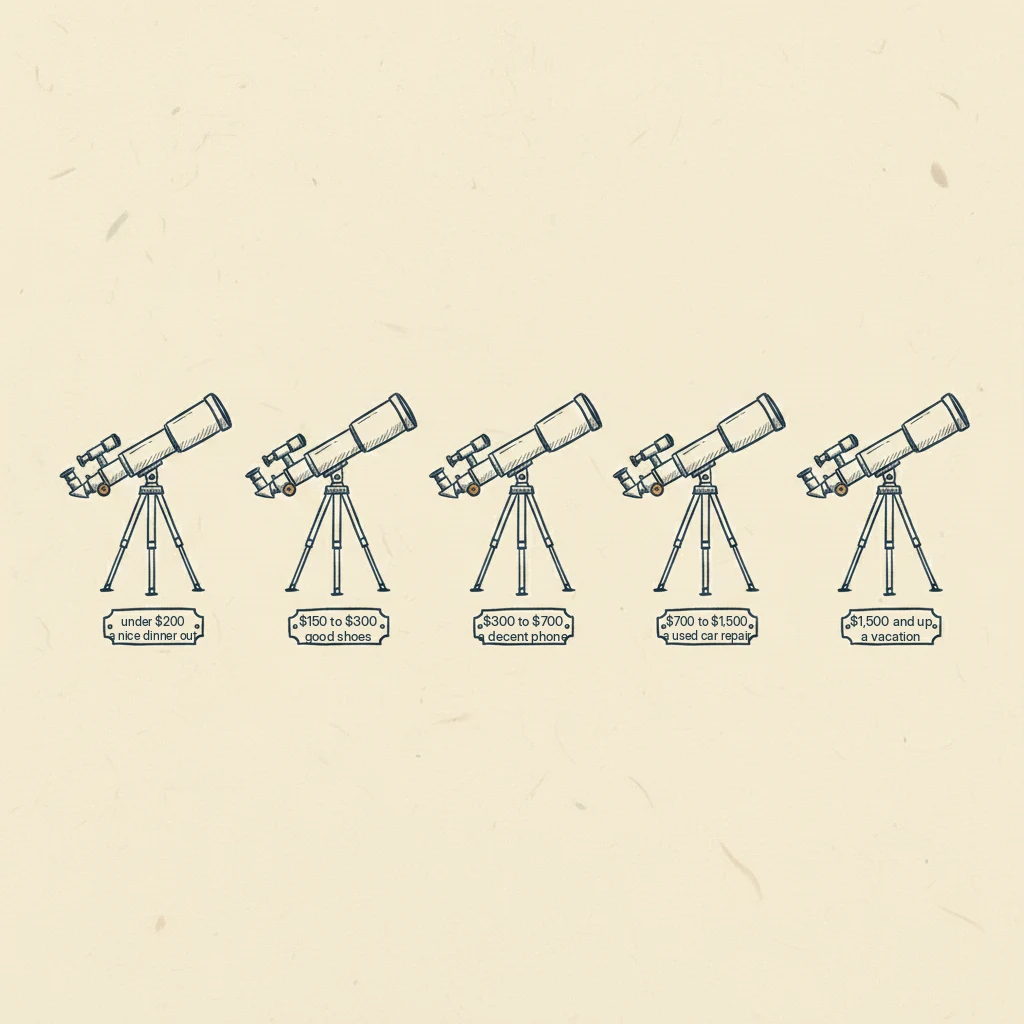
Let me walk the ladder, cheapest first, with what each rung actually shows you at the eyepiece. Every price is rounded to what I’m seeing as I write this, and nobody here has looked through these. We read the reviews and the spec sheets, and we tell you which is which.
| Budget | Roughly like | What you’ll see |
|---|---|---|
| Under $200 | A nice dinner out | The Moon’s craters, Saturn’s rings as a small oval, Jupiter as a little disc. No deep-sky. A Celestron AstroMaster 70AZ lives here, around $150 to $200. |
| $150 to $300 | A pair of good shoes | The real sweet spot. Rings plus the Cassini gap, Jupiter’s belts and four moons, star clusters, bright nebulae. A Sky-Watcher Heritage 130P is about $230 to $280. |
| $300 to $700 | A decent phone | More aperture, a 6-inch reflector around $355, Mars’s polar caps in a good year, a whole night of Messier objects. |
| $700 to $1,500 | A used-car repair | Computerized “GoTo” scopes that point themselves, like the Celestron NexStar 6SE at about $1,050 or the 8SE at about $1,500. Excellent planets, hundreds of deep-sky objects. |
| $1,500 and up | A serious vacation | Big 10-inch-plus light buckets and premium refractors, from about $1,150. Galaxy structure, and the door to astrophotography. |
For most first-time buyers, that $150 to $300 band is the sweet spot, and it’s where I’d point almost everyone. You get genuine astronomical views without the cost or the complexity. If you searched for the best telescope for $500, you’re comfortably inside the serious-beginner range, with room for a 6-inch reflector and good eyepieces. If you searched for the best telescope for $1,000, you can nearly reach a computerized GoTo scope, though a manual Dobsonian at that price gives you more aperture for the money.
The number the sellers bury: first-year extras
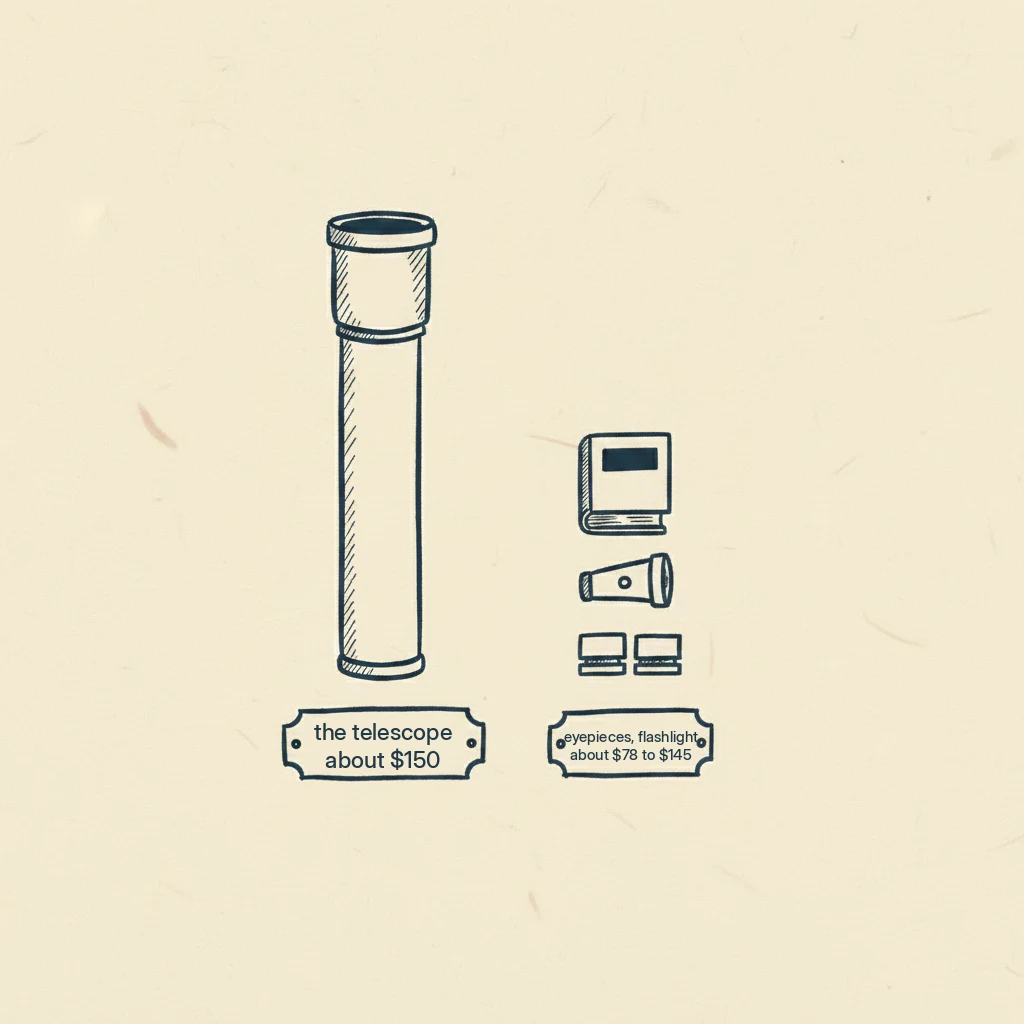
Here’s the math the listicles skip. The sticker price isn’t the total. A telescope out of the box usually comes with one or two mediocre eyepieces, and you’ll want a couple of good ones, plus a red flashlight so you don’t wreck your night vision, and maybe a simple star atlas or app.
On a budget scope, that’s another $78 to $145 the first year. On a mid-range setup, $155 to $280. So a $150 telescope is really a $230 to $300 first year once it’s actually usable. This is why I tell people not to blow the entire budget on the tube. The family that spends every dollar on the biggest scope can’t afford the eyepiece that makes it sing, and that’s a quiet way to end up disappointed with good gear.
Why telescopes cost what they cost
If you’ve ever wondered why one scope is $150 and another is $1,500, here’s what’s actually happening, in plain terms. Four things drive the price. Aperture is the big one: making a bigger, more accurate mirror or lens gets expensive fast, because the cost climbs roughly with the square of the diameter. A motorized mount that finds objects for you adds $200 to $500 just for the electronics. Better optical coatings cost more. And solid build quality, the stuff that keeps the tripod from shivering, costs more than flimsy build quality.
Notice what that means. When you pay up, a lot of your money is going to the computer and the motors, not to the view. A manual scope with no electronics puts every dollar into aperture, which is why a plain Dobsonian shows you more sky per dollar than a computerized scope at the same price. Neither is wrong. Just know which one you’re buying.
The cheapest way to see space isn’t a telescope
One honest detour, because it’s the true bottom of the price range. A good pair of sky binoculars runs about $48 to $130, less than any real telescope, and for most families that’s where I’d genuinely start. Binoculars show you the Moon’s craters, Jupiter’s moons, star clusters, and sweeping fields of the Milky Way, with no setup and nothing to wobble. They also get used at the game and on the trip, so they never end up in the closet.
Binoculars won’t show you Saturn’s rings, and that’s their one real limit for a sky-watcher. But if the question is “what’s the cheapest way to see space,” the honest answer isn’t a telescope at all. I lay out the no-cost, start-tonight version on the beginners page.
Questions people actually ask
How much should I spend on my first telescope?
Plan on $150 to $300 for the tube, and set aside another $80 to $150 for eyepieces and a red flashlight the first year. That $150 to $300 band is the sweet spot: real views, no wasted money, no overwhelming complexity. Below $100 you’re usually paying for a magnification number instead of an actual view.
Is a $100 telescope any good?
At exactly $100 you’re right at the edge. A steady, honest 70mm scope around $100 to $150 shows the Moon and Saturn’s rings and is a fine start. The trouble is the $40 to $60 shelf below it, where the optics and tripod fall apart. Buy at the top of that range with a solid mount, or wait and buy binoculars first.
Why are some telescopes so expensive?
Mostly aperture and electronics. A bigger, more precise mirror costs far more to make, and a mount that finds objects for you adds $200 to $500 in motors and computers. Premium coatings and sturdy build add the rest. A $1,500 scope isn’t fifteen times better than a $100 one. It’s bigger, steadier, and often automated.
What’s the best telescope for $500 or $1,000?
At $500 you’re in the serious-beginner range: a 6-inch reflector plus good eyepieces is a lot of scope. At $1,000 you can nearly reach a computerized GoTo scope, or buy a bigger manual Dobsonian and get more raw aperture for the money. Either way, leave room in the budget for the eyepieces.
What I’d tell a parent in the hallway
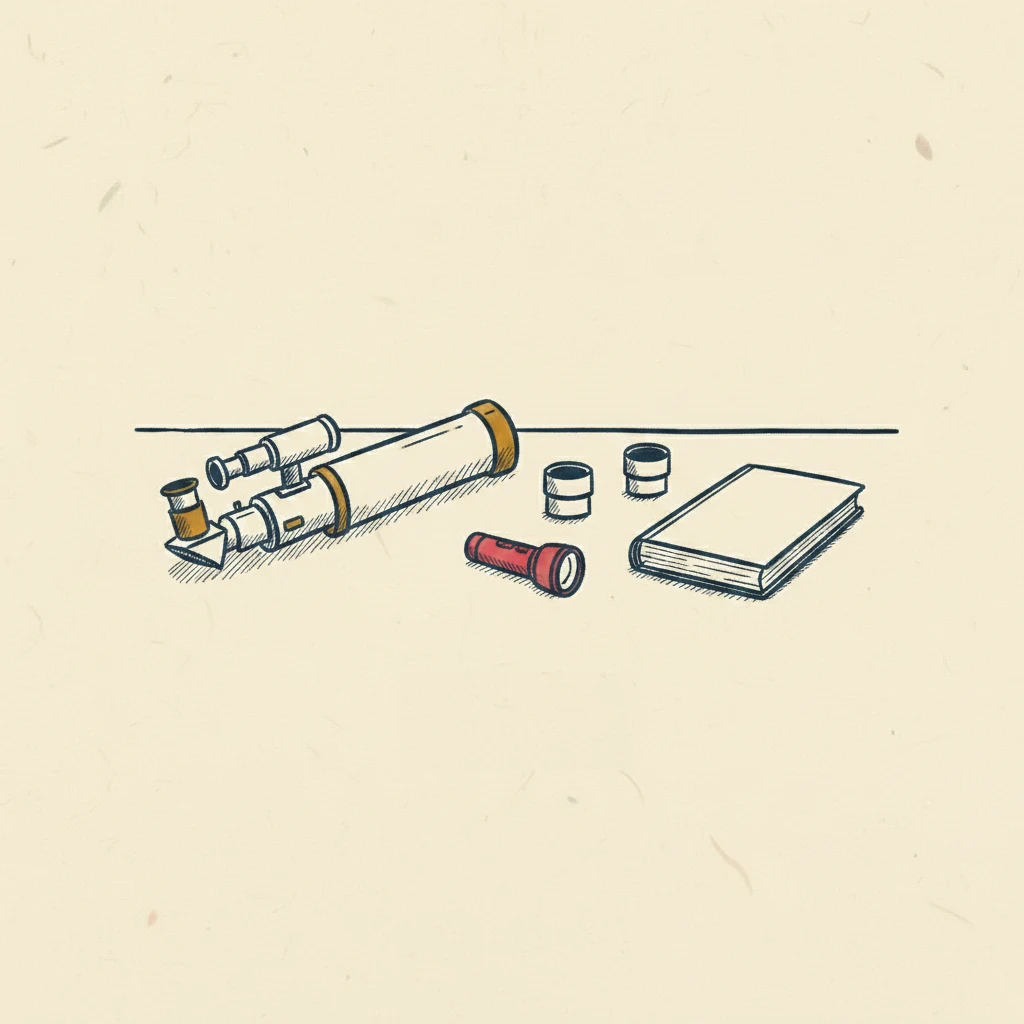
Spend about $200 on the telescope and about $80 on a good eyepiece and a red flashlight, and you’ve bought a scope that’ll show a kid Saturn’s rings and survive a few clumsy nights. Skip the $40 box entirely: it’s not cheap, it’s just a slower way to waste the money.
A few things you’re probably also wondering:
- Want the cheap end done right, in detail? See best cheap telescope.
- Ready to pick an actual model at your budget? See best telescope.
- Curious what that money buys you at the eyepiece? See telescope to see planets.
- Buying for a kid on a set budget? See best kids telescope.
- Want the spend-nothing-first version? See stargazing for beginners.
Ray Ostrander
Ray spent three decades explaining the sky to twelve-year-olds and their parents, and every January, hearing which Christmas telescopes ended up in the closet. He doesn't own a wall of gear and won't pretend to. He reads everything, tells you what owners agree on, and flags what's just his judgment. His goal is simple: no more January closets.