
Stargazing for Beginners: Start Tonight, Buy Nothing Yet
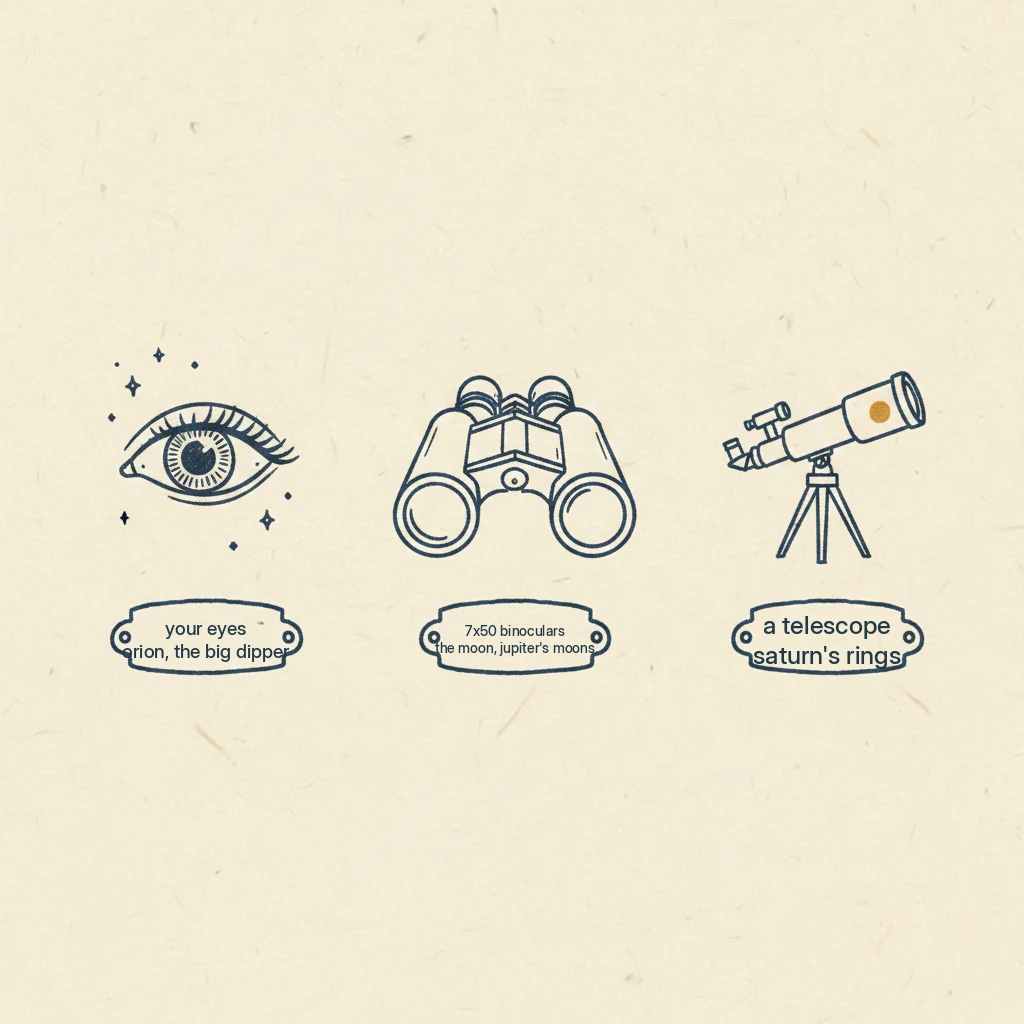
The order that works: learn three constellations with your eyes, add a 7x50 or 10x50 binocular next, and buy a telescope last, once you can actually find things. Jumping straight to a telescope is the classic mistake.
 Ray Ostrander · Updated July 24, 2026 · how I decide
If you buy through a link here, the site earns a little. It's never why anything gets picked.
Here’s the order that works. Learn three constellations with just your eyes first. Add a 7x50 or 10x50 binocular next. Buy a telescope last, once you can actually find things in the sky. The most common beginner mistake, and the fastest route to a scope in the closet, is jumping straight to a telescope before you know your way around up there.
What's on this page
Tonight’s part costs nothing
Put the credit card away. The first step in stargazing is your own eyes, and it works from any backyard. Don’t try to learn all eighty-eight constellations. Astronomy educators say to start with three anchor patterns and build out from there.
Learn Orion first, the most recognizable shape in the winter sky, with its three-star belt. Learn the Big Dipper, part of Ursa Major, which is up all year and points the way to everything else. And in summer, find Scorpius, low in the south, with the red giant star Antares glowing at its heart. Three shapes. Once you know them, the rest of the sky has landmarks.
Here’s the part I always wanted a kid to feel. When you find Antares and let that red light land in your eye, you’re catching a real photon that left the star long before you were born. It crossed all that distance to end its trip in you, tonight, for free. No gear required. That’s the whole hobby in one glance.
For finding your way, one small tool earns its keep: a star-chart app you hold up to the sky. You don’t need to buy a book to start. The guide authors who know this best name SkySafari, and its basic version runs about $7. Point your phone at a bright star and it tells you what you’re looking at. Free apps exist too, but that’s the one the people who do this recommend.
Then, and only then, binoculars
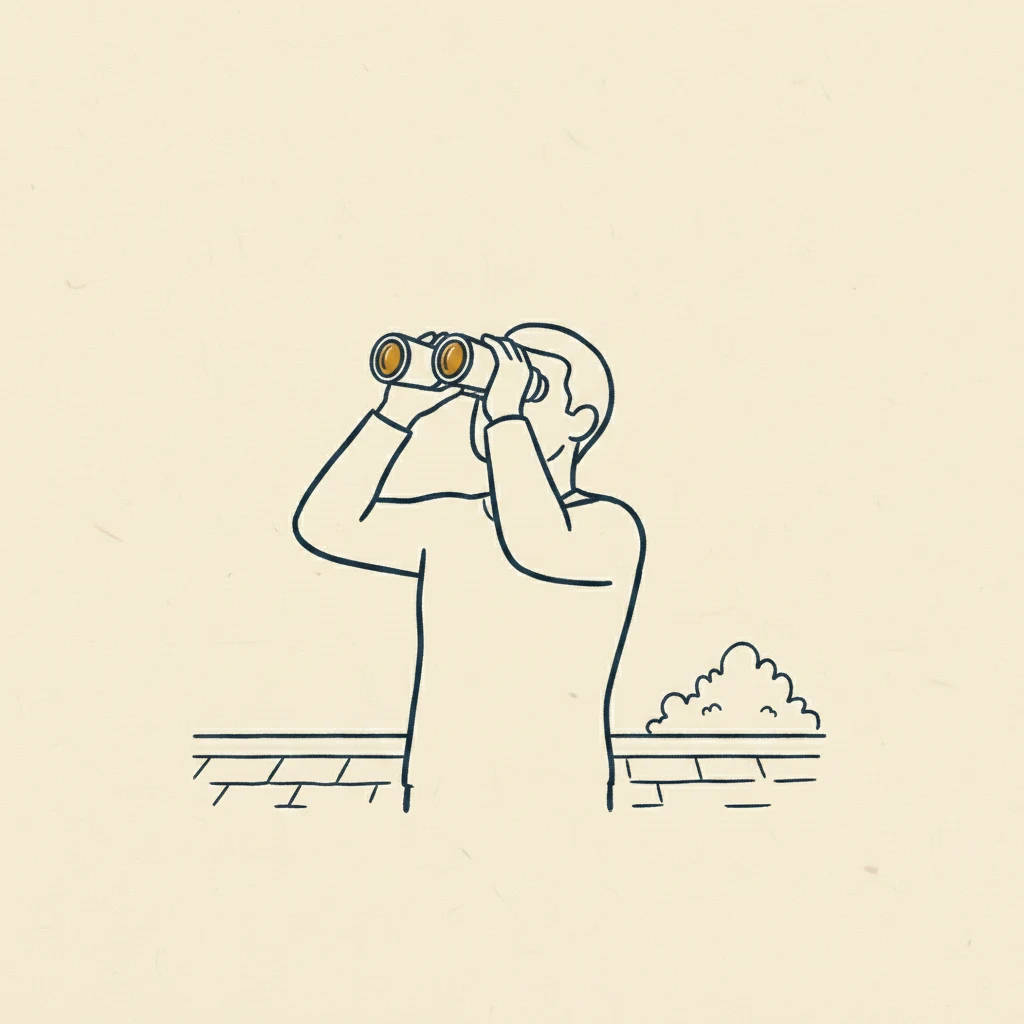
When you’re ready to spend a little, buy binoculars, not a telescope. This is the single most agreed-upon piece of advice in the whole hobby: binoculars first, telescope second. They cost less, need no setup, work at the ballgame and on vacation, and they never end up in a closet.
A binocular is labeled with two numbers, like 7x50. That just means seven times magnification and a fifty-millimeter front lens, the width that gathers light. For the sky, 7x50 is the classic size, and 10x50 gives a bit more detail while staying steady in your hands. Keep the magnification below 12x, because anything higher shakes too much to hold still.
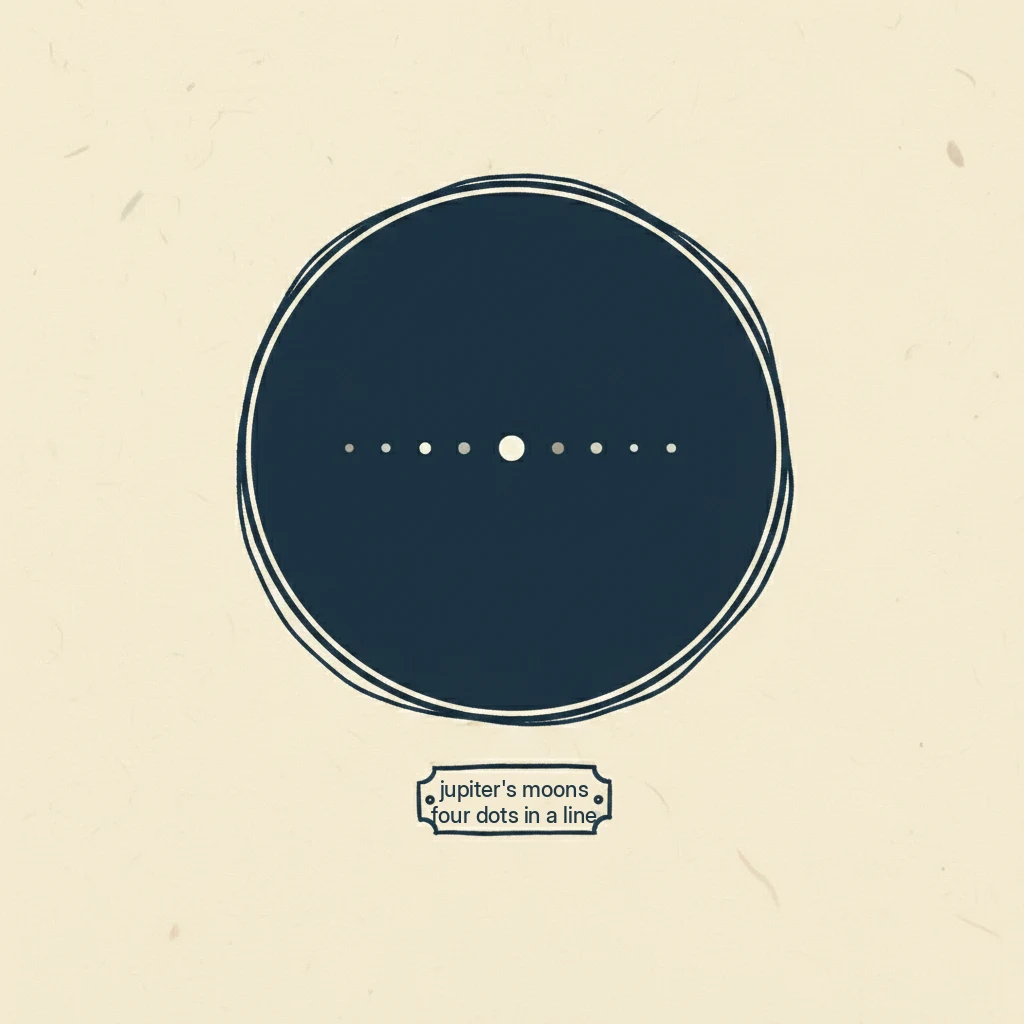
Point them up and here’s what you actually get: the Moon’s craters, mountains, and dark lava plains in real relief; Jupiter’s four biggest moons as tiny dots in a line; the Pleiades, the little cluster some people call the Seven Sisters, hanging in three dimensions; the Andromeda Galaxy as a faint oval smudge; and the Orion Nebula showing real structure. That’s a lot of universe for the price of a decent dinner out.
One honest heads-up before you look. Binoculars won’t show you Saturn’s rings. The rings need about thirty times magnification to separate, and a handheld binocular tops out well below that, so Saturn is a small bright dot here, not a ringed jewel. That view is the telescope’s job, later. Knowing it now keeps the smudge from feeling like a letdown.
Why buying the telescope first backfires
The trap is simple and it’s everywhere: a beginner gets excited, buys a telescope on day one, can’t find anything with it because they don’t know the sky yet, gets frustrated, and shelves it. That’s the January closet, and skipping the naked-eye and binocular steps is how people walk right into it. Learn the sky cheap and frictionless first, and a telescope becomes a joy instead of a chore.
One more buying trap while we’re here. Those giant binoculars, the 15x70 and 20x80 monsters, look tempting because bigger sounds better. But above about twelve to fifteen times, you can’t hold them steady, and the view jumps around uselessly without a tripod. For starting out, a modest 7x50 you can actually hold beats a giant you can’t.
The starter binocular shelf
Here’s the researched shelf, cheapest first, rounded prices as I write this. Nobody here has looked through these, which the About page says plainly.
- Celestron Cometron 7x50, about $48. The classic starter. Steady at 7x, and the 50mm front collects enough light for Jupiter’s moons, the Orion Nebula, and dozens of clusters.
- Celestron UpClose G2 10x50, about $52. A little more reach, still steady in the hands.
- Celestron SkyMaster 12x60, about $110. More light, right at the edge of what you can hold still.
- Celestron SkyMaster 15x70, about $130. A giant that shows more, but plan on a tripod, because you can’t hold this one steady.
My judgment, said plainly: start stargazing with your eyes and three constellations, add a 7x50 or 10x50 binocular next, and buy a telescope only once you can find things in the sky. That order is what keeps the hobby alive instead of shelved.
Questions people actually ask
What do I need to start stargazing?
Nothing but a clear night and your eyes, to start. Learn Orion and the Big Dipper first, add a star-chart app like SkySafari for about $7, and you’re stargazing. When you want more, a $50 pair of binoculars is the next step. A telescope comes last, after you know your way around the sky.
Do I need a stargazing for beginners book?
Not to begin. A star-chart app you hold up to the sky does the same job a book does and updates itself to tonight’s sky, which paper can’t. The guide authors point to SkySafari, with a basic version around $7. If you love paper, any current beginner star atlas works, but don’t let buying one hold up your first night out.
Should I buy binoculars or a telescope first?
Binoculars, almost always. They’re cheaper, there’s no setup, and they show you the Moon, Jupiter’s moons, and star clusters right away. Most families never regret buying binoculars, and plenty regret a rushed telescope. Buy the scope once you can already find things in the sky with your eyes and your binoculars.
What can you actually see with binoculars?
More than people expect. The Moon’s craters and mountains, Jupiter’s four biggest moons as dots in a line, the Pleiades cluster, the Orion Nebula’s structure, and Andromeda as a faint smudge. What you won’t get is Saturn’s rings, which need a telescope’s higher magnification. For everything else, a 7x50 is a genuine window on the sky.
Here’s tonight’s plan
Go outside after dark, find Orion or the Big Dipper with your own eyes, and open a star-chart app to name a few things around it. Do that a couple of clear nights, then buy a 7x50 binocular before you ever think about a telescope. That’s the whole on-ramp, and it starts tonight for free.
A few places to go next:
- Ready to understand what a telescope adds? See telescope to see planets.
- Wondering which cheap scope is worth it later? See best cheap telescope.
- Buying for a kid? See best kids telescope.
- Want binoculars for travel too, not just the sky? See best binoculars for an Alaska cruise.
- Curious about a one-eyed option for the trail? See monocular for bird watching.
Ray Ostrander
Ray spent three decades explaining the sky to twelve-year-olds and their parents, and every January, hearing which Christmas telescopes ended up in the closet. He doesn't own a wall of gear and won't pretend to. He reads everything, tells you what owners agree on, and flags what's just his judgment. His goal is simple: no more January closets.