
Best Telescope for Deep Space: Why a Dark Sky Beats a Bigger Scope
Aperture is the number that matters for deep space, but a dark sky can beat a bigger scope. A 6-inch under dark skies outshows a 12-inch in the suburbs. And it is all gray, not the Hubble photo.
 Ray Ostrander · Updated July 24, 2026 · how I decide
If you buy through a link here, the site earns a little. It's never why anything gets picked.
For looking at deep space with your own eyes, aperture is the number that matters, which is just the width of the opening that gathers light, not the magnification on the box. But here’s the honest twist the shelf skips: a dark sky can beat a bigger scope. A 6-inch under truly dark skies will show you more than a 12-inch in the suburbs. And whatever you buy, the galaxies are faint gray patches, not the Hubble photo.
One quick fork before we go further. If you mean photographing deep space, that’s a different craft with a different price floor, and it isn’t my lane. I hand that off honestly at best telescope for astrophotography. This page is for looking.
I taught earth science, not astronomy, for thirty-one years, and deep-sky hunting isn’t my garage. That belongs to the serious amateurs, and they’re wonderful people, so bring coffee. What I can do is tell you the truth about what it costs, what you’ll actually see, and where the good version of this lives. When owners agree I’ll say so. When it’s my judgment, I’ll flag it. And I make nothing when I tell you to drive instead of buy, which is most of this page.
What's on this page
- The finding the whole shelf buries
- Read the two ladders together, because nobody else does
- What you'll actually see, and why it's worth it anyway
- The one thing that makes galaxies disappear
- What this actually costs, honestly
- A warning for the deep-sky researcher
- Questions people actually ask
- What I'd tell you before you spend the money
The finding the whole shelf buries
Every “best telescope for deep space” article sells you the same thing: more aperture. Buy up, upgrade, add inches. And the leading page on that shelf contains, buried in its own text, the sentence that undoes the pitch.
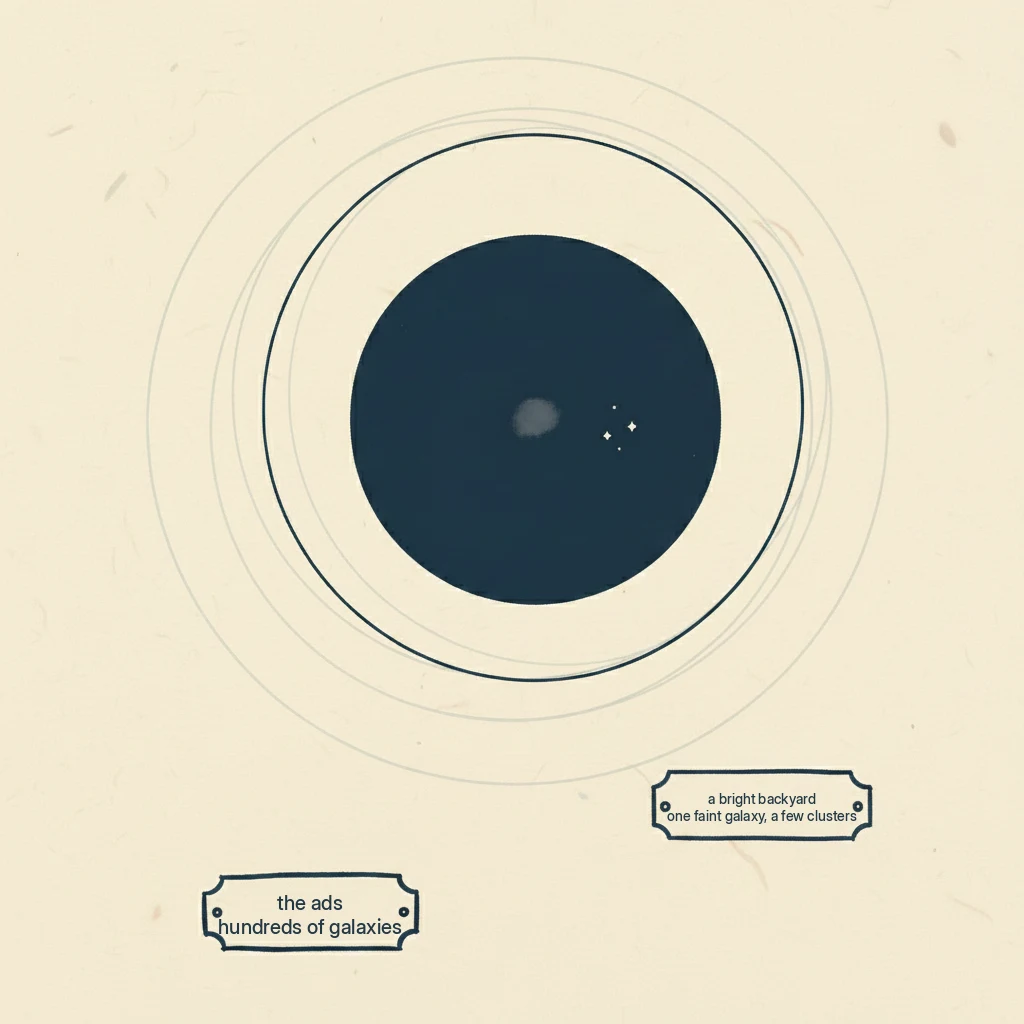
The honest finding is plain: a 12-inch telescope under suburban skies can be outperformed by a 6-inch under pristine dark skies. And sharper still: if you’re in suburban or city skies and thinking about upgrading from a 6-inch to an 8-inch, driving thirty minutes to darker Bortle 4 skies will improve your galaxy views more than a 2-inch aperture increase.
The physics of it says the same. A bright sky barely touches the moon and the planets, and then the deep-sky stuff falls off a cliff. Globular clusters take a heavy hit. Nebulae take a very heavy one. In other words, the exact objects you bought the telescope to see are the exact objects your backyard sky erases.
So here’s the trap most researchers walk into. You’re being sold aperture to solve a problem that aperture barely touches. The real variable is the darkness of the sky over your head. And the honest best telescope for deep space is partly not a telescope at all. It’s a tank of gas and a thirty-minute drive to somewhere darker. That answer sells nothing, which is exactly why nobody leads with it.
Read the two ladders together, because nobody else does
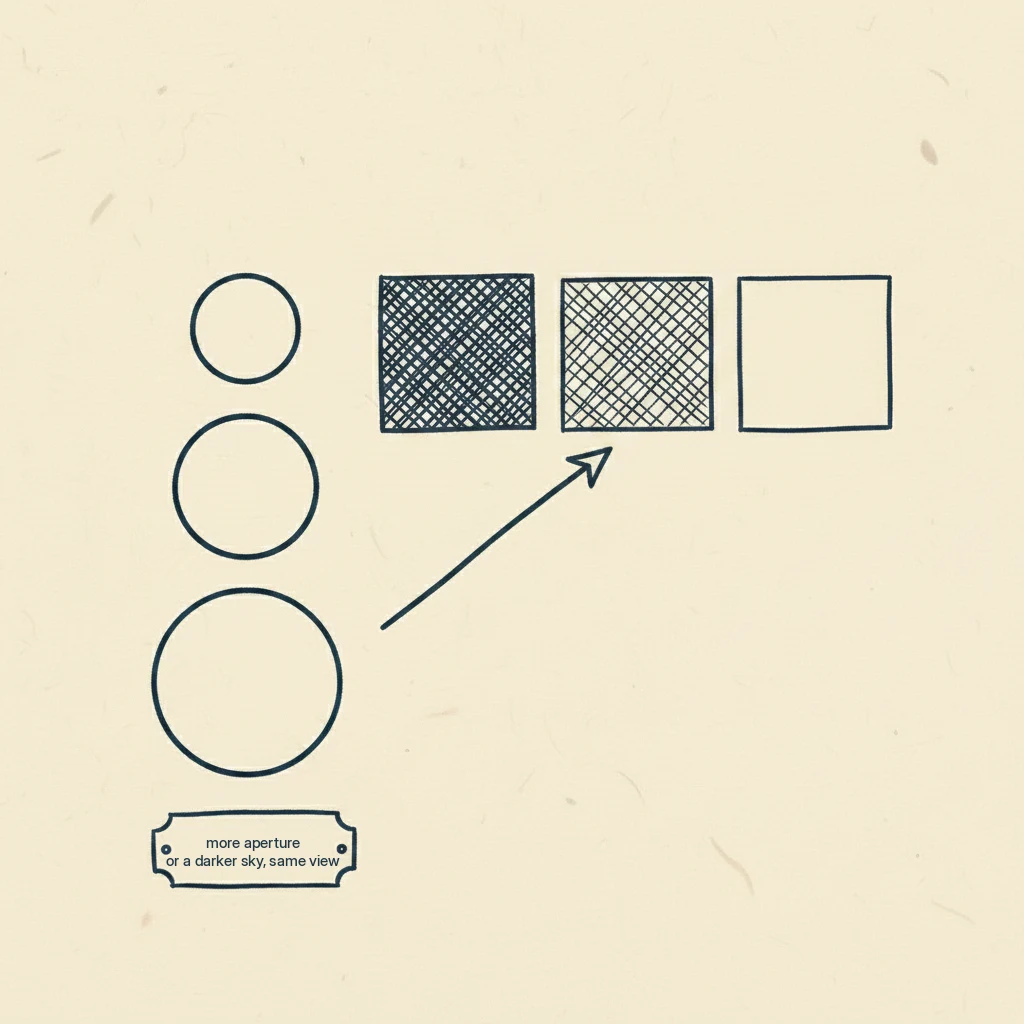
There are two things that decide your view, and they trade against each other. Here they are, laid out plainly.
What the size of the opening gives you:
| the opening | what you can expect to see |
|---|---|
| 4-inch | the brightest galaxies show a core and a faint halo, and Andromeda takes on an elongated shape |
| 8-inch | hints of spiral arms in a few galaxies, some mottling, a dust lane detectable in the brightest one |
| 12-inch and up | spiral arms traced in several galaxies, dust lanes and faint companions resolved |
What your sky allows:
| your sky | what it allows |
|---|---|
| dark (rural) | enough for real structure |
| suburban | the brightest galaxies, as patches |
| bright suburb and up | galaxy viewing severely limited |
| city | often just one galaxy, the bright one |
Now put them side by side, because that’s the whole point. An 8-inch scope parked in a bright city sky doesn’t give you the 8-inch view on that first table. It gives you roughly the 4-inch view, with a bigger, heavier tube to carry. The sky caps what the aperture can deliver. That’s the synthesis the shelf never makes, and it’s my judgment built on those two ladders, not a sales page.
One honest caveat: those exact Bortle-class thresholds are one observer’s mapping, not a hard rule. The direction, that light pollution wrecks deep-sky and spares the moon and planets, is settled and not in dispute. The precise class lines are the soft part. Treat them as a good map, not gospel.
What you’ll actually see, and why it’s worth it anyway
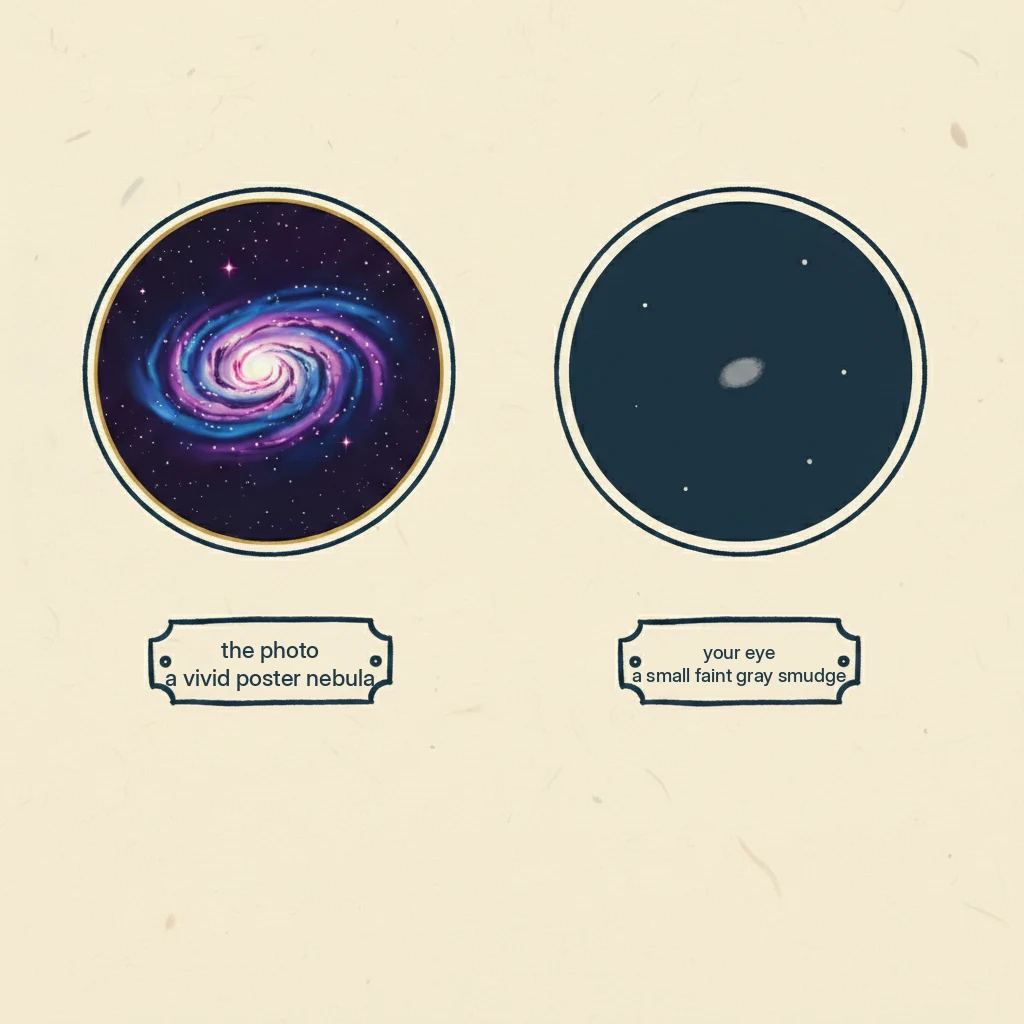
This is the part every page dodges, and it’s the reason you’re probably here. You saw a photograph. A glowing purple-and-gold nebula, or a spiral galaxy with arms you could count.
Look hard at those pictures. Your eyes aren’t cameras. Those images are long exposures, stacked and processed, gathering light over minutes or hours that your eye gathers for a fraction of a second. To your living eye, at any aperture you can afford, the galaxies are small, faint, gray smudges. No color. The people who have given this speech before put it kindly: the objects will appear much dimmer and without color. And notice something. The very page that shouts “aperture is everything” never once tells you the galaxies will be gray. That omission is why this page exists.
I’m not telling you this to talk you out of it. I’m telling you so the eyepiece doesn’t break your heart in January. Because there’s a different kind of thrill here, and it’s real. That gray smudge is a whole galaxy, a hundred billion suns, faint only because it sits so unthinkably far away. It isn’t the poster. It’s the actual thing. Grumpy as I’m about the nebula printed on the box, the smudge still gets me.
The one thing that makes galaxies disappear
If you take nothing else from the gear side, take this. High magnification is the enemy of deep space, not the friend the box implies.
Useful magnification is capped by the width of the opening, not the dial, and here’s the deep-sky specific part: pushing magnification higher dims the image, and it can make already faint objects nearly invisible. The galaxies are the faintest things you’ll ever aim at. Crank the power and you erase the exact thing you came for. The searcher hunting a “high powered” scope for galaxies is about to buy the one setting that makes them vanish. Wide opening, modest power, dark sky. That’s the recipe, in that order.
For aperture per dollar, owners agree a Dobsonian gives you the most opening for the money, which is why the deep-sky ladder is basically a stack of Dobsonians.
What this actually costs, honestly
A 6-inch to 8-inch Dobsonian, the real starting point for deep space, runs somewhere around $500 to $900 depending on the exact size and the seller. Prices on these drift, so take that as a range and check the date on anything you read. The 10-inch class, where the reviewer says the good structure really opens up, sits around $1,000 to $1,200. A 12-inch, the tier that traces spiral arms in several galaxies, climbs well past two thousand dollars. A computerized 8-inch that finds targets for you, like the NexStar 8SE, lists around $1,499.
Set that against the other line item. The drive to a dark sky costs a tank of gas and part of an evening, and it beats a $400 aperture upgrade. If your budget is the question, spend less on the tube and more on the gas. That’s not a slogan. It’s what the reviewer’s own numbers say.
There’s also a genuinely cheaper cousin for the objects that survive a bright sky. Open star clusters only take a minor hit from light pollution, and a good pair of binoculars shows them beautifully. If that’s where you land, I lay it out at best binoculars for stargazing. But you came asking about a telescope, so let’s not detour.
A warning for the deep-sky researcher
You’re going to read a lot of older articles, and two traps come with that. First, several well-ranked deep-sky guides still recommend brands that no longer exist, and even point you at a big retailer that’s closing its doors. If a page sends you to a storefront, check that the storefront is still open before you trust its prices. Second, the “deep space and planets in one telescope” idea. A single scope can point at both, sure. But the sky requirements are different: planets shrug off your city lights, and galaxies do not. So even the right scope needs the right sky for half of what you want. That’s not a scam. It’s just the thing the phrase hides.
Questions people actually ask
What’s the best telescope for deep space viewing?
For the eye, a 6-inch to 8-inch Dobsonian is the honest starting point, because a Dobsonian gives the most aperture for the money. But the more important answer is where you point it from. A modest scope under a dark rural sky beats a big scope in the suburbs. Buy the aperture you’ll carry, then get it somewhere dark.
Will I see galaxies and nebulae like the pictures?
No, and it’s better to know now. Those photos are stacked long exposures. Your eye sees faint gray patches without color. A bigger scope and a darker sky add hints of structure, a spiral arm suggested here, a dust lane there. The wonder is that the smudge is real, an entire galaxy, not that it looks like the poster.
Do I need a dark sky, or can I just buy a bigger telescope?
The sky usually matters more. Driving thirty minutes to darker skies beats a two-inch aperture upgrade, and light pollution hits the deep-sky objects hardest. From a bright city, an 8-inch performs closer to a 4-inch on galaxies. Spend on the drive before you spend on the inches.
Can I see deep space and planets with the same telescope?
The same telescope can point at both, yes. The catch is the sky. Planets and the moon come through fine even in a bright city, but galaxies and nebulae need a dark sky no matter how good the scope. So one instrument, two very different conditions. If planets are your real love, start at a telescope to see planets, because your backyard already gives you those tonight.
How big a telescope do I need to see galaxies?
Enough to gather light, so 6 inches and up, but the honest ceiling is your sky, not your scope. A 4-inch shows the brightest galaxies as a core with a faint halo, Andromeda stretched to an elongated smudge. An 8-inch adds hints of structure under a dark sky, and almost none of it under a bright one. Twelve inches traces spiral arms, if the sky is dark enough to earn it.
What I’d tell you before you spend the money
Here’s the plain version, one recommendation. Buy the largest Dobsonian you’ll genuinely haul outside, probably a 6-inch or 8-inch, then spend your next dollars and your best clear nights driving it somewhere dark. Don’t upgrade the tube to fix a sky problem. And go see the moon and Saturn while you wait for a dark-sky weekend, because those are yours right now, in any backyard, and they’re not gray.
When you finally do get that faint smudge to hold still in the eyepiece, sit with what it is. That dim gray light is an entire galaxy, and it left home so long ago that the whole distance is written in how faint it looks. It crossed all of that to end its trip in your eye. That’s the payoff the poster can never give you, because the poster isn’t real and this is.
If you feel the pull toward photographing it instead of watching it, that’s the serious amateurs’ craft, and I send you there honestly at best telescope for astrophotography. The aperture question that brought you here’s unpacked for the self-buyer at best telescope for adults. The shortlist is best telescope. And the free version of tonight, the one your city sky can actually deliver, starts at stargazing for beginners.
Ray Ostrander
Ray spent three decades explaining the sky to twelve-year-olds and their parents, and every January, hearing which Christmas telescopes ended up in the closet. He doesn't own a wall of gear and won't pretend to. He reads everything, tells you what owners agree on, and flags what's just his judgment. His goal is simple: no more January closets.