
The Best Binoculars for a Cruise: A Compact 8x25 You'll Actually Carry
For a warm-water cruise the pick is a compact 8x25, about $70, because the light is good and you're carrying it all day. It beats the 12-power best-seller on a moving deck. Alaska is a different question with its own page.
 Ray Ostrander · Updated July 24, 2026 · how I decide
If you buy through a link here, the site earns a little. It's never why anything gets picked.
Here’s the short answer for a warm-water cruise: a compact 8x25, something like the Celestron Outland X 8x25 at about $70 as I write this. The light out there’s good and you’ll be carrying it around all day, so small wins, and 8-power beats 10 or 12 on a moving deck. If your cruise is to Alaska, though, stop here, because that’s genuinely a different question and it has its own page: best binoculars for an Alaska cruise. Come along if you’re headed somewhere warm.
Let me walk you through why the small pair is the right one, and then help you with the question you’re really asking, which is whether to bother at all.
What's on this page
Alaska is a wildlife trip. A warm-water cruise is a holiday.
That’s the whole difference, and it decides everything. On an Alaska cruise you’re trying to see a whale or a bear or an eagle at a distance, in cold grey light, and that job justifies real glass. On a Caribbean or Mediterranean cruise you’re looking at ports, coastline, sea life off the rail, and the view from your balcony, in bright sun, and the hardest part is just packing the thing. The first one is a wildlife trip that happens on a boat. The second one is a holiday that happens on a boat. You’re on the holiday, so you get the easy answer.
Why small and why 8-power
The reason to go compact here’s different from every other page on this site, and I want you to have the actual reason, not just the rule.
On most situations I push people toward bigger front lenses, because bigger lenses gather more light and light is usually what’s scarce. Dawn, dusk, the woods, cold water. But a bright cruise deck at midday is the one place where light isn’t scarce at all. So the price you pay for going small, a dimmer image, is a price you can genuinely afford here, because there’s light to spare. That’s what lets you carry something that drops in a pocket instead of hanging off your neck all day.
Now the power. On a deck the ship moves, the wind pushes at your hands, the water throws bright reflections, and the magnification enlarges every bit of that shake right along with the view. Crank the power up to 10 or 12 and you’re not seeing more, you’re seeing a jumpier, dimmer, narrower picture that’s hard to hold on anything. That’s why 8-power beats 10 for cruises. The marine specialists actually build their purpose-made binoculars down around 7-power for exactly this reason, and only step up to 8 or 10 on big, stable vessels. A cruise ship is about as big and stable as a boat gets, so 8 is the sweet spot: steady enough to enjoy, enough reach to matter.
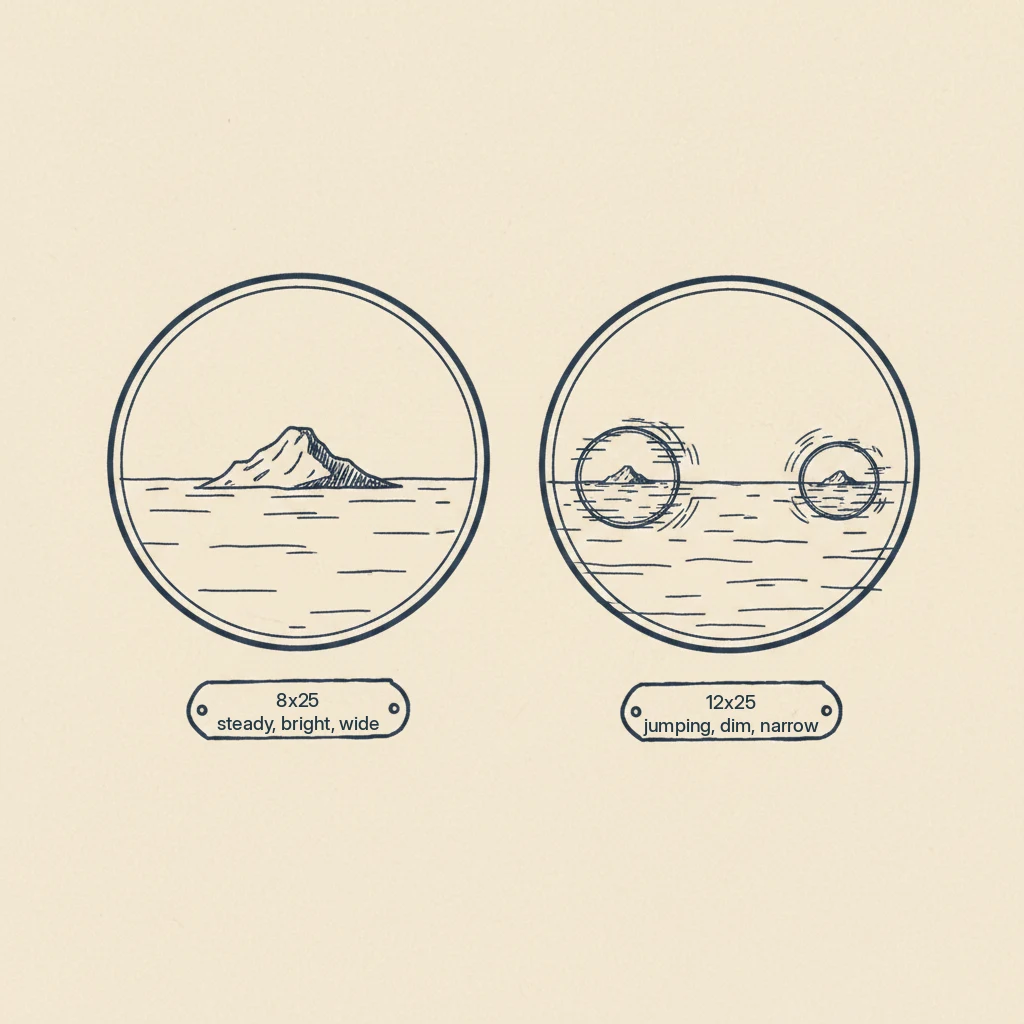
The best-seller is the wrong pick
If you go looking on the big sites, the compact that sells the most is a little 12x25, around $36, with tens of thousands of happy ratings. I’m not going to tell you the buyers are wrong to be happy, plenty of them use it in good light on solid ground and it’s fine. But for a cruise it’s the wrong end of every trade at once. Twelve-power on a moving deck is the shakiest option, and a 25-millimeter lens at 12-power sends your eye the smallest, dimmest sliver of light in this whole aisle. The spec is fighting you on both counts. An 8x25 in the same size and price neighborhood gives you a brighter, steadier view, and that’s the one I’d pack.
Do you even need them? The honest answer.
This is the real question, isn’t it. It comes up on the cruise boards constantly, usually titled something like “Packing binoculars or not????” with about four question marks. So let me treat it as a real question instead of assuming the sale.
Two honest halves. First, a lot of ships keep binoculars around for guests, and they’re frequently not very good, sometimes scratched or marked up, so I wouldn’t count on borrowing a decent view. Second, the case for bringing your own is genuinely strong. The cruise staff themselves make it: a ship is so massive you lose all sense of scale, and the guests who bring binoculars simply see more. Plenty of cruise directors call them a must-have. You’ll want them for spotting sea life on the long sea days, for pulling a coastline or a fort closer as you come into port, and yes, for the stars on a clear night from your balcony.
And the counterweight, because a binocular page that can’t say “maybe skip it” isn’t being honest with you: if your cruise is a pool chair, a buffet, and a good book, you may never lift them once. The thing people regret isn’t the $70. It’s the pair that rode along in the suitcase and never came out of the drawer. If that’s honestly you, bring nothing and enjoy the pool. Nobody’s grading you.
But here’s the thing I’ll say plainly, because the hobby crowd sometimes forgets it: you don’t have to become a birdwatcher to be allowed a pair of binoculars. You’re going on a boat for a week and you’d like to see the island. That’s a completely good reason to spend $70. Curiosity doesn’t owe anybody a lifetime commitment.
If you’ll use them past the holiday
One fork worth naming. Everything above assumes the binoculars are mostly for this trip. If you already know you’ll use a pair afterward, at ballgames, in the backyard, on the next trip, then it’s worth stepping up to a full-size 8x42, around $100, which gathers more light and reaches better and will outlive a dozen cruises. It’s bulkier, and for a warm-water cruise alone you don’t need it. Buy the bigger pair only if it’s really an all-purpose binocular that happens to be starting its life on a boat.
There’s also a stargazing angle from a private balcony at sea, and if that appeals to you it’s worth a look at best binoculars for stargazing, where the night-sky picks and the reasons live.

Questions people actually ask
What size binoculars are best for a cruise?
A compact 8x25 or 8x32 for a warm-water cruise. The 8-power stays steady on a moving deck, and the small size means you’ll actually carry it all day instead of leaving it in the cabin. In good cruise light you don’t need a big lens, so you can pack small without giving up much.
Are 10x or 12x binoculars good for a cruise?
Usually not the best choice. The higher the power, the more the ship’s motion, wind, and hand shake get magnified, so the picture jumps and dims. Most experienced cruisers land on 8-power for exactly that reason. Save the 10x and 12x for solid ground.
Do cruise ships provide binoculars?
Some do, but they’re often low quality and can be scratched or marked, so don’t plan your viewing around borrowing a good pair. A cheap compact of your own, around $70, gives you a far better view and lives in your day bag.
Are binoculars worth bringing on a cruise?
For most people who’ll spend time on deck or in port, yes, and a cruise director will tell you the same, because a ship’s scale hides how much you’re missing. If you honestly expect a pool-and-buffet week, it’s fair to skip them. The regret isn’t the money, it’s packing a pair you never use.
What I’d pack for the deck
If you’re still weighing whether to pack anything, the general travel-binocular tradeoffs are at binoculars for travel; think of that as the suitcase in general and this page as the ship in particular. If your cruise includes a whale-watching excursion off a smaller boat, that’s a different platform and it’s covered at binoculars for whale watching. If you want to be sure $70 is buying you enough glass, the best binoculars for the money lays out where the dollars stop mattering. And if you wear glasses on a bright deck, there’s one setting that makes all the difference over at binoculars for glasses wearers.
So here’s where I’d leave you, headed somewhere warm. Pack a compact 8x25, spend about seventy dollars, and don’t overthink the power, because small and steady will show you more from that deck than big and shaky ever will. If it’s Alaska, go get the right glass for it on its own page. And if you truly think you’ll never lift them, save the suitcase space with a clear conscience. Enjoy the trip.
Ray Ostrander
Ray spent three decades explaining the sky to twelve-year-olds and their parents, and every January, hearing which Christmas telescopes ended up in the closet. He doesn't own a wall of gear and won't pretend to. He reads everything, tells you what owners agree on, and flags what's just his judgment. His goal is simple: no more January closets.