
Binoculars for Whale Watching: Boat or Shore Changes the Answer
On a whale-watching boat, use 8x or 10x binoculars, because higher power shakes. The Vortex Triumph HD 10x42 runs about $100. From shore you can brace and go up to 15x.
 Ray Ostrander · Updated July 24, 2026 · how I decide
If you buy through a link here, the site earns a little. It's never why anything gets picked.
If you’re going out on a boat, get 8x or 10x binoculars. The Vortex Triumph HD 10x42 runs about $100 and does the job. If you’re watching from shore, where you can lean on a railing, you can go up to 15x and see more. That one question, boat or shore, decides everything else.
Almost nobody tells you that first. The listicles hand you twelve ranked models and let you figure out which trip you’re taking.
What's on this page
- Start here: which one are you doing?
- Why a moving boat caps the power you can use
- What owners keep saying (and it surprises people)
- The two numbers, quickly
- What about image-stabilized binoculars?
- The shelf, with honest prices
- Questions people actually ask
- What I'd tell a parent in the hallway
- While you're figuring this out
Start here: which one are you doing?
You already know the answer. You either bought a ticket on a boat, or you’re standing on a bluff with a thermos hoping something breaks the surface.
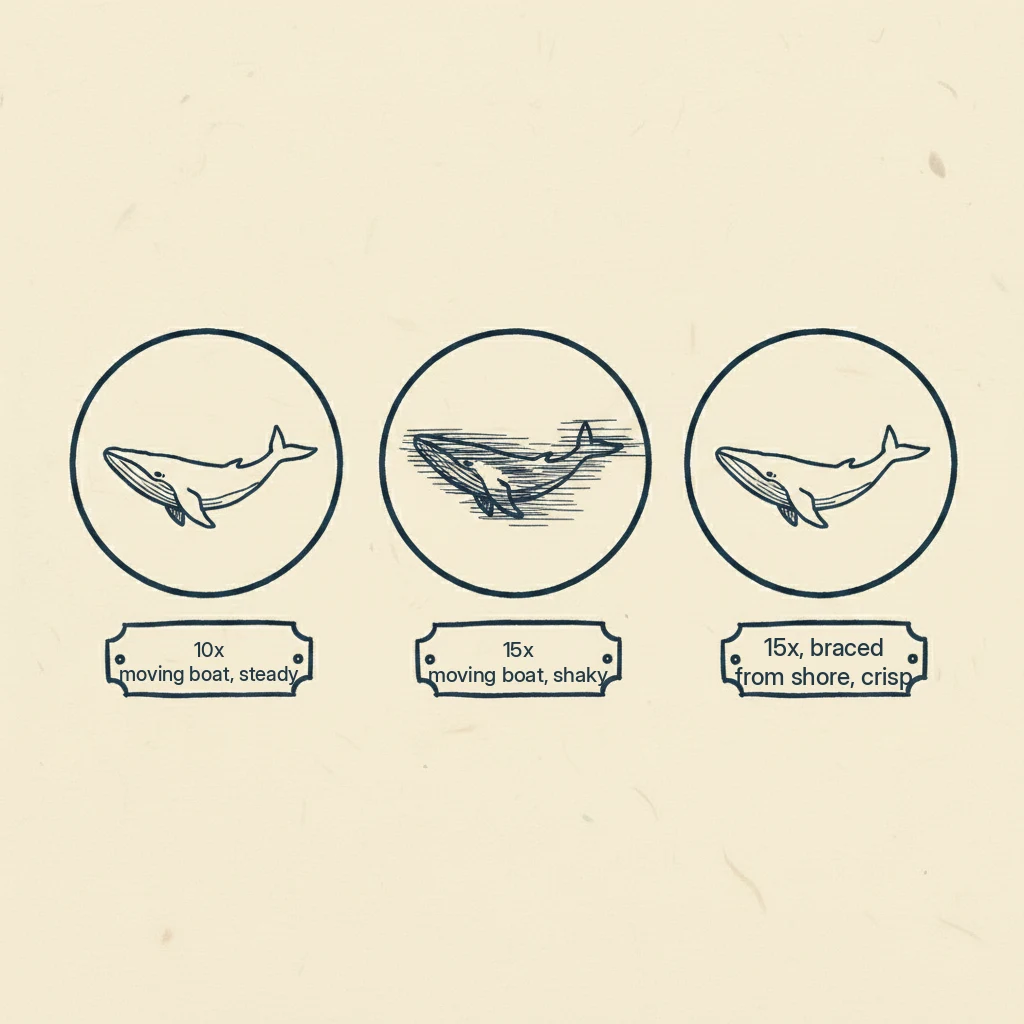
On a boat: the deck moves, so your ceiling is 8x to 10x. That’s enough power to pull the whale in close, and low enough that the boat’s roll doesn’t throw the view around, which is the balance of reach and stability a moving deck allows.
From shore: solid ground under you, and something to brace against, so you can push up to 10x to 15x and use that reach on a whale that’s a long way out.
Buy for the wrong platform and you’ve wasted the trip. That’s the whole trap this page exists to keep you out of.
Why a moving boat caps the power you can use
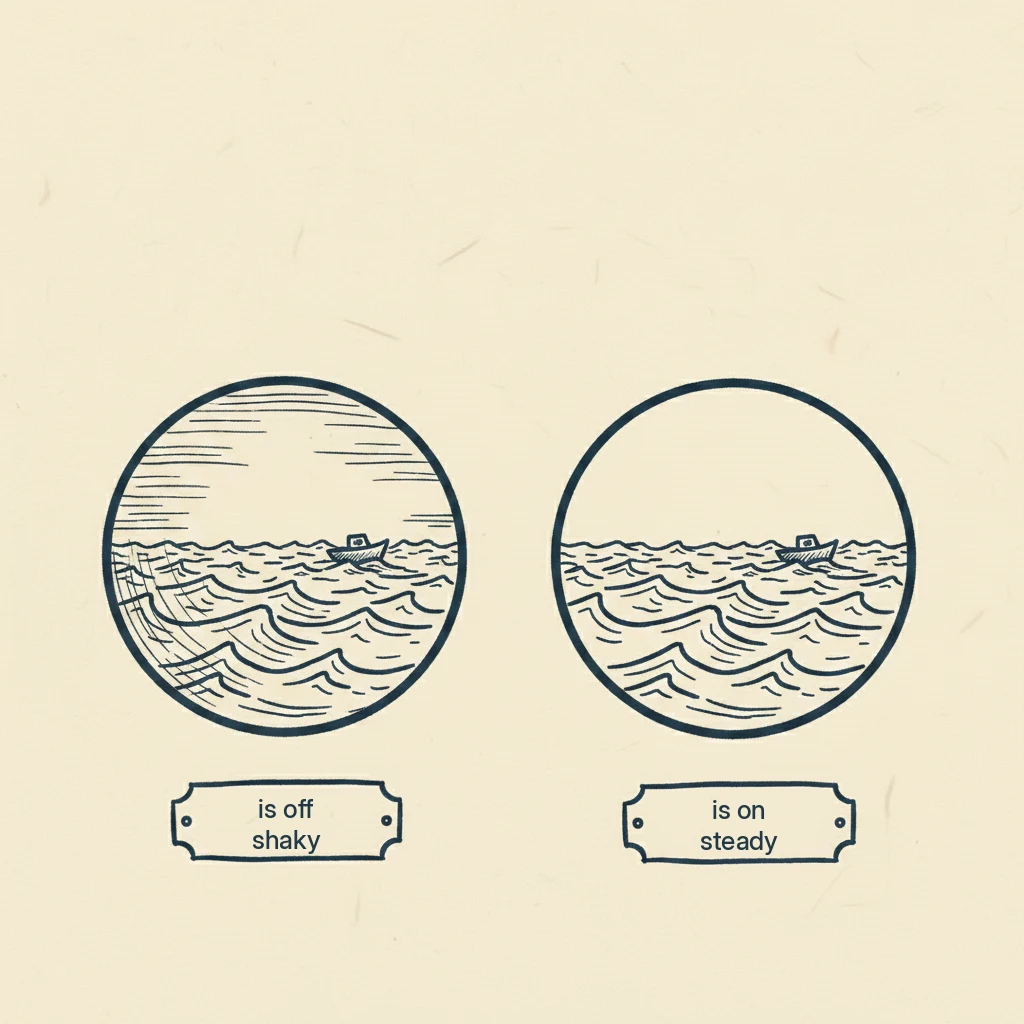
Magnification doesn’t just magnify the whale. It magnifies every wobble between you and the whale, including the ones you didn’t know you were making.
Your heartbeat nudges them. So does your breathing. Your hands never fully settle, the deck is rolling under your feet, and the water is working under the deck. Crank the power up and every bit of that motion is enlarged in lockstep with the whale. The optics makers say the same in plain terms: the higher the power, the more the image dances in your hands, because your unsteadiness scales right along with it.
So a 15x pair on a whale-watching boat doesn’t show you a bigger whale. It shows you a whale sliding around a jittery circle while your arms get tired. Meanwhile the person next to you with the humble 8x pair is watching the whale.
What owners keep saying (and it surprises people)
The owner consensus runs lower-power than the box art wants you to believe.
One whale-watcher who has done it from a zodiac, from a cruise ship, and from shore recommends an 8x32 or 8x42 pair, for the ease of holding them and for the wide field of view, which is just how much ocean you can see at once. That last part matters more than people expect. Whales don’t announce themselves. You’re scanning a big gray field looking for something that surfaces for four seconds, and a wide view finds it. A tight, high-power view is a straw you’re trying to aim.
There’s a pattern I see over and over in these threads: people who have been at this a while are moving DOWN in power, not up. One owner describes going from a 12x56, to a 10x42, to an 8x32, and calls the 8x32 so lightweight and easy. Another recommends 8x specifically for older users, whose hands are steadier at lower power.
That’s worth pausing on. The beginners are shopping for the biggest number, and the experienced people are quietly walking the other way.
The two numbers, quickly
A name like 8x42 or 10x25 is just two facts stuck together. The first is the power, how much closer it pulls the whale. The second is the front-lens width in millimeters, which decides how much light it drinks and how heavy it rides. On a boat you keep that first number modest, around 8x, and let the second do the brightening.
What about image-stabilized binoculars?
You’ll see the letters IS on some models, and they cost a lot more. IS is image-stabilized, which means there’s a mechanism inside actively steadying the view for you, canceling out the shake.
It works. It’s the thing that makes 12x usable on a boat, which is otherwise a contradiction in terms. The Canon 12x36 IS III is the model that keeps showing up in this class, and it was listed at about $690 back in August 2025. As I write this in July 2026, it’s about $730 on Amazon, so that price has been drifting upward, and you should assume it’s higher again by the time you read this.
Here’s the honest version, and it’s my judgment: image stabilization is real, and it isn’t a free upgrade. It costs about seven times what a boat-capable Vortex costs, and it adds weight and batteries to something you’re holding up for two hours. If whale-watching is your thing and you’ll be on boats for years, it’s a defensible splurge. If this is one excursion on one vacation, it’s a lot of money to make a whale hold still.
The shelf, with honest prices
These prices come from a whale-binocular guide published in August 2025, so treat them as a map of the neighborhood, not a receipt. Prices move. The ones I’ve refreshed are the Canon, which moved up, and the Steiner Marine, which that guide had listed too low.
| what it’s for | model | about what it cost (Aug 2025) |
|---|---|---|
| The boat pick, cheapest that works | Vortex Triumph HD 10x42 | about $100 |
| Boat, waterproof, a step up | Bushnell H2O Xtreme 10x42 | about $120 |
| Boat, the wide easy 8x | Nikon PROSTAFF P3 8x42 | about $150 |
| Serious marine glass | Steiner Marine 7x50 | about $375 |
| Nicer all-rounder | Nikon Monarch M5 10x42 | about $300 |
| Image-stabilized, boat shake solved | Canon 12x36 IS III | about $690 then, about $730 now |
The Vortex Triumph HD 10x42 at about $100 is the boring cousin, and the boring cousin is the right answer here. It’s boat-usable power without the stabilization premium.
If you’re the one buying a gift, and you’ve been eyeing something like the Nocs Standard Issue 10x25 at about $100, that’s a fine compact and it will make somebody happy. Just know what the 25 means: small front lens, less light, narrower view. The owners in these threads keep landing on 8x32 and up as the better tool for finding whales. A compact is what somebody actually carries, though, and that counts for a lot.
Questions people actually ask
Do I need waterproof binoculars for whale watching?
On a boat, yes. You’re getting spray, wind, and often rain, and a pair that isn’t sealed will fog on the inside where you can’t wipe it. Waterproof and fog-proof is the feature that keeps working, and it’s common enough on this shelf that there’s no reason to buy a pair without it.
Is 10x too much for a boat?
No, 10x is right at the top of the usable range. The consensus band for a moving boat is 8x to 10x. Go past that and the shake starts to win. If you have shaky hands, or you’re buying for someone older, 8x is the friendlier choice and owners say so directly.
What magnification for whale watching from shore?
Standing on solid ground, you can run 10x to 15x, and you should use something to brace against: a railing, a car roof, a fence post. The higher power buys you reach on whales that are far out. Just remember, it’s only steady because you’re not on the water.
Are compact binoculars good enough for whales?
They work, and they get carried, which is half the battle. The tradeoff is the small front lens: dimmer picture, narrower slice of ocean. Experienced whale-watchers keep recommending 8x32 or 8x42 instead, because finding the whale is the hard part and a wide bright view finds it.
Should I buy image-stabilized?
Only if you’ll be on boats often and the money doesn’t hurt. IS makes higher power genuinely usable on the water, and it costs several times what a good 10x42 does. For a single excursion, buy the $100 pair and put the difference into the trip.
What I’d tell a parent in the hallway
For a boat trip: the waterproof 10x42, about a hundred dollars, done.
Spend the extra energy on where you stand, not on what you hold. Get outside on the rail, away from the engine, and scan slowly with your eyes first. Find the whale bare-eyed, then bring the binoculars up to where you’re already looking. That habit will show you more whales than any upgrade will.
While you’re figuring this out
You’re probably also wondering:
- Whether the whole cruise needs a different pair than the excursion does: best binoculars for an Alaska cruise
- How any of this works when you wear glasses, which is the question I take personally: binoculars for glasses wearers
- Whether a one-eyed pocket option would get carried more: monocular for bird watching
- What to do with the pair after dark, once the boat’s back in: stargazing for beginners
Ray Ostrander
Ray spent three decades explaining the sky to twelve-year-olds and their parents, and every January, hearing which Christmas telescopes ended up in the closet. He doesn't own a wall of gear and won't pretend to. He reads everything, tells you what owners agree on, and flags what's just his judgment. His goal is simple: no more January closets.