
Binoculars for Fishing: You're Glassing for Birds, Not Fish
For fishing you want a wide, steady, waterproof pair you can hold on a moving boat: a 7x50 marine or a 10x42 like the Bushnell H2O Xtreme at about $120, with a floating strap on it. Buy less power, not more.
 Ray Ostrander · Updated July 24, 2026 · how I decide
If you buy through a link here, the site earns a little. It's never why anything gets picked.
For fishing, buy a waterproof pair with low power and a wide, bright view: a 7x50 marine or a 10x42 like the Bushnell H2O Xtreme, about $120 as I write this. Then put a floating strap on it, about $28. Seven-by-fifty is the marine standard and eight is the practical ceiling on a boat, because a moving deck adds the boat’s motion to your hands’ motion, and past 8x the image swims. A manufacturer will even tell you it can make you seasick. The failure mode here isn’t a blurry view. It’s the bottom of the lake.
That’s the whole answer, and if you buy nothing else you’ll be fine. But there’s one thing about fishing binoculars that almost no page tells you, and once you know it, the specs all make sense.
What's on this page
- Here's what's actually happening: you're looking for birds
- Why 7x50 is the marine standard
- The seasickness ceiling
- Waterproof isn't the same as floats
- What the shelf sells vs. what you need
- What about image-stabilized binoculars?
- What about polarized binoculars for fishing?
- Questions people actually ask
- What I'd tell you before you push off
Here’s what’s actually happening: you’re looking for birds
You aren’t glassing for fish. You can’t see fish. You’re glassing for birds, and then you’re reading which birds.
Owners who fish hard keep the same short list of what the binoculars are actually for. Sport Fishing Magazine laid it out plainly, and it’s worth reading slowly:
- spotting birds working over fish
- identifying the bird species to figure out the fish species below
- watching weed lines for birds and for flying fish being chased
- locating floating debris, which holds dolphin and wahoo
- following kite ribbons two hundred yards out
- picking out the tournament boats fighting a sailfish
- finding your friends’ boats in a spread-out fleet
Read that list again. The fish are never the target. The birds are the target, and the birds are the instrument. That line about identifying the species to read the fish below is a genuinely sophisticated piece of field knowledge, and it’s the reason this counter exists: the whole job is finding a distant commotion over the water and then reading it.
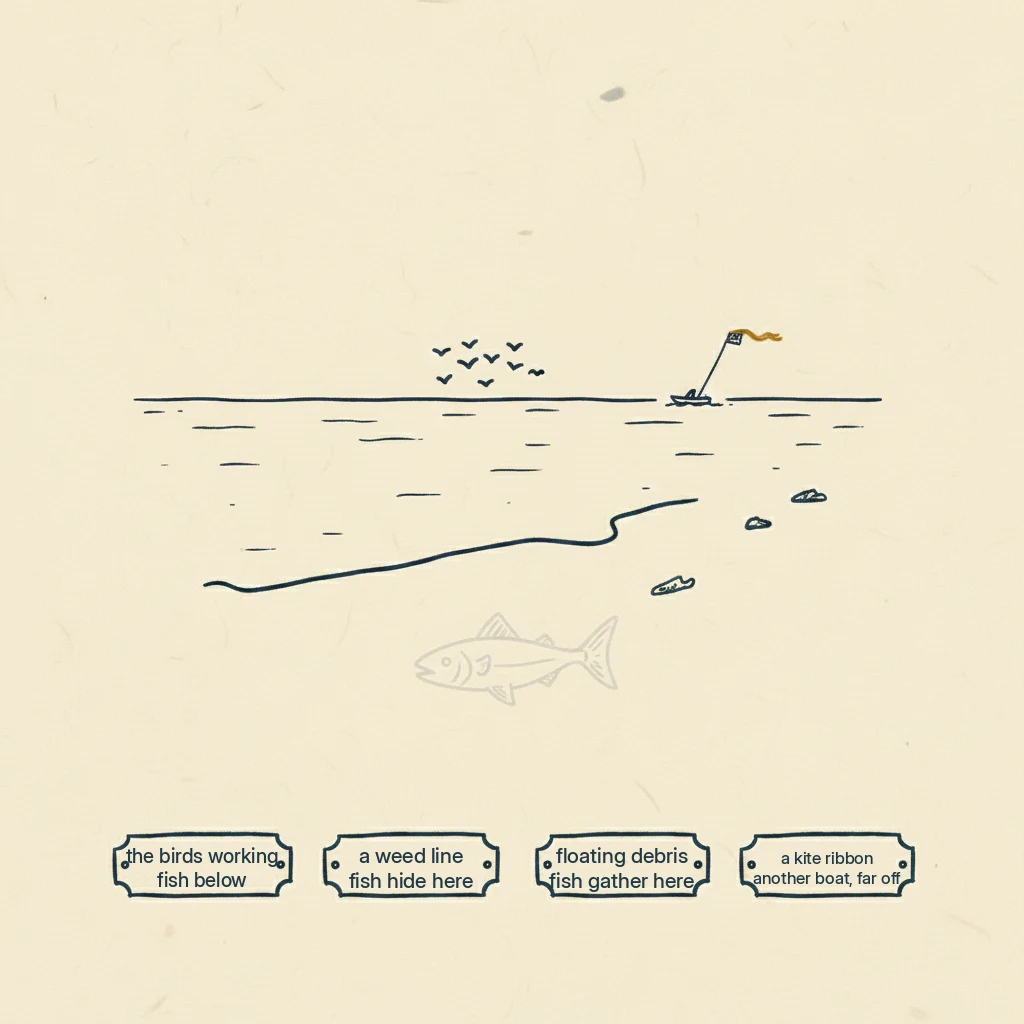
Once you see the job that way, the spec argument settles itself. If you’re finding and reading a far-off flock, you want a wide, steady, bright view, not a powerful one. And that’s exactly what the people who build marine binoculars have been saying for years.
Why 7x50 is the marine standard
Purpose-built marine binoculars run a low power, around 7x, with 8x to 10x reserved for larger, steadier boats. Steiner, the marine specialist, builds its flagship at 7x50, made to hold a steady image even in rough seas. The reasoning is the same one that runs through this whole site: more power makes it harder to hold a moving target from a moving platform, and the big 50mm front keeps the view bright and wide. That’s why the 7x50 profile is the marine standard.
There’s a number underneath that, and it’s the cleanest proof I can give you. Divide the front lens by the power and you have the exit pupil, the pool of light the glass pours into your eye. A 7x50 opens that pool to 7.1mm, the widest and brightest in this whole family. An 8x42 gives 5.25mm, a 10x42 gives 4.2mm, and a pocket 10x25 only about 2.5mm.
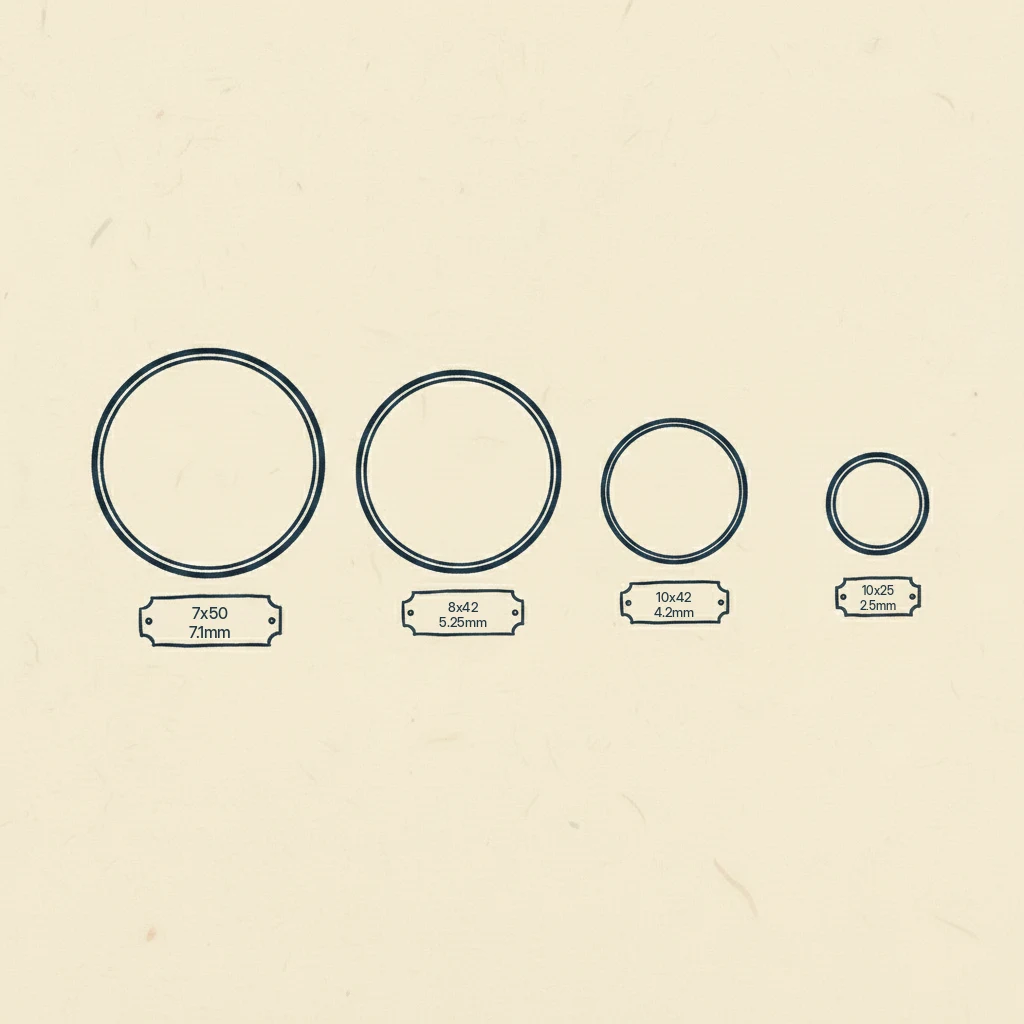
The marine standard is a low-light, wide, forgiving instrument on purpose. Dawn is when the birds work and the fish feed, so brightness at first light isn’t a luxury on this door, it’s the point.
The seasickness ceiling
This is the most physical version of a rule this site repeats everywhere, and it comes straight from a manufacturer telling you to buy less. Swarovski, quoted in Sport Fishing Magazine: “Binoculars stronger than 8x could be too unsteady in bumpy seas and have been known to make users seasick.”
Everywhere else on this site, too much magnification costs you steadiness. Here it costs you your lunch. The physics is ordinary: the higher the power, the more it blows up the fidget in your hands along with everything else, so the image gets harder to hold still. On a boat you add the deck’s motion to your hands’, and the view starts to swim. That’s the bodily reason the number stays low. Not “you’ll see less.” You’ll feel worse.
Waterproof isn’t the same as floats
Two claims get blurred on this shelf, and the difference costs money the day you learn it.
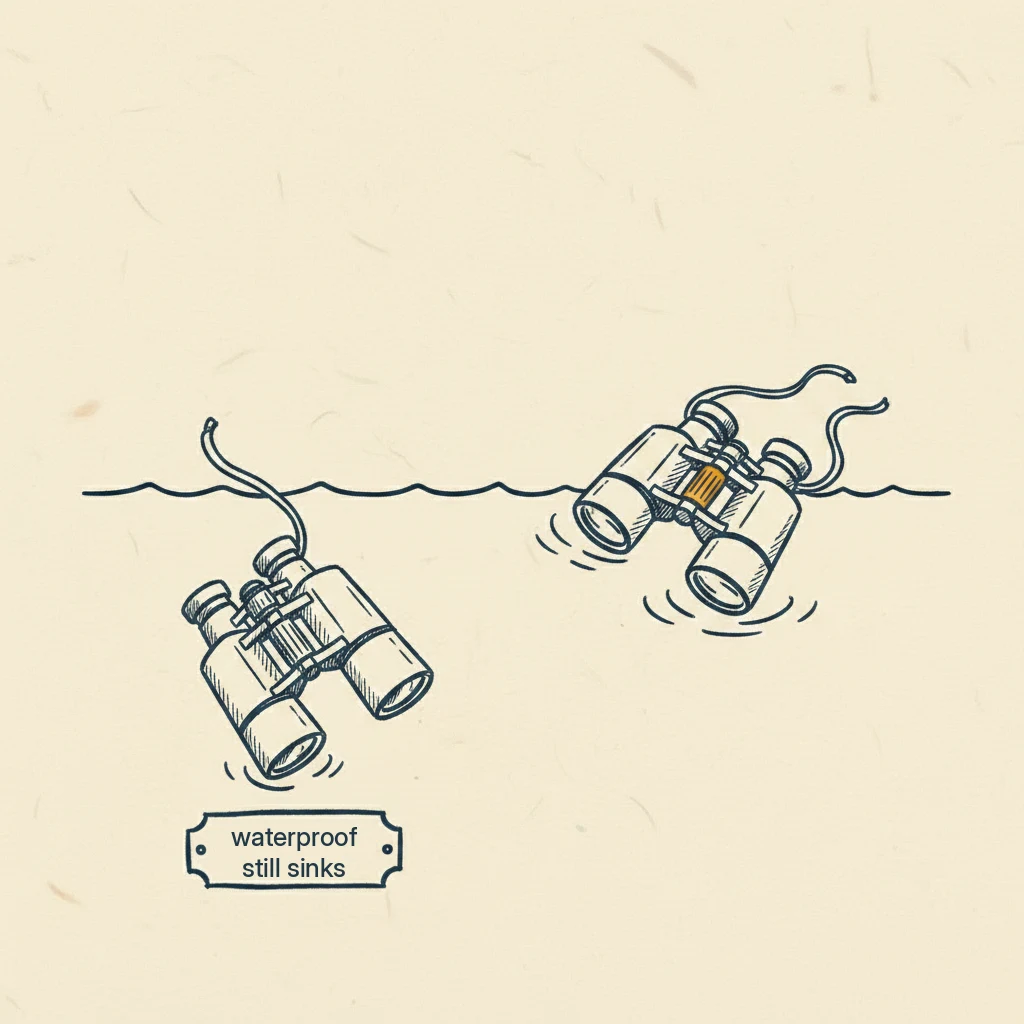
Waterproof means sealed: nitrogen-purged inside, O-ring seals, so spray and temperature swings don’t fog or flood it. Good marine binoculars are all built this way, and you want that. But waterproof doesn’t mean it floats. Most binoculars float only when you pair them with a floating strap. A binocular isn’t a buoy.
So the cheapest thing on this page is also the highest-leverage thing on it: a floating strap, about $28 (a safety-orange one made to float a 7x50 or smaller). It’s a $28 accessory that decides whether your $120 optic survives the season. Put it on before the first trip, not after the first splash.
What the shelf sells vs. what you need
Here’s where I get grumpy. Search “binoculars for fishing” and the pages that come back are mostly written for a very specific angler: the offshore tournament guy in a tuna tower, glassing kite ribbons and rival boats two hundred yards out. He buys serious glass, and good for him. But look at the models those pages actually name, and remember these prices are from 2019, so treat them as old:
| model (2019 prices, treat as old) | stated price |
|---|---|
| Fraser S250 | $3,695 |
| Swarovski EL Range 8x42 | $3,632 |
| Steiner 7x50 Commander Global | $3,105 |
| Swarovski EL 8x32 | $2,443 |
| Canon 14x32 | $1,449 |
The cheapest binocular named on that shelf is about $1,449. If you’re standing in a bass boat or on a jetty, that room isn’t for you, and no one on that shelf is priced for you. So here’s the room that is, all waterproof:
| model | about | why it’s here |
|---|---|---|
| Bushnell H2O Xtreme 10x42 | $120 | literally named for water; the default pick |
| Vortex Triumph HD 10x42 | $98 | the floor that still holds up |
| Nikon PROSTAFF P3 8x42 | $150 | a touch wider, easier on the eyes |
| Steiner Marine 7x50 | $375 | the true 7x50 marine profile, priced |
You can be correctly equipped for this job for about 3% of that shelf’s cheapest pick. Naming that gap is just respect.
What about image-stabilized binoculars?
They’re real and they genuinely solve the moving-deck problem: an electronic system steadies the image so you can hold a higher power on a rough boat. And they cost more than a lot of readers here will spend on the boat’s whole electronics package. A Canon 12x36 IS III runs about $729, and that price has been drifting up, so check it. My judgment: it works, it’s honest, and it’s not what you need for reading a flock at dawn. I’m not going to push you there.
What about polarized binoculars for fishing?
Polarized sunglasses are standard fishing kit, so it’s tempting to figure polarized binoculars cut water glare the same way. I read a fair amount before I write these, and I can’t back that up. The angling sources that go deep on binoculars don’t make the case, and I’m not going to invent it for you. Buy the polarized sunglasses. On the binoculars, spend on waterproofing and a wide view instead.
Questions people actually ask
What magnification is best for fishing binoculars?
Low. Seven-by-fifty is the marine standard and 8x is the practical ceiling on a small boat. Higher power magnifies the deck’s motion along with your hands’, so the image swims and, past 8x, a manufacturer warns it can make you seasick. You’re reading a distant flock, not counting scales, so a wide steady view beats a strong one every time.
Do fishing binoculars really need to be waterproof?
Yes, and it’s not close. Spray, rain, and temperature swings will fog or flood a sealed-poorly pair, so you want nitrogen-purged, O-ring-sealed housing. Just don’t confuse waterproof with floating: most pairs sink unless you clip on a floating strap. The strap is about $28 and it’s the accessory that saves the optic when it goes over the rail.
Are floating straps worth it?
More than almost anything else you’ll buy. A waterproof binocular is still a rock without one, and binoculars go overboard on boats. A safety-orange floating strap made for a 7x50 keeps a $120 pair on the surface where you can grab it. Put it on before the season starts, not after the first one goes down.
Can I just use a compact pair I already own?
You can, but it’s the wrong tool at the wrong hour. A pocket 10x25 gives you about a 2.5mm circle of light, the dimmest in this whole family, right when you need brightness most: dawn and dusk, when the birds work. Compacts are fine for a bright afternoon on a dock. For real fishing light, go wider.
What I’d tell you before you push off
Buy the waterproof 10x42, put the floating strap on it before the first trip, and spend the money you saved on gas. You’re not glassing for fish. You’re glassing for birds, and then for which birds, and a wide, bright, steady pair does that better than any powerful one ever will.
If you want to keep reading: binoculars for boating is the closest cousin to this page, and the line between them is simple. That page is about running the boat safely, reading buoys, markers, and hazards. This one is about finding the fish by reading the birds. Same water, different job. There’s also binoculars for whale watching for wildlife from a moving deck, best binoculars for the money if you want the value case laid out in full, and the Alaska cruise page where the marine 7x standard really lives. And if you catch yourself getting curious about the birds themselves instead of the fish under them, that’s what monocular for bird watching is for.
Ray Ostrander
Ray spent three decades explaining the sky to twelve-year-olds and their parents, and every January, hearing which Christmas telescopes ended up in the closet. He doesn't own a wall of gear and won't pretend to. He reads everything, tells you what owners agree on, and flags what's just his judgment. His goal is simple: no more January closets.