
No-Glow vs Low-Glow Trail Camera: Why the Security Answer Flips
For watching a property, choose no-glow. It uses a 940nm infrared that gives off no visible light, so the camera doesn't announce itself at night. The trade is real: it reaches about a third less far and takes a slightly darker, grainier night image. The hunting shelf favors low-glow because a deer barely notices the faint red glow.
 Ray Ostrander · Updated July 24, 2026 · how I decide
If you buy through a link here, the site earns a little. It's never why anything gets picked.
For watching a property, the answer is no-glow. It uses a 940nm infrared that gives off no visible light, so the camera doesn’t announce itself when it fires at night. There’s an honest price for that: no-glow reaches roughly a third less far, and its night pictures come out a little darker and grainier than a low-glow camera’s. The reason the reviews point you the other way is that they’re written for hunters, and a deer barely notices the faint red glow a low-glow camera makes. You’re not watching a deer, and that changes the pick.
What's on this page
- The shelf is answering a different animal's question
- Here's what's actually happening: the hunting logic runs backward for you
- The physics, in plain words
- What the one non-seller on the shelf says
- The good news: choosing right costs you nothing
- Two honest cautions
- Questions people actually ask
- What I'd do about the flash type
The shelf is answering a different animal’s question
Almost every page you’ll find on this compares the two flash types for hunting. That’s not a knock on those pages. It’s just that the whole trail-camera world grew up around hunting, so the question they’re really answering is “which one spooks fewer deer?” Your question is close to the opposite: “which one doesn’t tip off a person?” The same spec answers both, and it answers them in opposite directions. Let me walk you through why.
Here’s what’s actually happening: the hunting logic runs backward for you
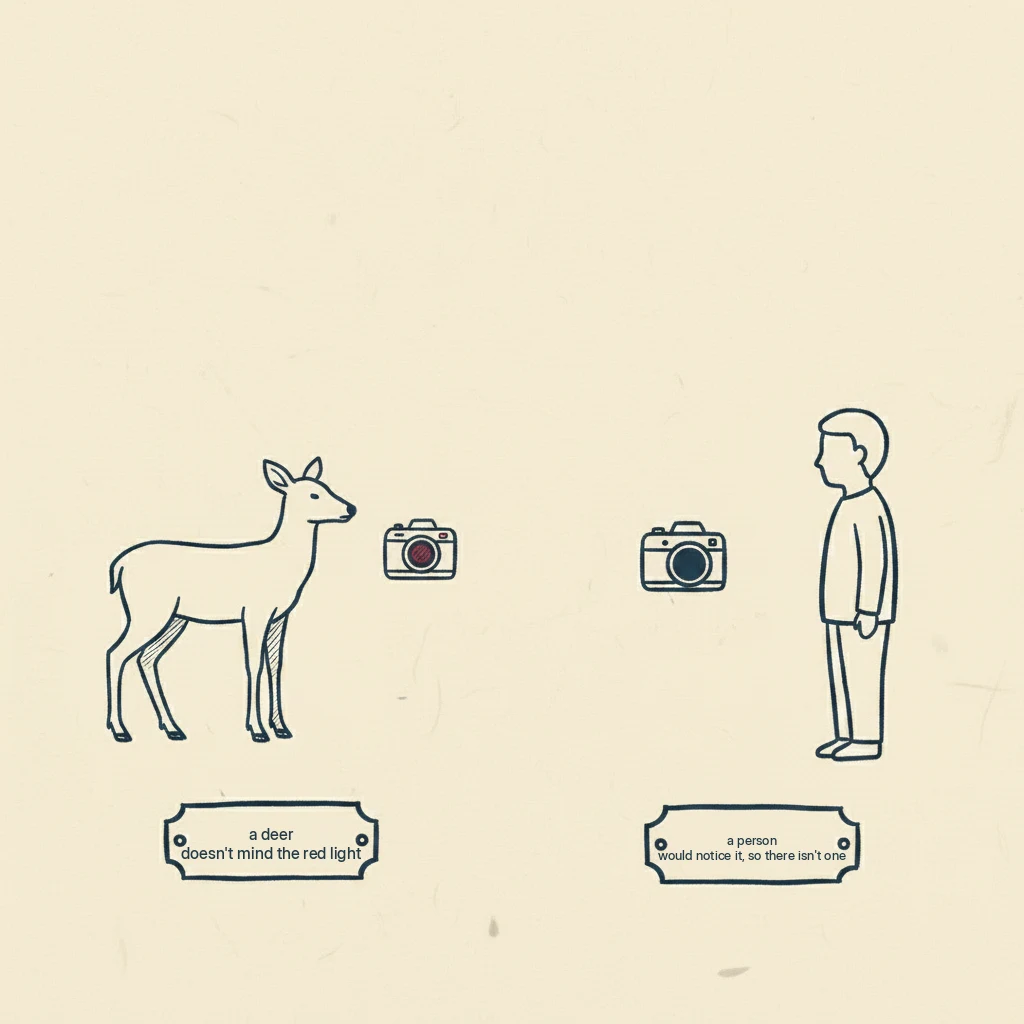
Read what the hunting guides actually say, and the whole thing clicks. Low-glow is the industry standard for watching food plots, feeders, and general deer herds, because most younger deer and raccoons are simply indifferent to the faint red light, and you get a brighter, longer-reaching picture in return. They only reach for no-glow in one specific case: when they’re watching mature bucks, coyotes, or foxes, the wary animals that are, in their words, highly pressured and sensitive to unnatural light, the ones that might change their behavior if they catch a flash.
Now sit with that. The hunting world pays extra attention to stealth only when its subject is the most light-aware, most easily spooked thing it watches. And your subject, a person who might walk onto your property, is more light-aware than any deer. A person notices a small red light on a post. So the exact situation that makes a hunter choose no-glow, a wary subject that must not see the flash, is your everyday situation. That’s why the shelf’s “best overall” camera, which is almost always a low-glow model, is the wrong default for you, on this one spec.
The physics, in plain words
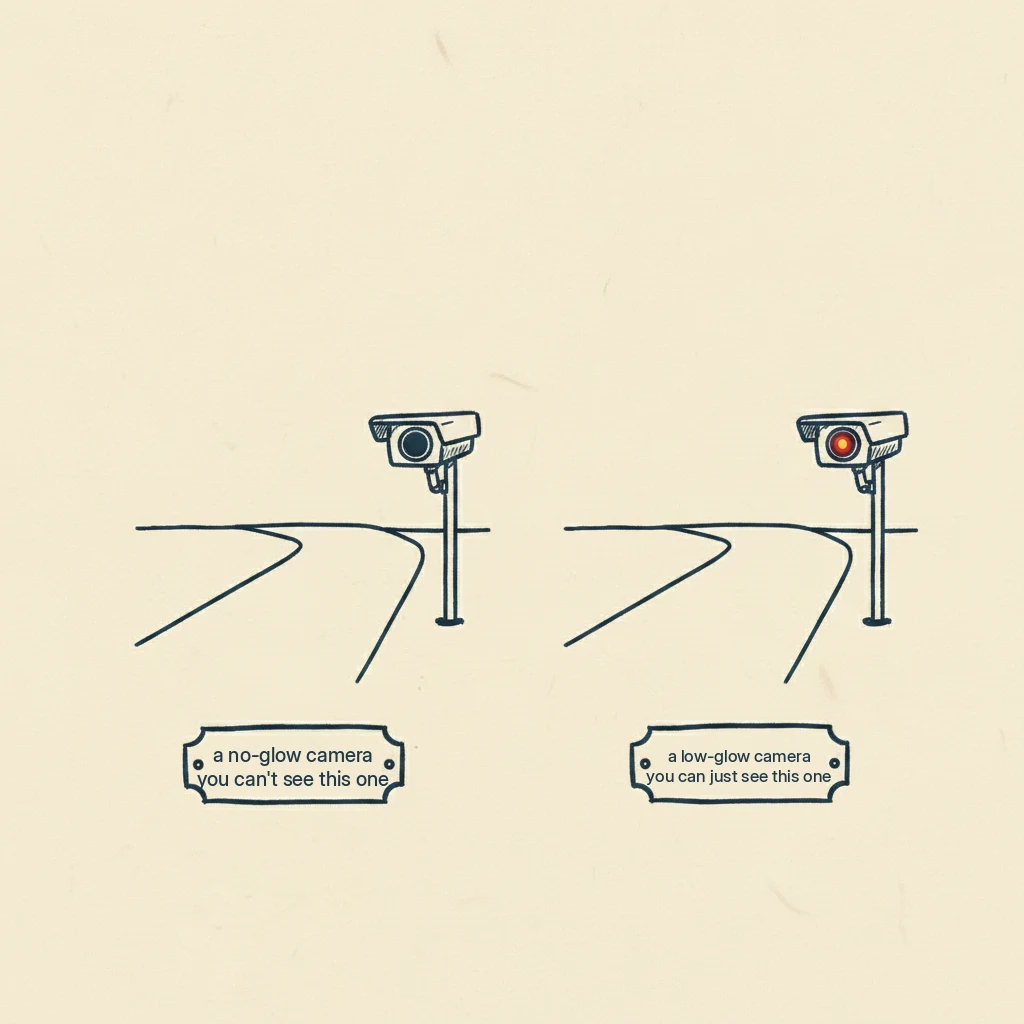
Two wavelengths, two behaviors. Low-glow cameras use LEDs in the 850 nanometer range, and no-glow cameras use 940 nanometers, which gives off no light your eye can see.
When a low-glow camera fires, those 850nm LEDs throw a faint red glow. Not a spotlight, more like, in one reviewer’s nice phrase, “the dying embers of a fire.” Faint. But some animals, and some people, will notice it. A no-glow camera’s 940nm flash has no visible glow at all.
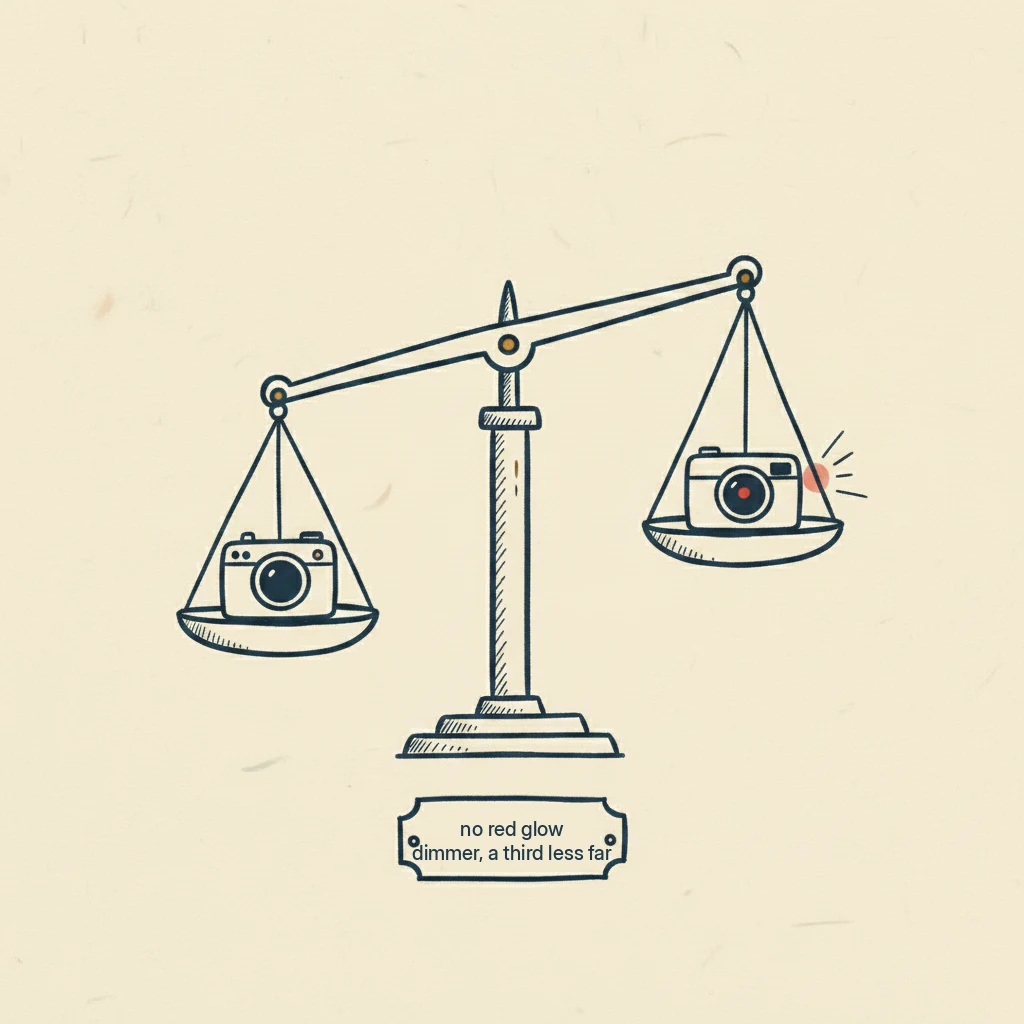
Here’s the catch, and it’s real physics, not marketing. Camera sensors are naturally more sensitive to that 850nm light. They can see it better. So the low-glow camera, working with light its sensor loves, takes a brighter, crisper black-and-white night image and reaches farther. The no-glow camera, working with light its sensor struggles with, has to boost the exposure to compensate, which makes its night images a touch darker and grainier, and can leave a moving subject slightly blurred. The reliable way to state the range difference, since the exact feet vary by source, is that no-glow reaches roughly 30 percent less far than low-glow. Stealth costs you about a third of your reach and a little clarity. That’s the deal.
What the one non-seller on the shelf says
Worth noting who’s talking. Nearly every page comparing these is a camera maker. The one independent review in the bunch is also the only one that even mentions the security use, and it lands exactly where the physics points: because there’s no small red glow when it triggers, a no-glow camera is “a stealthier device.”
I’ll be careful about what that does and doesn’t mean, because this is where a page like this can go wrong. Stealth is a spec fact: no visible flash means the camera is harder to notice at night. I’m not going to spin that into a promise about catching or scaring off anyone, because the source doesn’t say that and I’d be guessing. And “invisible” only describes the night flash, not the camera itself. The housing is still a box on a post that anyone can see in daylight. No-glow keeps the flash quiet. It doesn’t cloak the camera.
The good news: choosing right costs you nothing
Here’s the part that makes this an easy call. The flash type isn’t a price driver. The shelf’s low-glow “best overall” and a strong no-glow model sit at the same price, both around $120 as I write this. Moultrie’s Edge 2 Pro and Tactacam’s Reveal Pro 3.0 are both no-glow and both about $120. So picking the right flash type for a property doesn’t cost you a dollar more. It just isn’t the pick the hunting reviews put in the headline. This is a knowledge choice, not a spending choice, which is the best kind.
If you’d rather skip the whole monthly-plan business and just pull a card by hand, there are no-glow cameras that store to an SD card too. Browning’s Dark Ops line runs about $150 to $170 and is confirmed no-glow. Stealth without a subscription, if you can walk to the spot to collect the footage.
Two honest cautions
Don’t over-correct. Stealth isn’t free, so don’t buy no-glow and then mount it too far from a wide driveway. Give up a third of your range and put the camera out of reach of the spot, and you’ll get exactly the dark, grainy, half-blurred night shots you were trying to avoid. Match the camera’s range to the distance you actually need it to see.
The audio and property question. These cameras can record sound, and the rules on recording, on audio, and on where a camera may point, especially near a property line or a neighbor’s land, vary from state to state. I won’t tell you what your rules are, because they depend on where you live. Check your own state’s before you mount one.
Questions people actually ask
Should I get no-glow or low-glow for home security?
No-glow. It uses a 940nm infrared with no visible flash, so the camera doesn’t give itself away at night when a person is nearby. Low-glow is the hunting default because a deer ignores its faint red glow and the pictures are better, but a person doesn’t ignore a red light on a post. Being unseen is usually worth more than the extra reach on a property.
What’s the difference between 850nm and 940nm trail cameras?
850nm is low-glow: the LEDs throw a faint red glow when they fire, but the camera sees that light well, so the pictures are brighter and reach farther. 940nm is no-glow: no visible light at all, but the sensor is less sensitive to it, so the night images are a bit darker and shorter-range. It’s a stealth-versus-clarity trade.
Does no-glow really take worse pictures?
A little, at night, and only at night. Because sensors are less sensitive to 940nm light, no-glow night images run darker and grainier, and fast motion can blur slightly, while its reach is about 30 percent shorter than low-glow. Daytime pictures are unaffected. For most property watching, that’s a fair price for a camera that stays quiet.
Is a no-glow camera invisible?
Only its flash is. No-glow means no visible light when the camera fires at night, so it doesn’t announce itself in the dark. The camera body is still a physical box that anyone can spot in daylight. Think of no-glow as a silent flash, not a cloaking device.
What I’d do about the flash type
So here’s where I’d land. If there’s any chance the camera will be seen, and on most properties there is, I’d pick no-glow, and I’d go in reading “no-glow” as “the night picture will be a touch darker and a bit shorter-range.” Because it will be, and that’s the fair price of not being noticed. If the camera’s going somewhere it truly can’t be seen anyway, high up or well hidden, then low-glow gives you a better picture for the same money, and I’d take it. Either way, it costs you nothing to choose the right one, so choose it on purpose.
Once you’ve settled the flash type, the best trail camera for security is where to pick the actual camera, and trail camera subscription plans compared prices the plan behind it. If you’re setting one of these up for hunting instead, the choice flips, and trail camera for hunting walks through why low-glow is usually the right call out there.
Ray Ostrander
Ray spent three decades explaining the sky to twelve-year-olds and their parents, and every January, hearing which Christmas telescopes ended up in the closet. He doesn't own a wall of gear and won't pretend to. He reads everything, tells you what owners agree on, and flags what's just his judgment. His goal is simple: no more January closets.