
Trail Camera Subscription Plans Compared: The Camera Is the Cheap Part
SPYPOINT is the only major brand with a real free tier, 100 photos a month per camera, and the cheapest paid plan is a few dollars a month. Watch the words per camera, because most brands charge the plan again for every camera you add. And the camera still saves to its SD card without any plan at all.
 Ray Ostrander · Updated July 24, 2026 · how I decide
If you buy through a link here, the site earns a little. It's never why anything gets picked.
Two things almost nobody selling one of these will tell you up front. First, the camera still saves every picture to its own SD card without any plan at all. The plan only sends those pictures to your phone. Second, SPYPOINT is the only major brand with a real free tier, a hundred photos a month per camera at no charge, and the cheapest paid plan runs only a few dollars a month. If a hundred photos a month covers your one gate, you may be done here. If it doesn’t, the number that decides your real cost isn’t the sticker on the camera. It’s the plan, charged per camera, over the years you own it.
What's on this page
This page sells you nothing
The camera pages help you pick a camera. This one prices the thing the camera hides. You’ve already decided you want a cellular camera, one that mails you pictures, and now you’re doing the math you probably should have done first. Good. That’s exactly the right instinct, because the checkout price and the sticker price are two different numbers, and the gap between them is the whole story.
Fair warning about who writes the other comparison pages, so you can weigh them. The cleanest multi-brand tables tend to come from a company selling one of the cameras, and the neutral write-ups are mostly written for hunters, in hunting language. I’m going to give you the same numbers with the sales angle named and the deer talk stripped out.
The plans, on one table
Here’s the shelf as it stands as I write this. Prices move, so check the brand’s own plan page when you actually buy. Every one of these is billed per camera unless I say otherwise.
SPYPOINT. The only major brand with a genuine free tier: 100 photos a month, per camera, forever. Paid plans start around $5 a month, and unlimited photos with video runs about $15 a month.
Stealth Cam. Home of the cheapest single paid plan, about $4 a month for 600 photos. A middle tier with video is around $8, and unlimited runs about $20.
Tactacam. Starts around $5 a month for 250 photos, about $8 for 500, and roughly $13 a month for unlimited with video. Paying for a full year at once knocks off somewhere around 15 to 20 percent.
Moultrie. No free tier. About $9 a month for the Standard plan, about $13 for Unlimited, and about $23 for the Pro Series, all per camera, with annual billing discounting things. Read Moultrie’s terms carefully, because its own page says something the others don’t, and I’ll come to it.
GardePro. The one that bills differently. Instead of a flat per-camera fee, it charges full rate for your first camera and a discounted rate for each one after, and all of them draw on one shared pool of data. Its Standard tier is about $10 for the first camera and about $7 for each additional. That’s not “pay once for all your cameras,” and I don’t want you to hear it that way, but it does add up differently once you own more than one.
Here’s what’s actually happening: “per camera” is the whole game
This is the number that flips everything, and it’s the reason a one-camera comparison can lie to a three-camera buyer.
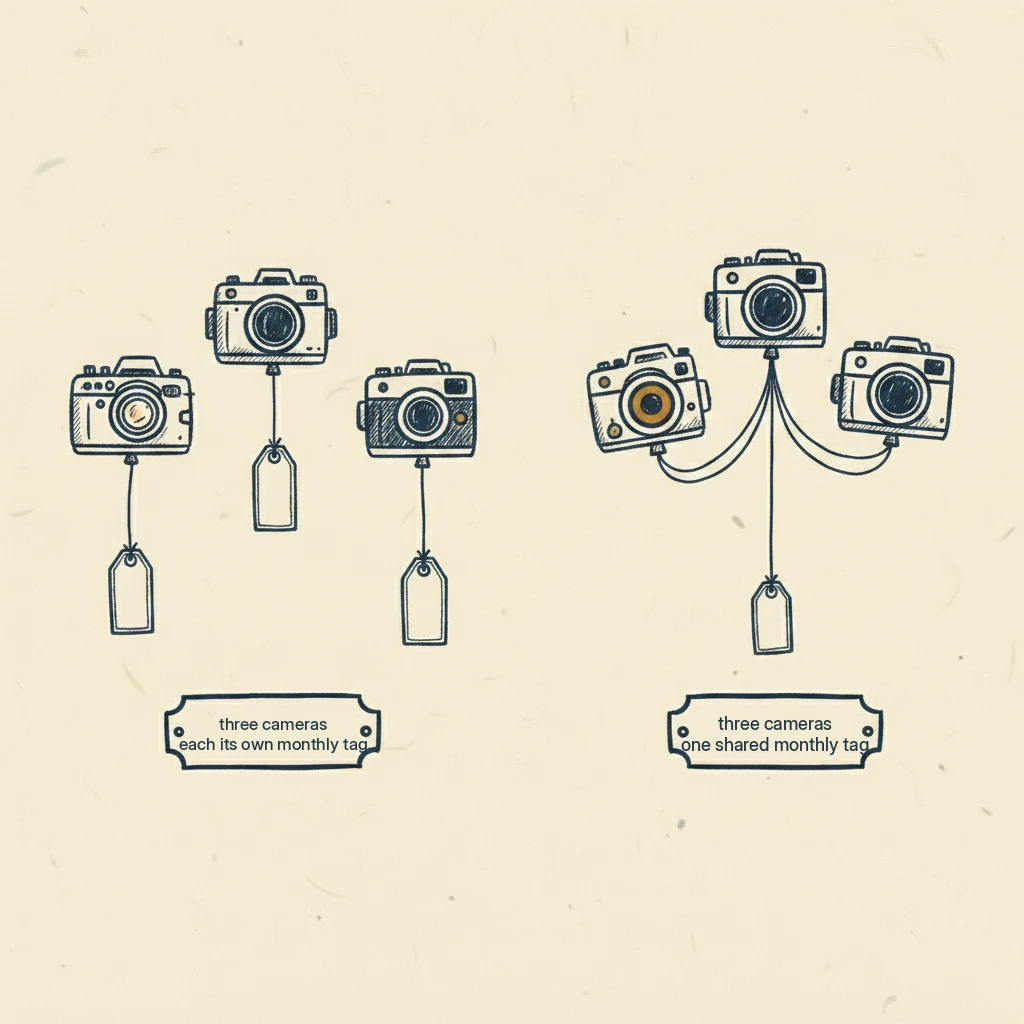
Most brands bill the plan for each camera you run. So the plan you compared for one camera isn’t the plan you pay for three. Say you’re watching a driveway, a gate, and a back shed. On a flat per-camera brand like Moultrie, three cameras on the roughly $13 Unlimited tier is about $39 a month, three times over. On GardePro’s shared-pool Standard, three cameras is about $10 plus $7 plus $7, so around $24 a month drawing on one data balance. Same three cameras, very different bill. That’s why the cheapest brand for one camera is often not the cheapest brand for three, and it’s the comparison almost no page bothers to make.
The sticker isn’t the price
Let me show you what a plan does to the real cost over three years, because three years is the honest window for a thing you mount and forget.
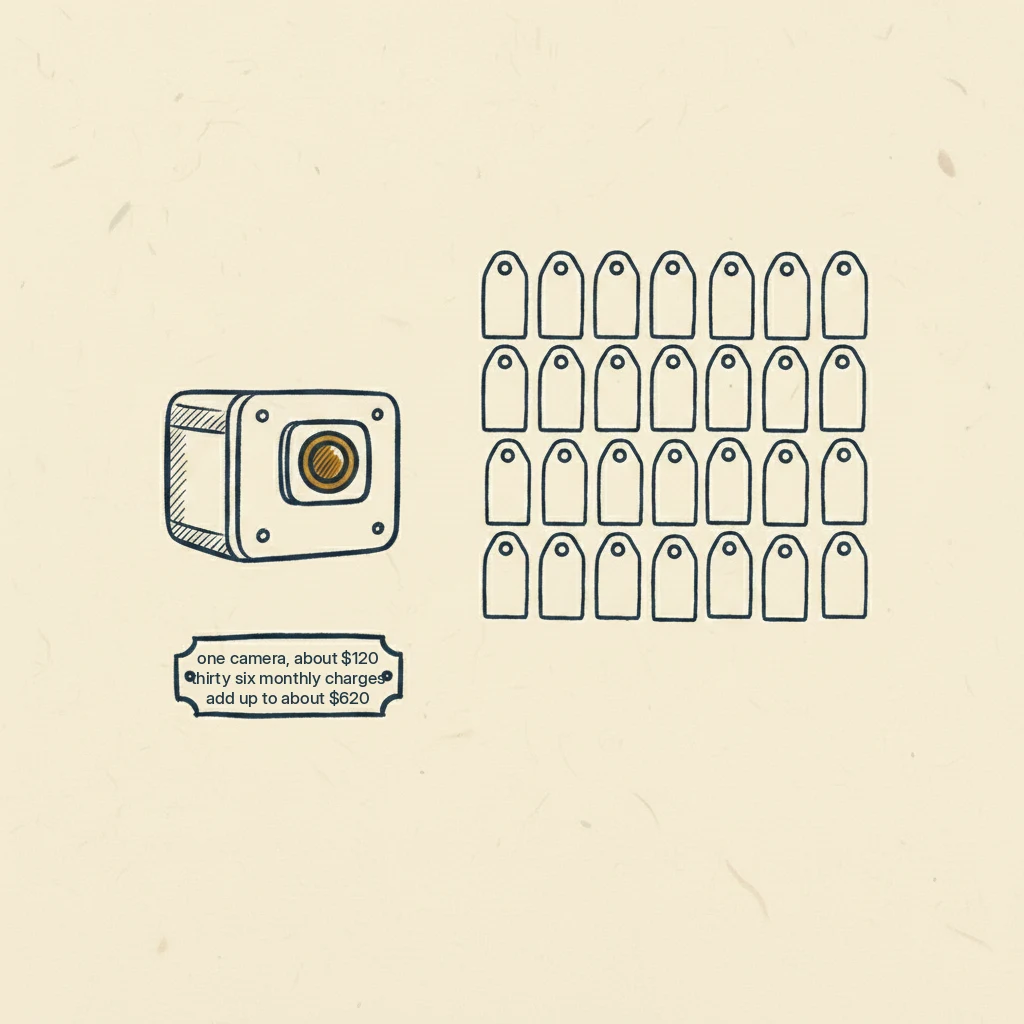
Take a SPYPOINT Flex-M, about $80. Run it on the free tier and after three years you’ve spent $80, full stop, as long as a hundred photos a month is enough. Run that exact same camera on the unlimited plan and after three years you’ve spent around $620. Same camera. The plan is the price. A Moultrie Edge on the Unlimited plan lands near $590 over three years. Meanwhile a plain SD-card camera like the Browning Recon Force Elite HP5, about $180, costs you $180 and never asks for another dime, because it doesn’t send anything and can’t take a plan.
Look at that spread. The two cheapest three-year answers on the whole shelf, an $80 camera on a free tier and a $180 camera with no plan possible, are the two nobody advertises, because neither one makes anybody a monthly check.
The escape hatch: you may not need a plan at all
Here’s the sentence the independent reviewers put plainly, and the sellers don’t: “The camera itself will still trigger and save images to the SD card without a subscription. But it won’t send anything to your phone without an active plan.”
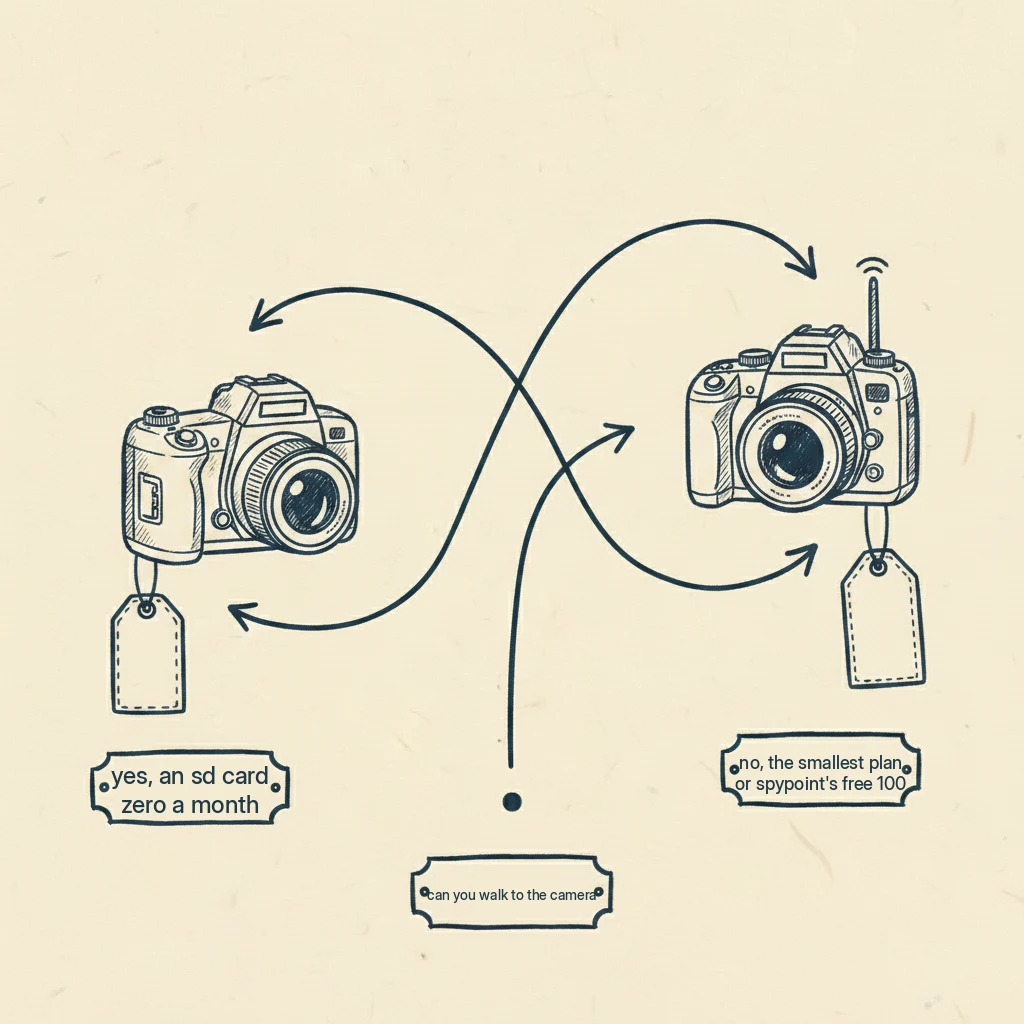
Read that twice, because it changes the question. The plan buys you exactly one thing: not walking to the camera. The pictures still get taken and stored either way. For a gate a quarter mile down a dirt road, not walking is worth real money every month. For a driveway you pass on your way to the mailbox, not walking might be worth nothing at all, and pulling the card once a week is the entire cost.
There’s one honest complication I won’t paper over. That “SD card still works” rule is the general case, but it isn’t universal. Moultrie’s own plans page states flatly: “All connected devices require a paid plan to operate.” So at least one major brand ties the whole device to a paid plan, card or no card. That means you can’t assume the free path exists on every camera. Check the specific model’s terms before you count on saving anything to a card without a subscription.
A few plan traps worth naming
The annual-billing nudge. Paying for a year up front saves money only if the camera’s actually up all year. A seasonal watcher can end up paying for months of a spot he isn’t watching.
Tier padding. The unlimited-with-video top tiers exist to sell video volume. Most property watching is a handful of motion stills a day, and that’s my judgment about typical use, not a claim about yours. If that’s your pattern, the cheapest paid tier or a free tier likely covers it, and the big plan is money spent on capacity you won’t touch.
The audio and property question. These cameras can record sound, and the rules on recording, on audio, and on where a camera may point, especially near a property line or a neighbor’s land, vary from state to state. I won’t tell you what your rules are, because they depend on where you live. Just check your own state’s before you mount one.
One thing I genuinely can’t tell you yet: whether any affiliate arrangement pays a site like this a cut of the plan revenue, as opposed to the one-time camera sale. That’s the money that actually flows on a page like this, and it’s stated nowhere I can see. I’d rather flag that I don’t know than pretend I do.
Questions people actually ask
Which trail camera plan is cheapest?
For a free option, SPYPOINT is the only major brand with a real free tier, 100 photos a month per camera. For the cheapest paid plan, Stealth Cam’s Standard runs about $4 a month for 600 photos. But “cheapest” depends on how many cameras you run, because most plans are billed per camera and multiply with each one you add.
Do I have to pay a subscription for a trail camera?
Only if you want the pictures sent to your phone. The general rule is that a cellular camera still saves everything to its SD card without a plan, so you can retrieve the card by hand for free. The catch is that at least one brand, Moultrie, states its cameras need a paid plan to work at all, so check your specific model’s terms.
What does “per camera” mean on a trail camera plan?
It means the monthly fee is charged for each camera separately. A plan that’s $13 a month covers one camera; run three and you’re paying that three times, around $39 a month. GardePro is the exception, billing a discounted rate for extra cameras that share one pool of data, which can change which brand is cheapest once you own more than one.
How much does a trail camera really cost over time?
Far more than the sticker if it’s cellular. The same $80 SPYPOINT costs $80 on the free tier or around $620 over three years on the unlimited plan. The camera is close to a loss-leader; the subscription is the real product. Price three years, not the box.
What I’d do before I compared a single plan
So here’s where I’d start, and it’s not with the plans. I’d ask whether I need a plan at all. For one gate I pass every day, a plain SD-card camera or SPYPOINT’s free hundred photos a month may be the whole answer, and that’s about the cheapest peace of mind there is. If I did need the pictures sent to me, I’d price three years and not the sticker, and I’d watch the words “per camera” like a hawk, because that phrase, not the box price, is what this hobby actually costs over time.
If you’re still choosing the camera itself, the best trail camera for security is the pick, and security camera vs trail camera sorts out whether a trail camera is even the right kind. For a spot with no WiFi at all, a driveway camera without WiFi lays out the paths, and if you care whether the camera glows at night, no-glow vs low-glow is the one to read.
Ray Ostrander
Ray spent three decades explaining the sky to twelve-year-olds and their parents, and every January, hearing which Christmas telescopes ended up in the closet. He doesn't own a wall of gear and won't pretend to. He reads everything, tells you what owners agree on, and flags what's just his judgment. His goal is simple: no more January closets.