
Best Trail Camera for the Money: Why the Cheap One Costs More
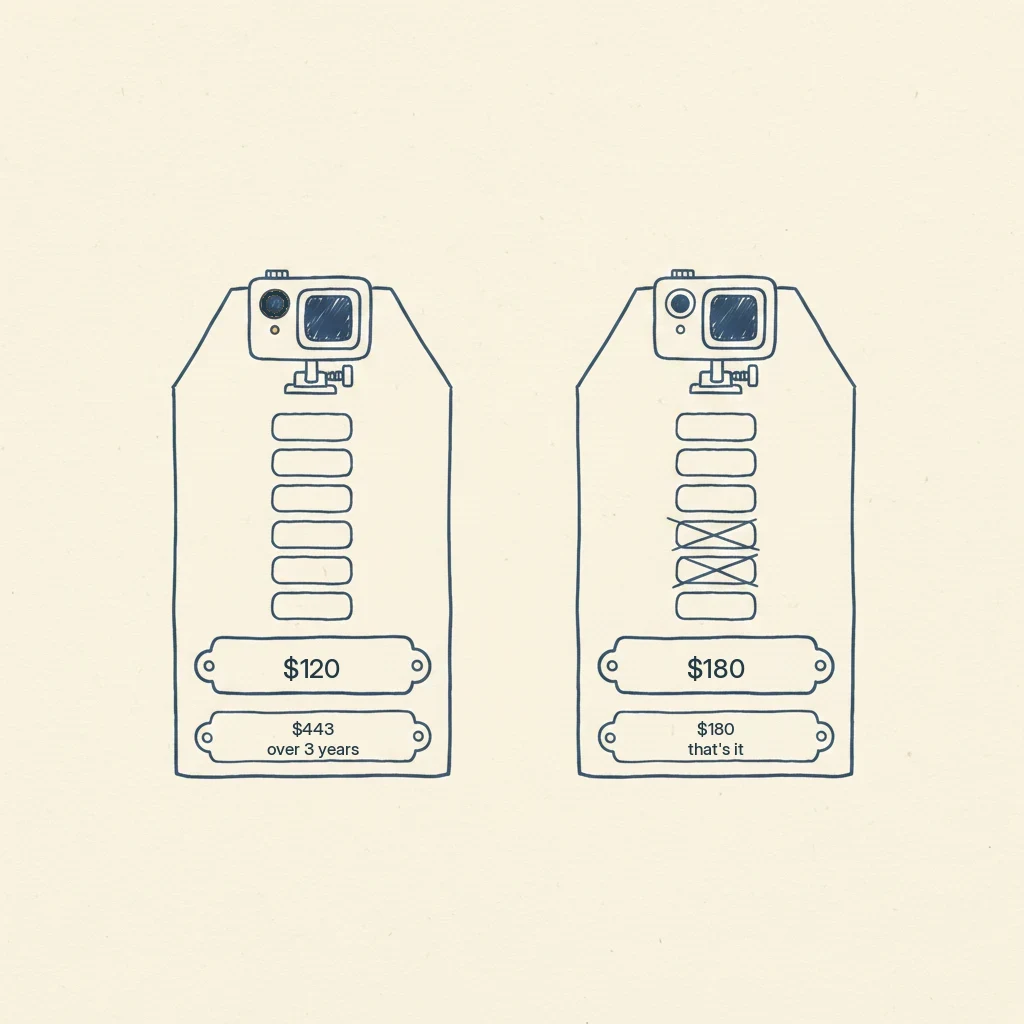
For the money is a multiplication, not a sticker price. A cellular trail camera can't run without a paid plan, roughly $9 to $23 a month per camera, so a $120 camera can cost $443 over three years. An SD-card camera like the Browning HP5, about $180, has no monthly fee at all. If you can walk to it, the expensive camera is the cheap one.
 Ray Ostrander · Updated July 24, 2026 · how I decide
If you buy through a link here, the site earns a little. It's never why anything gets picked.
Here’s the number pair that decides this whole thing. A cellular trail camera can’t work without a paid plan, roughly $9 to $23 a month per camera, so a $120 cellular camera really costs about $443 over three years at the cheapest plan. An SD-card camera like the Browning Recon Force Elite HP5, about $180, has no monthly fee ever. Which means the most expensive camera on the shelf is often the cheapest one to own, and the one that looks like a bargain is the one that quietly bills you every month. “For the money” is a multiplication problem, and almost every page ranking these cameras is doing one-year addition.
What's on this page
What “for the money” actually asks
The phrase you typed is a value-anxiety phrase, not a spec phrase. You’re not asking which camera has the most megapixels. You’re asking how not to get taken. Good instinct. The trouble is that the pages built to answer that question are answering a different one: which camera is cheapest to buy. That’s not the same as which is cheapest to own, and on cellular cameras those two numbers are wildly far apart.
So let me do the arithmetic nobody on that first page of results bothered to do, using prices you can check, and let you see the sum instead of asking you to trust it.
Here’s what’s actually happening: the plan isn’t optional
This is the sentence that makes this page necessary. Moultrie states it on its own plans page, flatly: “All cellular connected devices require a paid subscription to operate.”
Read that again. The camera doesn’t work at all without the plan. So the $120 you pay for a cellular camera isn’t the price of a camera. It’s the price of a key to a lock that costs about $108 a year to keep unlocked, forever. The camera is close to a loss-leader. The plan is the actual product you’re buying, the same way a printer is really a way to sell you ink.
Once you see that, the whole shelf reads differently. Let me put real three-year numbers on it.
The three-year math
Every camera price and plan price below is a first-party number you can verify. The totals are just multiplication, done in the open. I’m using a three-year window because it’s a fair span for a thing you mount and forget, but that window is my choice, not the industry’s, so I’ll show you the yearly figure too and you can pick your own span.
A Moultrie Edge 2 Pro at about $120, on the cheapest Standard plan of about $9 a month, comes to roughly $443 over three years. Put it on the $13 Unlimited plan and it’s about $588. A Tactacam Reveal Pro 3.0, also about $120, on a plan starting around $5 a month, lands near $300. A SPYPOINT Flex-M, about $80, run on its free tier, costs you $80 and nothing after, though I’ll come back to what “free” really means. And the Browning Recon Force Elite HP5, about $180, an SD-card camera with no cellular at all, costs $180 and never asks for another dime.
Look at what that does to the ranking. The Moultrie that looks $60 cheaper than the Browning is actually about $264 more expensive over three years, and that’s at its cheapest plan. The bargain was the expensive one all along.
The one question that picks your winner
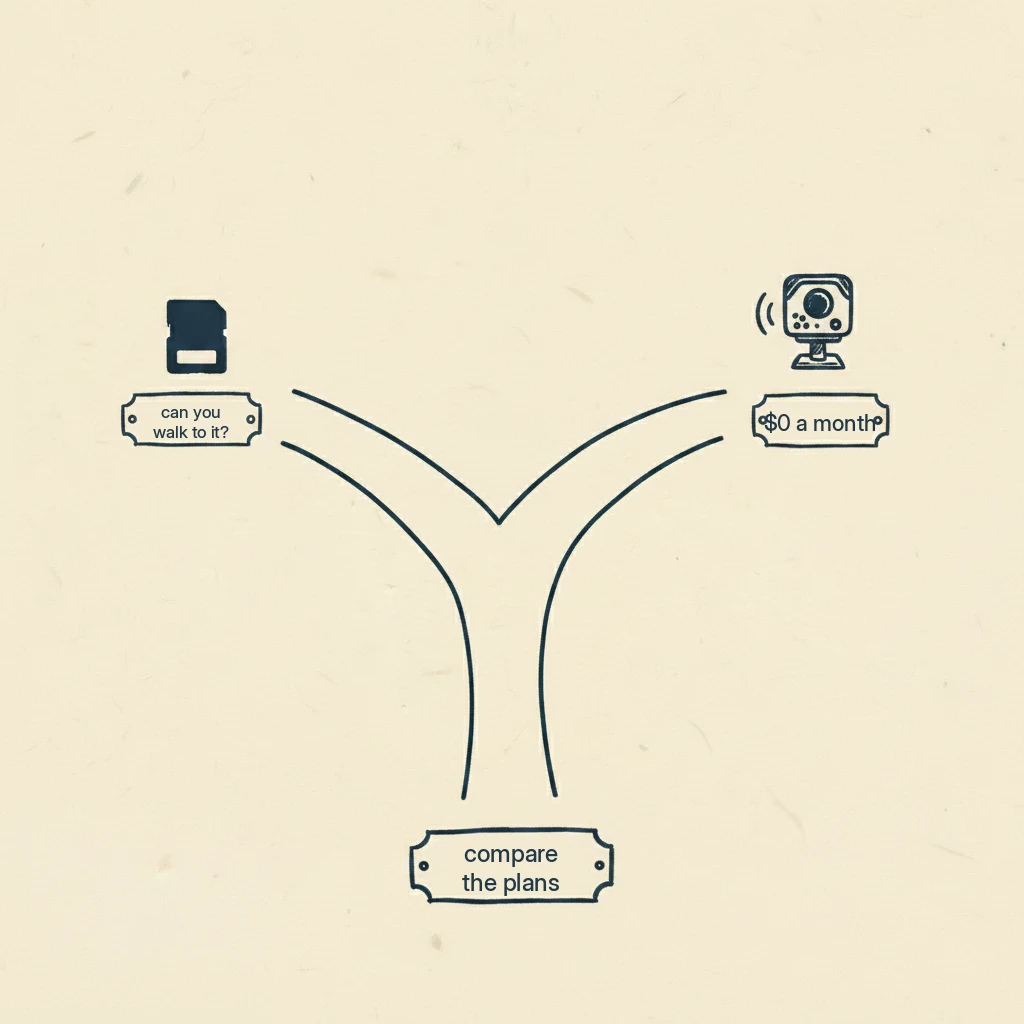
The best value here isn’t a camera. It’s a question: can you walk to it?
If you can walk to it, and if you’re watching your own driveway or your own back fence, you almost certainly can, then the SD-card camera wins outright. About $180 once, and zero forever. Here’s the thing that makes this clean. The whole reason the hunting reviews knock SD-card cameras is that you have to walk in to pull the card, which leaves scent and, in their words, risks educating mature bucks. That’s a real cost to a deer hunter. It’s worth exactly nothing to a man walking out to his own driveway. The shelf’s deciding criterion doesn’t apply to you, which is precisely why the shelf’s “best value” pick is the wrong one for your yard.
If you genuinely can’t walk to it, a remote gate, a cabin, a second property with no easy access, then you’re into cellular, and now the plan is the product. Tactacam and SPYPOINT start their plans around $5 a month, under Moultrie’s roughly $9 floor, and SPYPOINT has a genuine free tier. At that point the plan comparison, not the camera, is where your money lives, and that has its own page.
Two honest cautions before you spend
“Per camera” doubles quietly. That plan cost, about $9 to $23 a month, is charged for each camera. Watch a driveway and a back gate on two cellular cameras and you’ve just doubled a recurring bill you may not have realized you were signing up for. It’s the single most expensive thing a first-time buyer misses on this shelf.
“Free” has a ceiling. SPYPOINT’s free tier is real, and it’s 100 photos a month per camera. That’s genuinely free, and it’s genuinely only 100 photos. For one quiet gate it may be plenty; for a busy spot it’ll run out mid-month. I can’t tell you exactly what happens when you hit photo 101, because no source I trust says, and I’m not going to guess.
About that wall of “best of” lists
One more thing, because it’s the water you’re swimming in when you search this. Eight of the nine pages on the first page of results are template lists with a number in the title, 12 Best, 13 Best, 15 Best, several from websites with no visible connection to the outdoors at all. One boasts of “12 Field-Tested Models.” Another claims it tested a dozen cameras across four locations and analyzed over 15,000 images. One of those domains is, at the same time, the self-declared “expert” on microscopes for soldering. The same content farm reviews trail cameras and soldering scopes with equal confidence.
I’ll be straight with you about my own position, because it’s the honest counter to all that. Nobody at this site has hung one of these cameras on a tree. I haven’t tested them, and I won’t pretend I did. What I’ve done is read the vendors’ own pages, pull the real prices and the real plan terms, and do the arithmetic in front of you. On a page full of people claiming field tests that may never have happened, a man who says plainly that he didn’t test them and shows you his sources instead is, oddly enough, the more trustworthy voice. That’s not a boast. It’s just how thin the rest of the shelf is.
A fair note on my own recommendation, too. The one camera I keep pointing you toward, the SD-card Browning, is a brand this site has no money arrangement with that I’ve checked. The camera whose economics I’m criticizing hardest is the one with the affiliate program I do know about. I’m telling you to buy the one that likely earns this site nothing extra, because that’s where the evidence lands. That’s the deal here, always: the evidence picks the answer, and the money follows it or it doesn’t.
One last plain word, on the rules rather than the money. These cameras can record audio, and the rules on recording, on audio, and on where a camera may point, especially near a property line or a neighbor’s, vary from state to state. I won’t tell you what yours are, because they depend on where you live. Check your own before you mount one.
Questions people actually ask
What’s the cheapest trail camera to own?
To own, not to buy, an SD-card camera with no cellular, like the Browning HP5 at about $180. It has no monthly plan, so its three-year cost is its purchase price, full stop. A cheaper-looking cellular camera can cost two to three times as much over the same span, because the plan it requires runs about $9 to $23 a month per camera.
Why does a cheaper trail camera cost more in the end?
Because a cellular camera can’t function without a paid subscription, and that plan runs every month for as long as you own the camera. A $120 cellular camera plus a $9 monthly plan is about $443 over three years. The $180 SD-card camera is $180, period. The sticker hides the subscription, and the subscription is where the real money is.
Do I need a cellular trail camera or an SD-card one?
Ask whether you can walk to the camera. For your own driveway or fence, you can, so an SD-card camera wins: no monthly bill, and the only “cost” is a short walk to grab the card. Cellular earns its plan only when the camera is somewhere you truly can’t reach easily, like a remote gate or a second property.
Is SPYPOINT’s free plan actually free?
Yes, and it’s limited. It’s 100 photos a month per camera at no charge, which is real, but it’s a small allowance. For a low-traffic spot it can be all you ever need; for a busy one it’ll run out before the month does. Just size it against how often your spot actually sees motion before you count on it.
What I’d buy with my own money
So here’s where I’d land, plainly. If I could walk to the spot, and for a driveway I can, I’d buy the SD-card camera, pay once, and never think about it again. The pricier sticker is the cheaper life. If the spot were somewhere I truly couldn’t reach, I’d go cellular and then shop the plan harder than the camera, because the plan is what I’d actually be paying for over the years. Either way, I’d price three years, not the box, and I’d read the words “per camera” like they cost money, because they do.
If you’re not sure a trail camera is even the right tool, security camera vs trail camera sorts that out first, and the best trail camera for security is the hub for this whole corner. For the no-WiFi angle, a driveway camera without WiFi says the same thing from the other side, and if you land on cellular, trail camera subscription plans compared is where the plan money gets counted. The same “for the money” logic runs the optics aisle too, over on best binoculars for the money and best spotting scope for the money.
Ray Ostrander
Ray spent three decades explaining the sky to twelve-year-olds and their parents, and every January, hearing which Christmas telescopes ended up in the closet. He doesn't own a wall of gear and won't pretend to. He reads everything, tells you what owners agree on, and flags what's just his judgment. His goal is simple: no more January closets.