
Security Camera vs Trail Camera: One Question About Your Spot Decides It
If the spot has power and a WiFi or cell signal, a security camera does more for the money: it records all the time and sees wider. A trail camera is the right tool in one case, a spot with neither, where it wakes only on motion and the footage is harder to read faces from.
 Ray Ostrander · Updated July 24, 2026 · how I decide
If you buy through a link here, the site earns a little. It's never why anything gets picked.
Here’s the short answer before we go anywhere. If the spot you want to watch has power and a reliable WiFi or cell signal, a security camera does more for the money: it records continuously instead of only when something moves, and it sees a much wider slice of the yard. A trail camera is the right tool in exactly one situation, a spot with neither power nor WiFi, where it runs on a battery and mails you pictures over a cell signal. The catch on the trail-camera side is that it only wakes on motion, and its video is lower resolution, so faces and license plates are harder to make out.
What's on this page
- This isn't really a fight between two products
- Here's what's actually happening: two questions, not two aisles
- Don't take my word for it: the makers draw the same line
- The four differences that actually decide it
- The one caveat that cuts the trail-camera way
- The honest cost, both directions
- One thing to check before you mount either one
- Questions people actually ask
- What I'd do with a spot to watch
This isn’t really a fight between two products
Notice what you typed. You put the two names side by side because nobody has told you which question decides between them. So let me tell you: it isn’t which camera is better. It’s which one fits the spot you have. Answer that, and the camera picks itself.
The reason the reviews feel slippery is worth knowing. Nearly every page that comes up when you search this sells a camera, and most of them sell only one of the two kinds. So each one leans its verdict toward the thing it happens to make. A neutral page that sells neither and just asks you the two questions that matter is the hard one to find. That’s this one.
Here’s what’s actually happening: two questions, not two aisles
Before you spend a dollar, answer these in order.
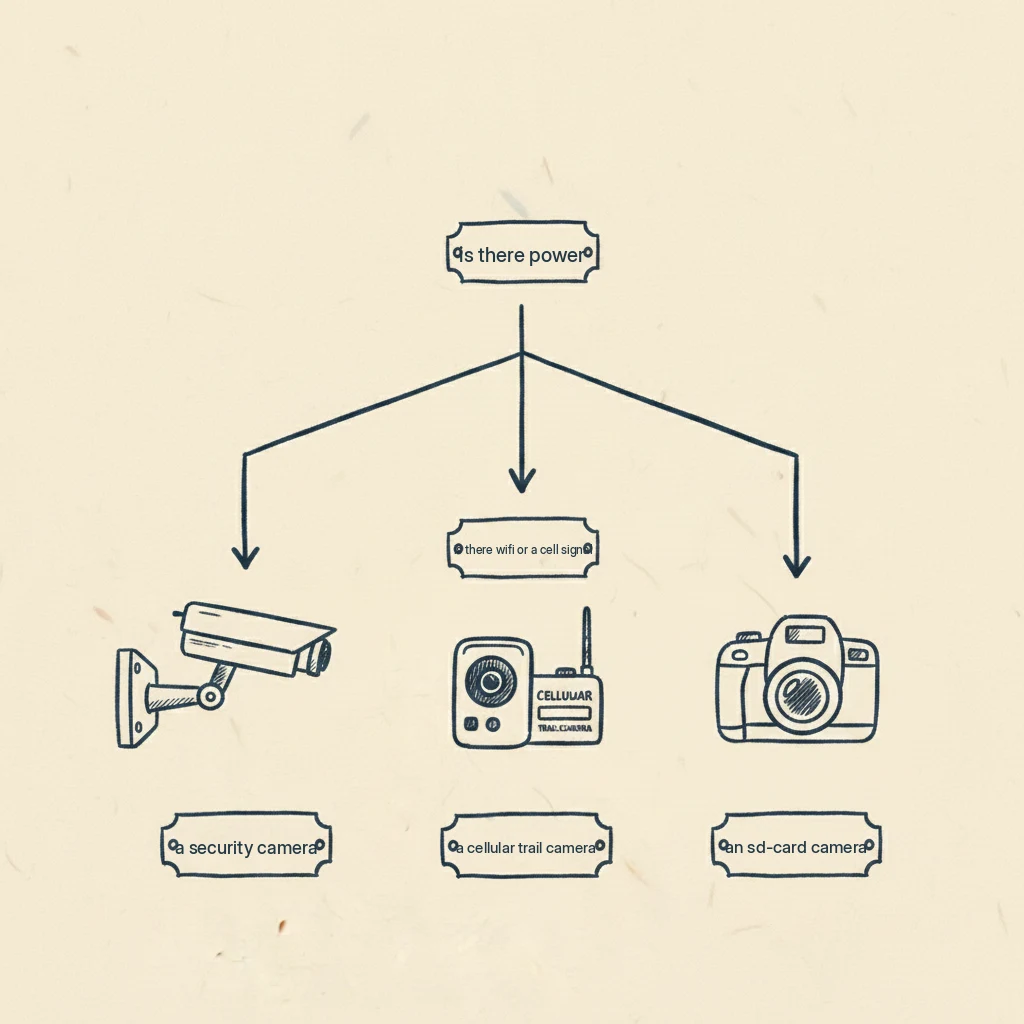
First: is there power and a WiFi signal where you need to watch? If yes, a security camera is your tool. It plugs in, joins your network, records around the clock, and sees wide. This is your front door, your garage, your driveway, your backyard, the ordinary spots close to the house.
Second, only if the answer to the first was no: is there at least a cell signal out there? If there’s a cell signal but no WiFi and no easy power, a cellular trail camera is the right answer. It runs on batteries and uses the same kind of signal your phone does to send its pictures. This is the gate a quarter mile down the road, the shed at the back of a rural lot, the fence line with nothing out there but posts.
And if there’s no cell signal either, there’s still a simpler kind of trail camera that saves everything to an SD card. No signal needed, no monthly cost, but you have to walk out and pull the card yourself to see what it caught.
Don’t take my word for it: the makers draw the same line
This is the part that ought to settle it. Ask the vendors directly and they say it plainly: you can absolutely use a trail camera for home security, but if security is the job, they recommend actual security cameras, because that’s what those are built for. That’s the people who sell trail cameras telling you when not to buy one.
The clearest tell of all is structural. Tactacam, which makes one of the best-known trail cameras, sells a completely separate security-camera line right next to it. Two families, named differently, by the one company that makes both. When the manufacturer draws the same line I’m drawing, you can trust the line.
The four differences that actually decide it
Here’s what separates the two, in plain terms.
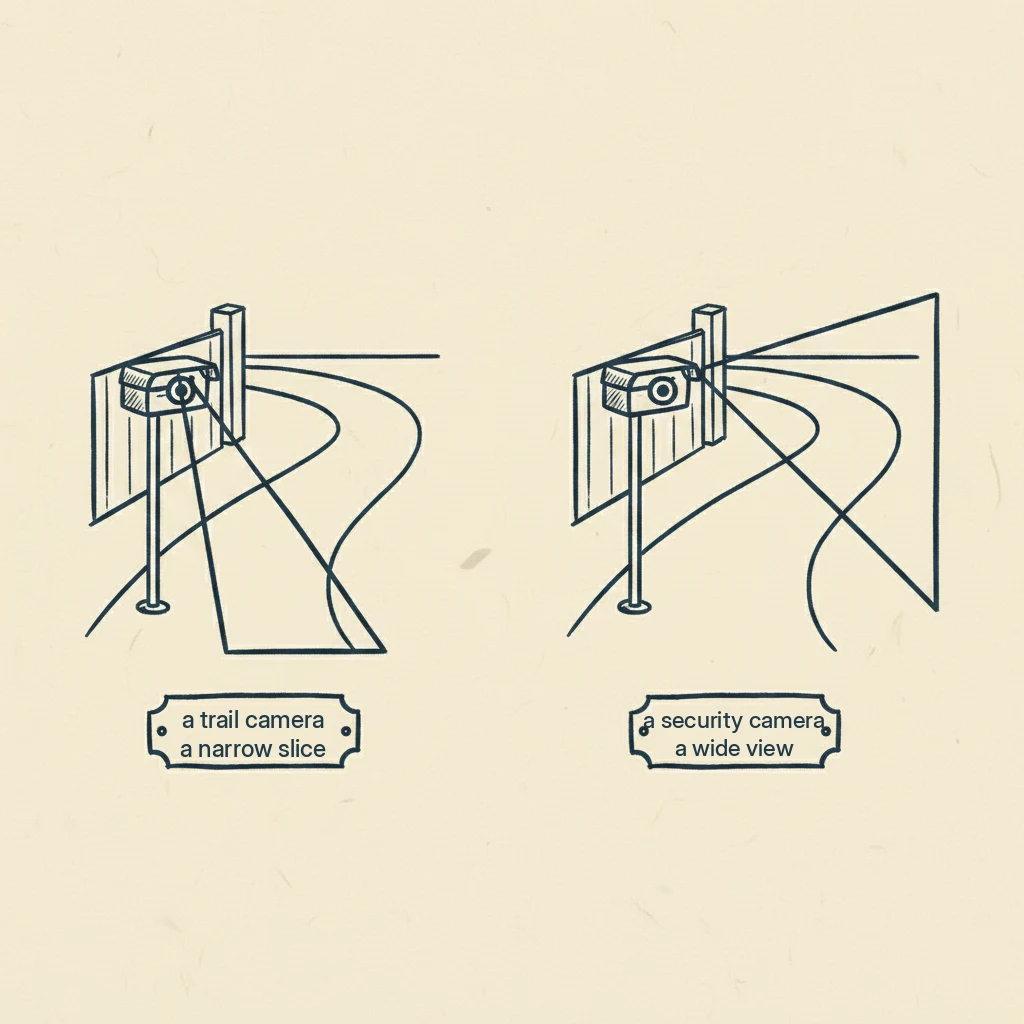
How much they see. A trail camera usually has a narrow field of view, roughly 40 to 60 degrees. A security camera often runs 180 degrees or more, sometimes with wide-angle or dual lenses. That gap hides a cost most people miss: to cover the same area one wide security camera watches, you might need to buy and mount several trail cameras. The narrow view is the quiet spec that matters.
When they record. A security camera can record continuously, all day and night, or watch live. A trail camera captures only when it detects motion, to save its battery. That’s the trade that lets it run for months off-grid, and it’s the same trade that lets it miss whatever happens between triggers.
What they run on. A trail camera is battery-powered and stores to an SD card, or sends over a cell network. A security camera leans on WiFi or wired power, cloud storage, and sometimes a recorder box. Different set of strings, and your spot decides which set it can already carry.
Who they’re for. Security cameras are built for the front door, the driveway, the garage, the backyard, the places near the house with power and a network. Trail cameras earn their keep at remote gates, barns, cabins, long driveways, the places where WiFi, power, or phone signal are weak.
The one caveat that cuts the trail-camera way
If your goal is knowing who, not just that something happened, be honest with yourself here. Trail-camera video is lower resolution than a dedicated security camera’s, and the people who make these say so directly: it can be harder to identify faces or license plates in detail. Not impossible, and the newer models take sharp high-megapixel stills, but harder. A camera that reliably tells you someone was there at 2am but can’t tell you which someone hasn’t fully solved the problem. It’s more of a “something happened” tool than a “here’s exactly who” tool, and a driveway close to the house, with power and WiFi, is exactly where a security camera does that identification job better.
The honest cost, both directions
One thing I won’t do is quietly steer you to the cheaper camera by hiding its costs. Neither kind is free after the box.
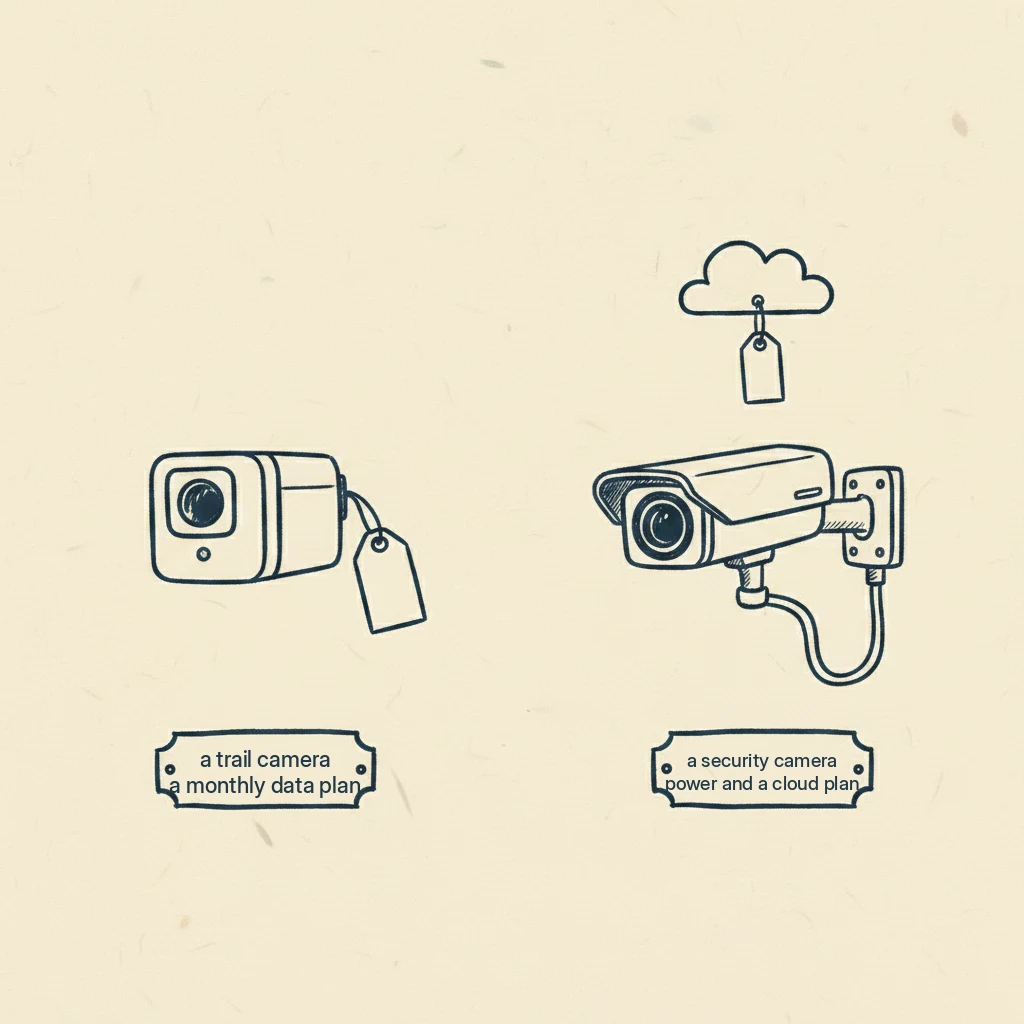
The trail camera’s hidden cost is the subscription. A cellular one needs a data plan to send its pictures, monthly, per camera. Moultrie, for one, states flatly that its cellular cameras require a paid subscription to work at all. So the camera price is only the down payment. The full math on that, and the cheaper free-tier and SD-card paths around it, has its own page.
The security camera’s hidden cost is the infrastructure. It leans on power, a network, and often a cloud storage plan you pay for. I’m not going to put a dollar figure on that here, because I don’t have a fair, current number for it in front of me, and I’d rather flag that than guess.
So the fair frame is this. Neither one is free after purchase. The trail camera bills you monthly to mail you pictures. The security camera asks for power, a network, and often a cloud plan. The real question is which set of strings your spot can already carry.
One thing to check before you mount either one
I’ll be plain and brief here, because it isn’t my place to give you legal advice. Several of these cameras record sound as well as pictures, and the rules on recording, on audio, and on where a camera may point, especially near a property line or a neighbor’s land, vary from state to state. I’m not going to tell you what your rules are, because they depend on where you live and I’d be guessing. Just check your own state’s before you put one up, not after.
Questions people actually ask
Can I use a trail camera as a security camera?
You can, and in the right spot it works well. That spot is one with no power and no WiFi, like a remote gate or an outbuilding. If the area has power and WiFi, a regular security camera gives you continuous recording, a wider view, and clearer images, and the trail-camera makers themselves recommend going that way.
Which is better for home security, a trail camera or a security camera?
For a typical driveway or yard near the house, a security camera is generally the better choice: it records all the time, sees wider, and makes faces and plates easier to read. The trail camera wins only when the spot is remote or lacks power and WiFi. Answer the power and signal questions first and the choice makes itself.
Do trail cameras record all the time like security cameras?
No, and this is the core difference. A security camera can record continuously or watch live. A trail camera fires only when it detects motion, to save battery, so it can miss whatever happens between triggers. That off-grid battery life is exactly what you trade for the always-on recording.
Can one trail camera cover my whole yard?
Often not. A trail camera sees a narrow 40 to 60 degree slice, where a single security camera can cover 180 degrees or more. To watch the same area you might need several trail cameras, which is a real cost worth counting before you assume one will do it.
What I’d do with a spot to watch
So here’s where I’d land. Before I spent a dollar, I’d answer two questions. Is there power at the spot, and is there a signal, WiFi or at least cell. If both are there, I’d buy a security camera and get clearer, always-on footage for less over the years. If neither is there, a cellular trail camera is a genuine answer, and a good one, as long as your phone gets bars where you plan to mount it. Answer the power question and the signal question first, and the camera picks itself.
If your fork landed on a trail camera, the next thing worth reading is the best trail camera for security, and if the spot has no WiFi at all, a driveway camera without WiFi walks that path. When you’re ready to count the real monthly cost, trail camera subscription plans compared does the math, and if you’re wondering whether the camera lights up at night, no-glow vs low-glow is the one to read.
Ray Ostrander
Ray spent three decades explaining the sky to twelve-year-olds and their parents, and every January, hearing which Christmas telescopes ended up in the closet. He doesn't own a wall of gear and won't pretend to. He reads everything, tells you what owners agree on, and flags what's just his judgment. His goal is simple: no more January closets.