Binoculars for Hiking: It's Really a Question About Five Ounces
For hiking you want 8x25 to 8x32. 8x is the power you can hold steady, a 25mm pair weighs about ten ounces and a 32mm about fifteen, and that five ounces comes straight out of the light: small is right for daytime, dimmer at dawn.
 Ray Ostrander · Updated July 24, 2026 · how I decide
If you buy through a link here, the site earns a little. It's never why anything gets picked.
For hiking, go 8x25 to 8x32. Eight-power is the one setting you can hold steady when you’re out of breath, on uneven ground, halfway up a slope. A 25mm pair weighs about ten ounces, a 32mm pair about fifteen, and that five ounces is the whole decision: the weight you save comes straight out of the light. A 25 is dimmer at dawn and dusk, which is exactly when animals show up.
A good concrete starting point is an 8x25 like the Celestron Outland X, about $70 as I write this. But the pick matters less than understanding the trade, so let me show you the trade.
What's on this page
- You've already decided it has to be small
- The ounces come straight out of the light
- Five ounces, and what's on each side of it
- Should you carry them at all?
- What breaks this: the carry system
- The trap: the cheapest compact is the wrong one
- The lightest real answer isn't a binocular
- Questions people actually ask
- What I'd tell you at the trailhead
You’ve already decided it has to be small
Look at how people search for this: compact binoculars for hiking, best compact, small binoculars for hiking. You didn’t type “which binocular.” You typed “how little can I get away with.” That’s a weight question wearing an optics question’s clothes, and it’s the right instinct. A person who counts ounces on a tent counts them on optics too.
So this page isn’t going to talk you into more binocular. It’s going to tell you exactly what the small one costs you, in the currency you already think in.
The ounces come straight out of the light
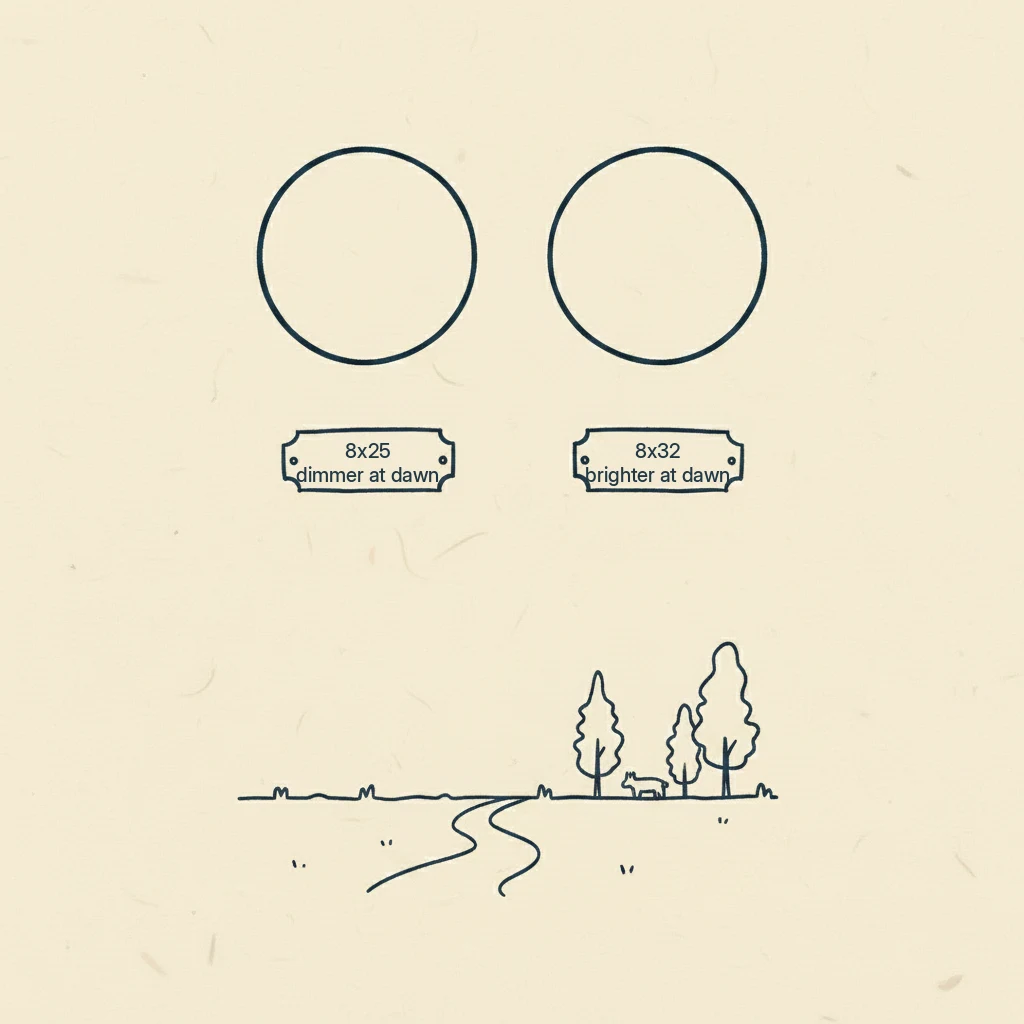
Divide the lens width by the power and you land on the exit pupil, the round patch of light that reaches your eye. The wider that patch, the brighter the view.
An 8x25 gives you a 3.1mm circle. An 8x32 gives you 4mm. That doesn’t sound like much until it’s twenty minutes before sunset and a deer steps out of the treeline. The 4mm view is noticeably brighter in poor light. The 3.1mm view is fine at noon and thin at dusk.
Here’s the part the shelf won’t tell you: the one hiking page that actually lists weights says nothing about this at all. It quantifies the cost of the binocular, in ounces, and never mentions the cost of going small, in light. So you get half the trade. Here’s the other half: the ounces you save on your back come out of what you can see when it matters most.
Five ounces, and what’s on each side of it
This is the entire decision, in one table. These are stated weights from a backpacking reviewer, one source, so treat them as a guide rather than gospel:
| model | weight |
|---|---|
| Nikon Trailblazer 8x25 | 9.9 oz |
| Zeiss Terra ED 8x25 | 10.9 oz |
| Maven C.2 7x28 | 12.4 oz |
| Vortex Vanquish 8x26 | 12.7 oz |
| Wingspan Scout 8x32 | 15.2 oz |
Read the top and bottom lines. Going from a 25mm to a 32mm objective costs you about five ounces. That’s the trade. Everything else on this page is commentary.
Now put the benefit in the same unit. Hikers who carry a light 8x25 describe it the same way: ten ounces they barely feel, and a peregrine falcon picked out at two hundred yards, worth every ounce in the pack. Hear the grammar. It isn’t about optics. It’s about ten ounces and one bird, the cost and the payoff in the same currency.
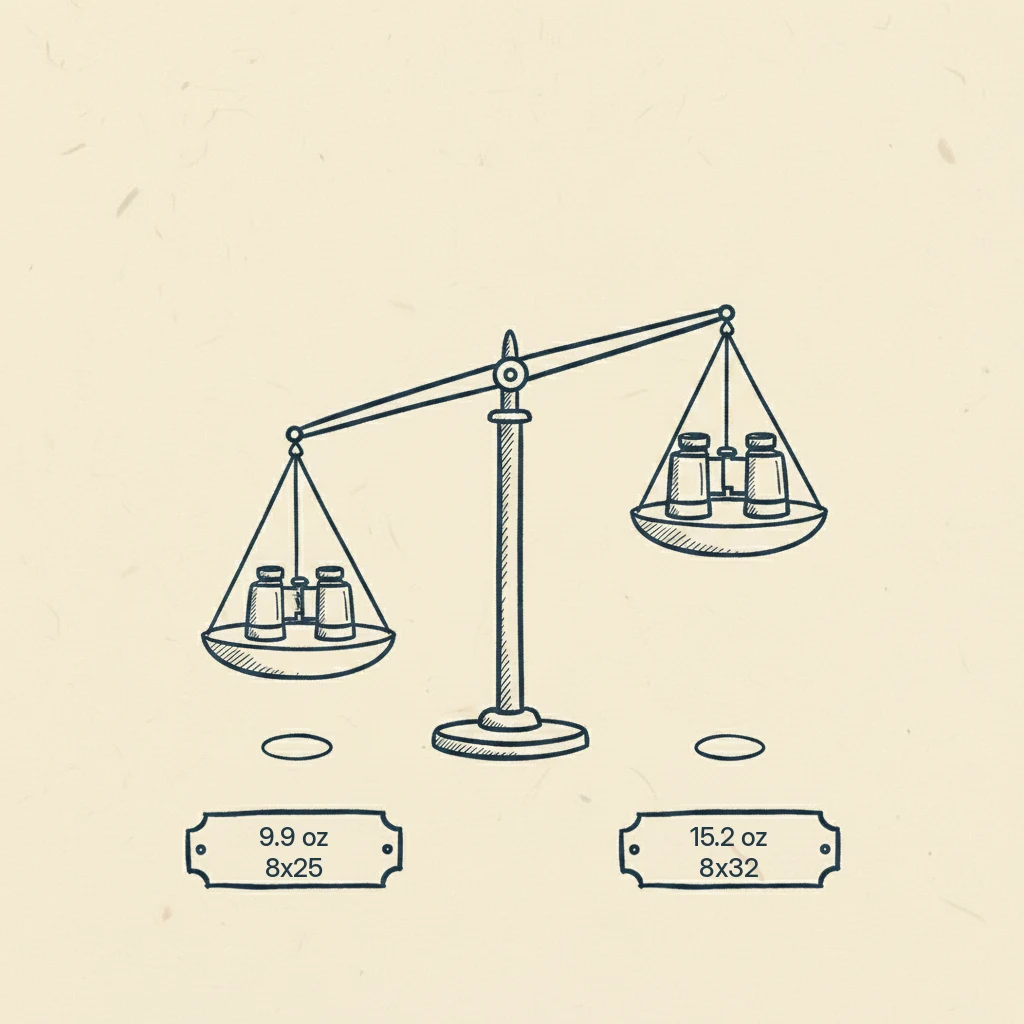
Ten ounces is a paperback. Fifteen is closer to a full water bottle. When you weigh it against the rest of your pack, that’s the actual size of the thing you’re deciding.
Should you carry them at all?
This is the honest question, and I’m not going to dodge it. The people who carry binoculars hiking put a condition on it: yes, if you’re into wildlife, navigation, or birding, a ten-ounce pair adds more than most gadgets do. Notice the “if.” Nobody says every hiker should carry binoculars, and I won’t either.
If you hike heads-down for the miles and the fitness, ten ounces of glass will ride in a drawer, not your pack. That’s fine. But if you’re the kind of hiker who stops for a hawk, or wants to read the ridgeline you’re headed for, this is one of the few things you carry that earns its weight in a single moment. Curiosity doesn’t owe you a lifetime commitment. You don’t have to become a birder to be glad you had the glass the day the falcon showed.
What breaks this: the carry system
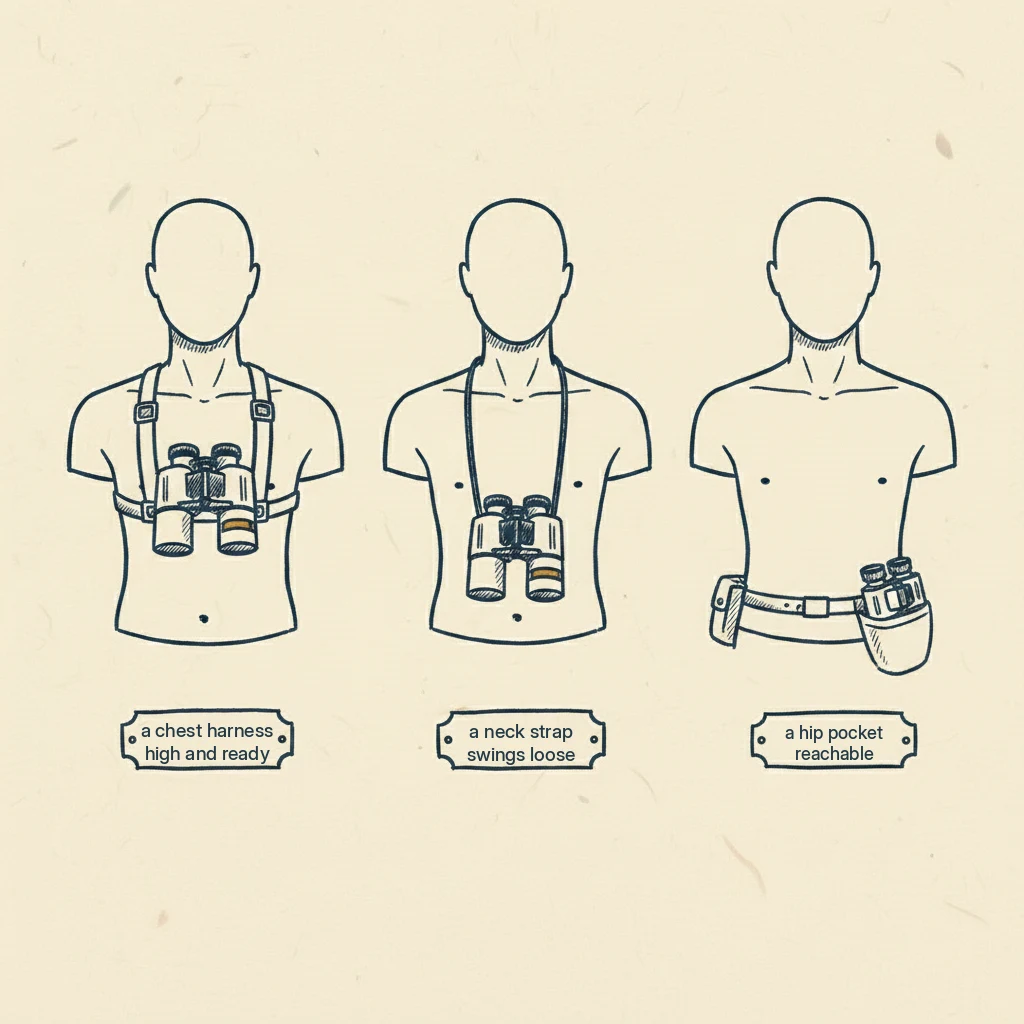
Here’s the failure that has nothing to do with the optics. The binocular that’s buried in the bottom of your pack, or bouncing on your chest with every step, gets left at home by the second trip. On this door, friction is literally weight, and the fix isn’t a different binocular.
It’s how you carry it. A chest harness holds the pair high and ready without hanging on your neck, and a side pocket or a hip-belt clip works too. Whatever keeps them within a two-second reach is what keeps them in your life. Buy the harness with the binocular, not after you’ve already learned this the hard way.
The trap: the cheapest compact is the wrong one
Search for a cheap compact and the best-seller that comes back is usually a 12x25, around $36. It’s tempting. It’s also specifically wrong for this door, for two reasons that are the same reason.
A 12x25 gives you only about a 2.1mm circle of light, the dimmest option there is, right when you need light most. And at 12-power in your hands, every breath you take is blown up into the view, so it never sits still, least of all when you’re winded on a climb. Cheapest isn’t right here. Cheapest is the one spec combination the physics argues against. Stay at 8x, and if you want a little more reach, know that a 10x25 still drops you to a 2.5mm circle. Not a scam, just a trade you should make on purpose.
The lightest real answer isn’t a binocular
If ounces are truly the thing, a monocular is half the weight of binoculars, and a decent one runs about $70 to $120. The honest catch, from owners: it’s harder to hold a single tube steady one-handed as your hands get older, and there’s less to choose from. It’s the lightest thing that still works, and there’s a whole page on when it’s the right call.
Questions people actually ask
What size binoculars are best for hiking?
8x25 to 8x32. Eight-power is steady enough to hold handheld when you’re winded on a slope, and the objective is where you spend your weight budget: a 25mm pair runs about ten ounces, a 32mm about fifteen. Go 25 if you hike mostly in daylight, 32 if you’re out at dawn or dusk, because the bigger lens is brighter exactly when you need it.
Are compact binoculars good enough for hiking?
For daytime, yes, easily. A quality 8x25 or 8x32 is all most hikers need and light enough to actually carry. The one honest limit is low light: the smallest compacts dim out at dawn and dusk. If your hiking is mostly midday, buy small with a clear conscience. If it’s mostly golden-hour, size up to a 32mm and carry the extra few ounces.
How much do hiking binoculars weigh?
A compact 8x25 lands around ten ounces, and a slightly larger 8x32 around fifteen. That roughly five-ounce spread is the real decision you’re making. For comparison, ten ounces is about a paperback. It’s little enough that the deciding factor usually isn’t the weight itself, it’s whether you have a comfortable way to carry them within reach.
Should I get binoculars or a monocular for hiking?
A monocular is about half the weight, so if grams rule, it wins on paper. The tradeoffs: it’s harder to hold a single tube steady, especially one-handed and especially as you age, and the selection is thinner. Binoculars are steadier and more comfortable for a long look. Pick the monocular for absolute minimum weight, binoculars for a better view.
What I’d tell you at the trailhead
Get an 8x25 if you hike in daylight, an 8x32 if you’re out when the light is low, and buy a chest harness in the same order so they never end up in a drawer. Ten ounces is a small tax, and some days it buys you a falcon at two hundred yards.
If you want to keep reading: binoculars for travel is the closest cousin to this page, and the line between them is simple. That page is about bulk in a bag, fitting the trip in a suitcase. This one is about ounces on your back, carried uphill. Same little binoculars, different arithmetic. There’s also monocular for bird watching for the lightest option of all, and best binoculars for the money for the value case laid out in full, anchored at the binoculars-by-situation hub. One caution before you cross-shop: binoculars for hunting reaches the opposite verdict and says skip the compact, and it’s right to, because hunting lives at dawn and dusk where the small lens goes dim. Same physics, different hour.
Ray Ostrander
Ray spent three decades explaining the sky to twelve-year-olds and their parents, and every January, hearing which Christmas telescopes ended up in the closet. He doesn't own a wall of gear and won't pretend to. He reads everything, tells you what owners agree on, and flags what's just his judgment. His goal is simple: no more January closets.