
Binoculars for Night Vision: What They Can and Can't Do in the Dark
Ordinary binoculars gather light, they don't create it. A 7x50 pair makes a moonlit night far brighter to your eye for about $48, but only a heat-reading thermal device sees in true darkness, and that's a very different budget.
 Ray Ostrander · Updated July 24, 2026 · how I decide
If you buy through a link here, the site earns a little. It's never why anything gets picked.
Here’s the short version, because you searched for something the store is going to happily blur for you. Ordinary binoculars gather light. They collect more of it than your eye can and hand it to you, but they can’t make light that isn’t there. Night-vision devices amplify the little light there is. And thermal devices read heat instead of light, which is the only kind that truly sees in the pitch dark. Your binoculars will show you a moonlit field, the moon, and the planets far better than your naked eye. They will never show you a dark room.
If you actually meant the night sky, stargazing, the planets, the Milky Way, then you’re one word away from the right page and I’ll send you straight there: best binoculars for stargazing. Don’t buy a night-vision device for astronomy. Come back here if what you meant was seeing in the dark.
What's on this page
Three different machines, and the store sells all three as “night vision”
This one distinction is the whole reason I built this page, and not one of the shops selling this stuff will lead with it.
There are three separate technologies, and they work on different principles.
Ordinary binoculars gather light. Big front lenses funnel whatever light exists, moonlight, starlight, the glow of a town, into your eye more efficiently than your own pupil can. More light in means a brighter picture. But the machine is passive. Point it at true darkness and you get darkness, magnified.
Night vision amplifies light. This is the green-image gear. It takes the faint light that’s already there, starlight, moonlight, and electronically multiplies it into something your eye can read. And here’s the part that surprises almost everyone: night vision still needs some light to work with. It relies on ambient light, the stars, the moon, or a distant glow, and multiplies that. On a truly moonless, overcast night in the deep woods, basic night vision has nothing to amplify. The word promises more than the machine delivers.
Thermal reads heat, not light. This is the different one. Instead of amplifying light, a thermal device detects infrared energy, which is just heat, and paints a picture from it. Because it isn’t using light at all, it needs zero light. It sees in absolute, pitch-black darkness. That’s the only one of the three that does what most people imagine “night vision” means.
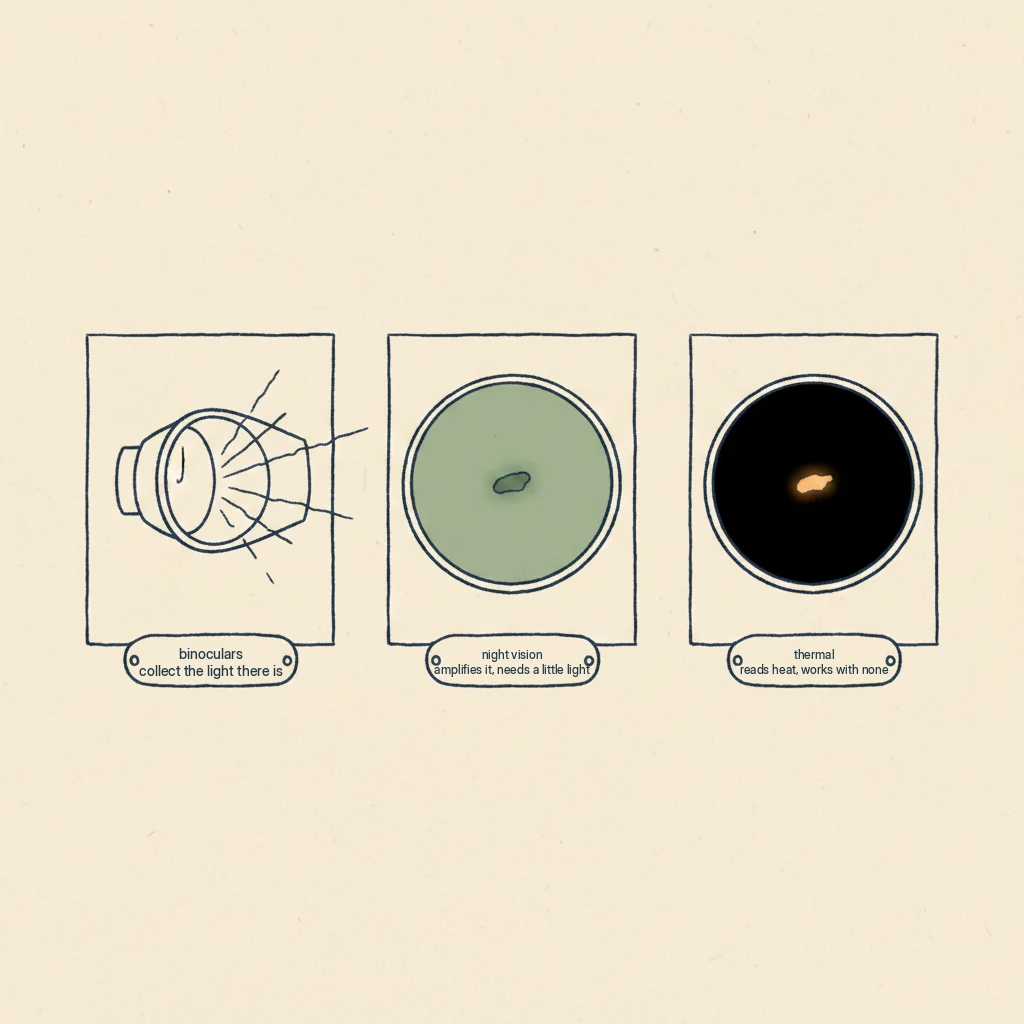
So the punchline, and hold onto it before you spend a dollar: “night vision” doesn’t mean “sees in the dark.” Most of it needs a moon. Only thermal needs nothing.
What your binoculars actually do after dark
Now the generous half of the truth, the half the shops skip because it doesn’t sell a $1,000 device.
Your binoculars are already a low-light instrument. That’s literally what those big front lenses are for. There’s a number that tells you how much light a pair funnels to your eye, the exit pupil, and it’s simply the front lens size divided by the magnification. A 7x50 pair, seven power with fifty-millimeter lenses, comes out to about 7 millimeters, the biggest in this whole corridor. That’s why 7x50 is the old marine and astronomy standard: it’s the “night glass.”
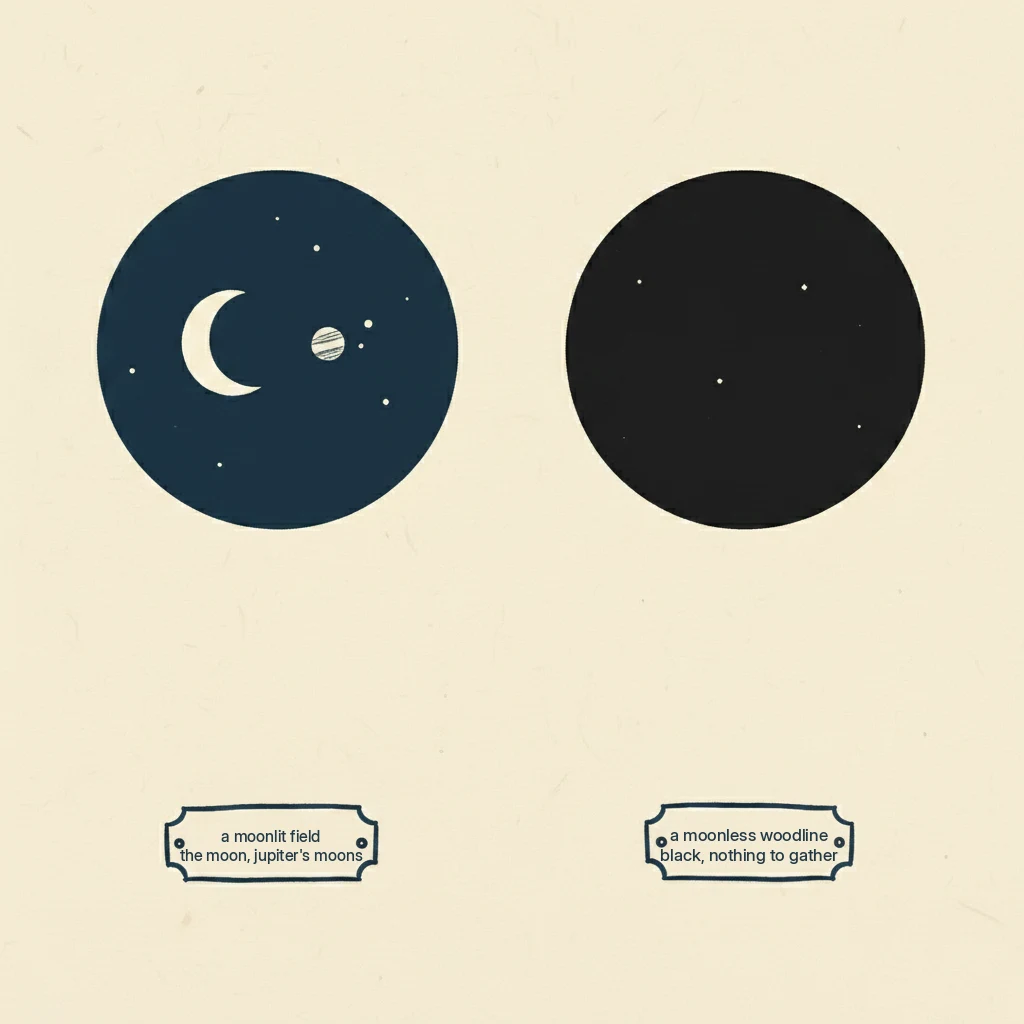
What does that actually get you? A moonlit landscape you can genuinely make out. The moon itself, close enough to see craters. Jupiter as a real disk with its moons as pinpoints beside it. All of that from a pair of ordinary binoculars, in the dark, doing nothing but gathering the light that’s already falling. An amateur astronomer who kept a night-by-night observing log put exactly those sights down: the planet as a disk, its moons as points of light strung out beside it.
What they won’t do is invent light. Aim them into a moonless woodline and you’ll see the same black your eye sees, just magnified. That’s not a defect. It’s the honest limit of a light-gathering machine.
What the real thing costs, and why I can’t give you a clean number
If you do need to see where there’s little or no light, the real gear exists, and I want to be honest about two things: what it is, and that the price is genuinely hard to pin down.
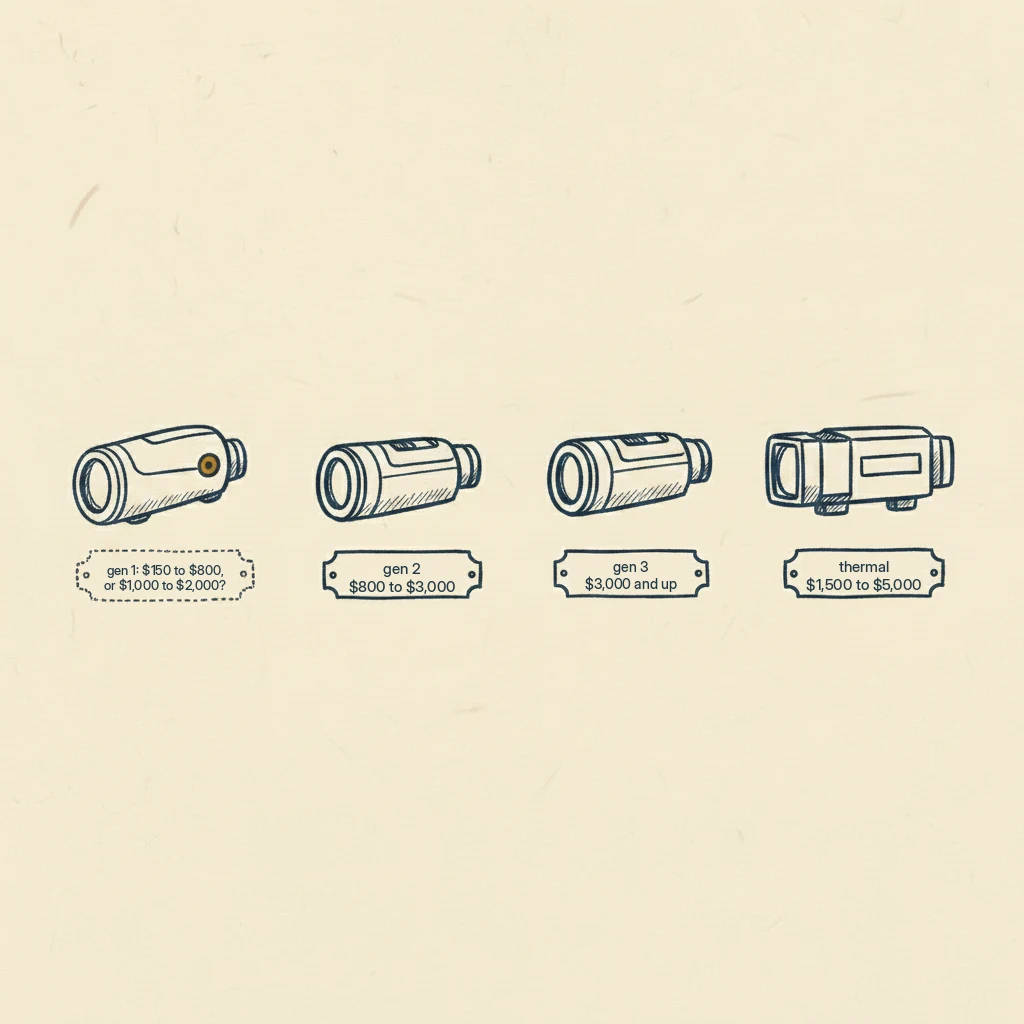
The amplifying kind comes in generations. Gen 1 is the oldest and cheapest consumer version, from the 1960s, the most basic, working out to around 75 yards with a grainy image and some distortion at the edges. Gen 2 was the big leap. Gen 3 is the current military-grade standard and the top of what’s widely sold. There’s also a digital class, the kind you’ll find cheapest on the big marketplaces, which uses a camera-style sensor and still trails the better analog gear in really low light. That digital class is what most of the cheap “night vision binoculars” listings actually are.
On price, the market flat-out disagrees with itself, so I’m going to give you the range rather than split the difference and lie to you with a tidy average. Gen 1 gets quoted anywhere from about $150 to $800 in one place and a thousand to two thousand in another. Gen 2 runs roughly $800 to $3,000, and Gen 3 starts around $3,000 and climbs past $10,000. Thermal, depending who you ask, lands somewhere between about $500 and $10,000, with most of it in the $1,500 to $5,000 band. When the shelves can’t agree within a factor of ten on what the cheapest tier costs, that tells you something too: this is a market where the people explaining the price are the people selling it.
Put that against your other options. The binoculars people in this corridor tend to buy sit under a hundred dollars. Even the very cheapest night-vision number quoted starts above that, and the honest ceiling is five figures. This isn’t an accessory to your binoculars. It’s a different budget entirely.
The cheaper answer, depending on who you are
Before you commit to that budget, three quieter answers, all of them a fraction of the price.
If you just want more out of a real night, a 7x50 pair is the “night glass” I described above, and a plain one runs about $48 as I write this. It won’t see in the dark. It will make a moonlit night genuinely usable, which is what a lot of people are really after.
If what you want is to know what’s crossing your yard at night, you almost certainly want a trail camera, not night-vision optics. It sits there, watches, and shows you in the morning what came through, for far less than a night-vision device, and you don’t have to stand out there holding anything. That’s its own subject, and I’ve got it waiting at best trail camera for security.
If you’re a hunter chasing the last of the light, the honest low-light answer is a good pair of binoculars with a big exit pupil, which is the whole point of binoculars for hunting. And one thing I’ll say plainly and then stop: hunting with night-vision or thermal gear is regulated, and the rules vary a great deal from state to state and species to species. I’m not going to tell you what your rules are, because I don’t know your state and getting this wrong has real consequences. Check your own state’s regulations before you buy anything, not after.
Questions people actually ask
Can regular binoculars see in the dark?
No, and it’s worth being clear about why. Binoculars gather existing light, they don’t create it, so they need a moon, stars, or some glow to work with. Give them that and a 7x50 pair makes a night far brighter than your bare eyes can. Take the light away entirely and there’s nothing for them to gather.
What’s the difference between night vision and thermal?
Night vision amplifies faint light that’s already there, so it still needs a little, starlight or moonlight. Thermal reads heat instead of light, so it needs none at all and works in total darkness. If your worry is a genuinely lightless situation, thermal is the only one of the two that answers it, and it’s usually the pricier one.
Are cheap night vision binoculars worth it?
The inexpensive ones on the big marketplaces are mostly the digital class, which trails the better gear in very low light. I haven’t tested any specific model and won’t pretend to. What I can tell you is the physics: they still need some ambient light, so if you’re expecting to see on a black, moonless night, that price wasn’t buying you what you thought.
Is night vision legal to own?
Owning the basic tiers is generally unremarkable, though the highest, military-grade generations can face permit or export restrictions in some places. Using it, especially for hunting, is a separate and much stricter question that varies by state and species. Look up your own jurisdiction before you buy.
What I’d tell you before you spend
The two-eyes-versus-one question that shapes stargazing shows up here too, if you’re weighing a night-vision binocular against a monocular version; I walk through that tradeoff at best monocular for stargazing. The reason magnification alone doesn’t rescue a dim view is spelled out at binoculars for long distance. And the big-lens, low-light logic that makes a 7x50 a night glass in the first place lives at binoculars for fishing and the binoculars hub.
So here’s where I’d leave it, plainly. If you meant the night sky, go to the stargazing page and don’t let anyone sell you a device. If you meant seeing in your yard, look hard at a trail camera first. And if you genuinely need to see where there’s no light, understand that only thermal does that, that it’s a real budget, and that the rules for using it are yours to check before you spend. What your ordinary binoculars give you, a brighter moonlit world, is more than most people expect and costs about forty-eight dollars. Start by knowing which of those three you actually need.
Ray Ostrander
Ray spent three decades explaining the sky to twelve-year-olds and their parents, and every January, hearing which Christmas telescopes ended up in the closet. He doesn't own a wall of gear and won't pretend to. He reads everything, tells you what owners agree on, and flags what's just his judgment. His goal is simple: no more January closets.