
Spotting Scope vs Telescope: The Same Instrument, Aimed at Opposite Jobs
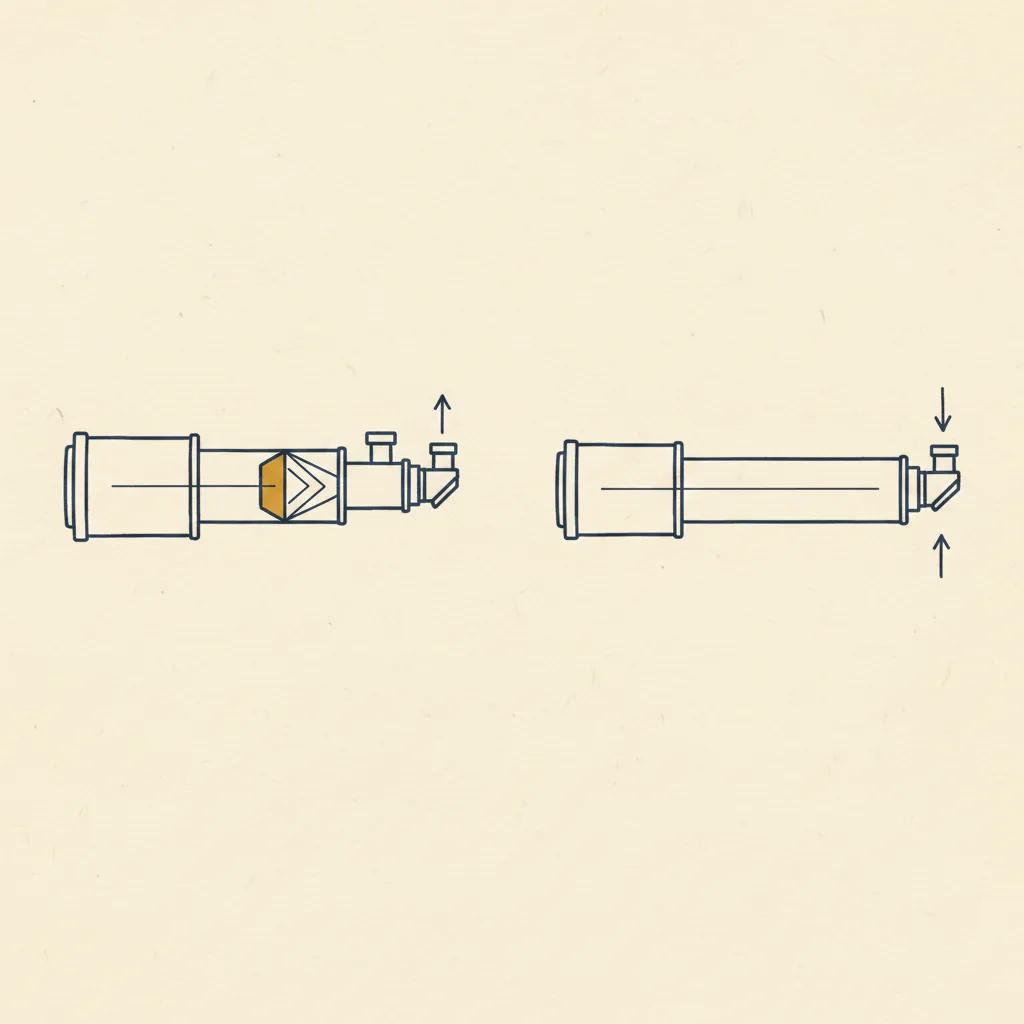
One fact explains every other difference: a spotting scope shows you an upright picture and an astronomical telescope doesn't bother. Celestron says the prisms that fix the image reflect the light 4 to 5 times, losing some each time. Astronomers won't pay that. Here's what follows from it.
 Ray Ostrander · Updated July 25, 2026 · how I decide
If you buy through a link here, the site earns a little. It's never why anything gets picked.
They’re the same idea built for opposite jobs, and the giveaway is which way up the picture is. A spotting scope hands you an upright, correctly oriented image at modest magnification in a body built to be carried and rained on. An astronomical telescope hands you an image that’s upside down, or backwards, or both, at far higher magnification, and it does that on purpose.
That single fact explains nearly everything else about the two instruments, and it’s a genuinely satisfying thing to understand, so let me start there rather than with a specification table.
If you’re deciding which to buy: daylight, at distance, on the move means spotting scope. Planets and deep sky means telescope. If the honest answer is both, you’re buying two things, and I’ll show you why the compromise instrument doesn’t really exist.
What's on this page
- Why the telescope doesn't bother fixing the picture
- Aperture is the real divide, with one honest exception
- Magnification, and why a spotter stops around 60x
- Weather, weight and carrying, where the spotter wins outright
- Eyepieces and mounts, where the two diverge again
- Can you use a spotting scope for astronomy?
- Can you use a telescope for terrestrial viewing?
- Questions people actually ask
- What I'd tell somebody at the counter
Why the telescope doesn’t bother fixing the picture
Celestron states it flatly: astronomical telescopes are designed to produce an upside down or inverted image. It isn’t a fault and there’s nothing wrong with your telescope. Nobody looking at a nebula cares which way up it is, because there’s no up out there to get wrong.
The standard accessory most people add, a mirror diagonal, makes the eyepiece easier to reach and flips the image the right way up, but Celestron is careful to note that it will still appear backwards left to right. So even a well equipped telescope isn’t giving you a correct picture, and for the sky that costs you nothing.
A spotting scope can’t work that way, because a deer facing left and a deer facing right are different pieces of information. Celestron’s guidance on land based observing puts it directly: unlike an astronomical telescope, most spotting scopes are designed with prisms to provide an upright, correctly oriented left to right view, exactly the orientation you’d see with your eye.
Now the part that makes this worth knowing rather than just true.
Those prisms are not free. Celestron’s own number: the prisms in spotting scopes and binoculars reflect the light path 4 to 5 times before sending it to the eyepiece, and a little more light is lost at each one. Astronomers refuse to pay that toll, because when you’re chasing something faint, every photon counts. Daylight observers pay it happily, because in daylight there’s light to spare and knowing which way the animal is facing is worth more.
So it isn’t that one design is better. It’s that one of them spends light to buy orientation, and the other spends orientation to buy light. Every remaining difference follows from that trade.
Aperture is the real divide, with one honest exception
Aperture is the width of the front lens or mirror, and it’s the single specification that decides how much light an instrument collects and how much fine detail it can resolve. It’s also where these two categories genuinely separate.
Celestron says the most popular and common spotting scope size is the 80mm, and the whole category is built around that figure. Astronomical telescopes are not built around it. They begin in that neighbourhood and keep climbing, which is the entire reason the aperture argument only runs one direction. If you want to see that ladder in actual instruments rather than in the abstract, it runs from small tabletop scopes up to eight inch Dobsonians over at best cheap telescope.
Here’s the exception, and I’d rather give it to you than pretend the categories are tidy, because Celestron themselves sell the counterexample. Their C5 is sold as a spotting scope and carries a 127mm aperture with a 1250mm focal length, 50x with the eyepiece it ships with, a 45 degree diagonal and an erect image finder. So a spotting scope with more aperture than most beginner telescopes does exist.
Look at what it costs, though: 96 ounces, which is six pounds, for the optical tube alone before you add the tripod that will hold six pounds steady at 50x. That’s the answer to why the category mostly stops at 80mm. Aperture is heavy, and a spotting scope’s entire reason for existing is that you can carry it up a hill. The exception is the kind of thing this site hands you on purpose, and I’ve explained why I work that way.
Magnification, and why a spotter stops around 60x
Most spotting scopes are sold as a zoom in the 20 to 60x range. Celestron’s Regal M2 80ED is a representative example at 20 to 60x on 80mm. Telescopes routinely run well past that.
The ceiling isn’t arbitrary, and you can derive it. Nikon’s guide gives the arithmetic: the width of the light beam arriving at your eye is the aperture divided by the magnification. On an 80mm scope at 60x that’s about 1.3mm, which is a small, dim window. Push the same 80mm to 120x and it collapses to two thirds of a millimetre, which is unusable. The aperture sets the ceiling, and 60x on 80mm is already near it.
A telescope escapes that by having far more aperture to divide up, which is the whole reason it’s built without the prisms and without the weatherproofing and without any expectation that you’ll walk anywhere with it.
There’s a second ceiling in daylight that has nothing to do with the optics. Warm air rising off the ground distorts everything you look through, and the higher the magnification the more it shows. On a hot afternoon across an open field, a spotting scope at 60x can be genuinely worse than the same scope at 30x. Nights are calmer, which is part of why telescopes get away with high magnification at all.
Weather, weight and carrying, where the spotter wins outright
This is the part specification tables never capture and it’s most of why people buy spotting scopes.
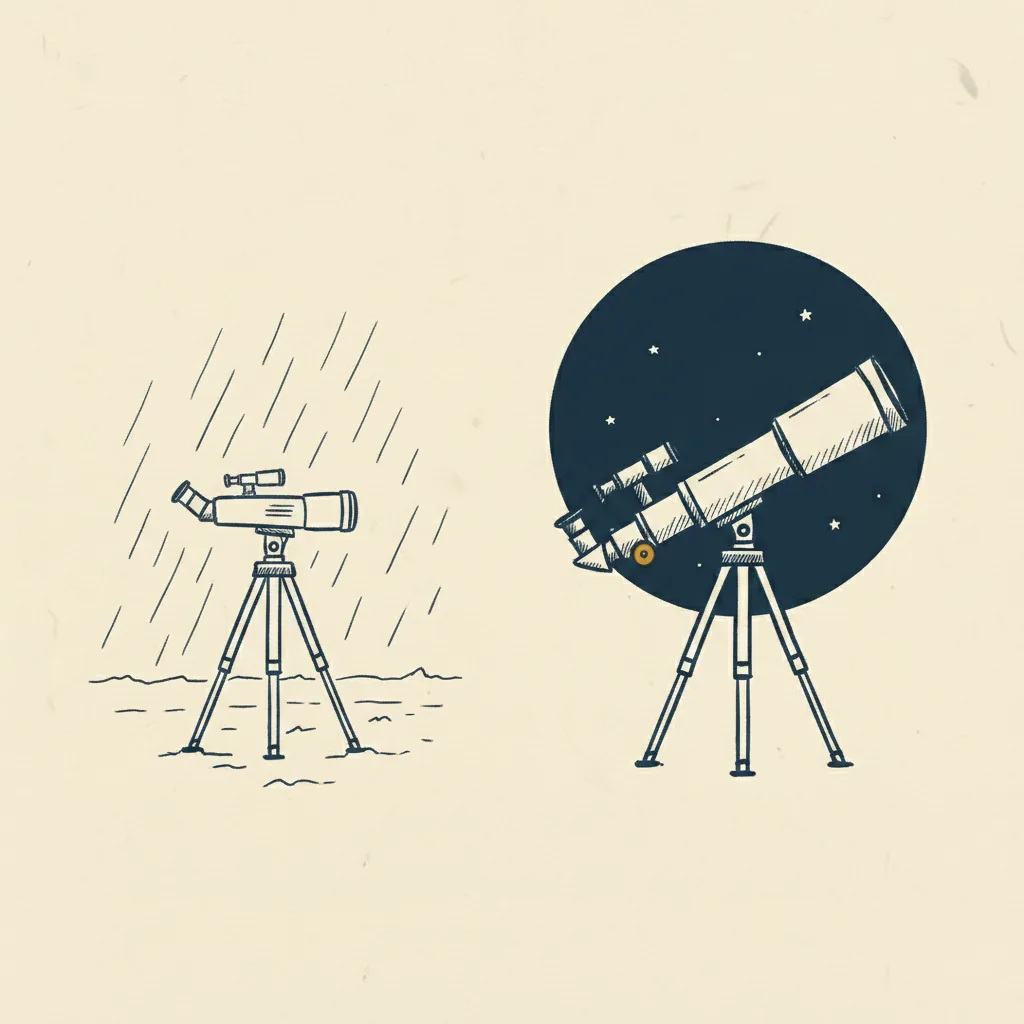
A spotting scope is sealed against weather and built to be rained on, dropped in a pack and left in a truck. It has a single fixed eyepiece or a zoom, so there’s nothing to lose in the field. It mounts on an ordinary photo tripod, the Regal M2 weighs 55.5 ounces without its eyepiece and 66.6 ounces with it, and it’s ready the moment the legs are down. That readiness is what you’re paying for: the Regal M2 80ED runs about $800.
An astronomical telescope is generally none of those things. It expects an indoor life, a set of eyepieces you keep in a case, a mount that needs setting up and often aligning, and it does not want to be rained on. Set up time is measured in minutes rather than seconds.
That difference is worth more than it sounds, and it’s the same lesson as the one in telescope vs binoculars: the instrument that gets used is the one you don’t have to think about. A spotting scope that lives in the truck gets used constantly. A telescope in a closet gets used when you decide to have an evening about it.
Eyepieces and mounts, where the two diverge again
Here’s a difference that catches people out after they’ve bought, because it changes how you use the thing day to day.
A spotting scope arrives finished. The Regal M2 ships with a 20 to 60x zoom eyepiece offering 20mm of eye relief at its low end, and that’s the whole optical system. You change magnification with a ring, there’s nothing to unscrew, nothing to carry, and nothing to drop in wet grass at first light. For a field instrument that’s exactly right.
A telescope arrives unfinished on purpose. Magnification isn’t a property of the telescope, it’s the telescope’s focal length divided by the focal length of whichever eyepiece you put in it, so the instrument is a platform and the eyepieces are how you drive it. Celestron’s C5 has a 1250mm focal length and ships at 50x, which tells you the supplied eyepiece is a 25mm. Swap in a shorter eyepiece and you get more magnification out of the same tube.
That’s more flexible and more faff, and it’s the right trade for the sky, where you genuinely want three or four different magnifications across an evening and you’re standing next to a case anyway.
The categories do touch here, and it’s worth knowing: Celestron notes that some spotting scopes are compatible with 1.25 inch astronomical eyepieces, which is the standard barrel size in astronomy. If yours takes them, you can borrow the telescope world’s eyepieces for a night, and that’s the cheapest way to find out how far your spotter really goes on the Moon.
Mounts diverge the same way. A spotting scope uses the ordinary photographic standard, and even the big C5 carries an integrated quarter inch by twenty thread for a tripod, so any decent camera tripod and head will run it. A telescope generally wants a mount built for the sky, which either swings on two axes or tracks the Earth’s rotation, and that mount is frequently the most expensive single part of the setup.
Can you use a spotting scope for astronomy?
Yes, at its limit, and a lot of people are pleasantly surprised. The Moon is excellent, Jupiter’s moons show up, Saturn’s rings resolve as a shape in decent conditions. What you run out of is aperture, and the prisms that made it useful in daylight are quietly taxing the faint objects where you’d most want the light back.
That’s a full page rather than a paragraph, and it already exists on this site: spotting scope for astronomy covers what you’ll actually see and where the ceiling is. If you’re leaning toward the sky as your main use, start at telescope for beginners instead, and if it’s specifically the rings you want, best telescope to see saturn.
Can you use a telescope for terrestrial viewing?
Also yes, with an accessory, and with two costs.
You’ll want an erecting prism or a correct image diagonal, which flips the view the right way round in both axes. Celestron notes those work by using complex sets of prisms to flip the image, which is precisely the arrangement that costs you light at each reflection. So you spend money on an accessory that makes your telescope slightly worse at the thing telescopes are for.
The second cost is that you still have a telescope: heavier, slower to set up, unsealed, on a mount built for tracking the sky rather than swinging across a hillside. It’ll show you a distant rooftop beautifully from your back garden. It won’t come up a ridge with you.
There’s no single instrument that does both well, and looking for one is the most common way people waste money here. The spotting scope compromised toward astronomy is a small telescope that costs too much for its aperture. The telescope compromised toward daylight is a heavy spotting scope that can’t be rained on. Buy for the use you’ll actually have most weeks, and treat the other use as an occasional bonus.
Questions people actually ask
Can a spotting scope be used as a telescope?
Yes, within its aperture. Expect a fine view of the Moon, Jupiter’s moons, and Saturn’s rings as a recognisable shape. Don’t expect faint galaxies or nebulae, because an 80mm collects a fraction of the light a mid sized telescope does, and the prisms that make it a spotting scope cost a little more at every reflection.
Why is my telescope image upside down?
Because it’s designed that way. Celestron states that astronomical telescopes are designed to produce an upside down or inverted image, and there’s nothing wrong with yours. Adding a mirror diagonal will flip it the right way up, but the view will still be reversed left to right.
Is a spotting scope better than a telescope for daytime?
Much better, and not because of the optics. It gives a correctly oriented picture, it’s sealed against weather, it sets up in seconds on a normal tripod, and it’s built to be carried. A telescope needs an extra prism to show daylight scenes the right way round, and even then it’s the wrong shape for the job.
What magnification is a spotting scope?
Most are zooms in the 20 to 60x range. You’ll spend most of your time near the bottom of that, because the light beam reaching your eye narrows as magnification rises, and on an 80mm scope at 60x it’s down to about 1.3mm.
Can you see planets with a spotting scope?
Yes. Jupiter with its moons and Saturn’s rings are both within reach of a good 80mm at 50 to 60x, in steady conditions. Detail on the planets’ surfaces is where you’ll feel the aperture limit.
Which should I buy if I can only buy one?
Whichever matches what you’ll do most weeks. If that’s looking at land, water or animals in daylight, buy the spotting scope, because it will also give you a decent Moon. If it’s the night sky, buy the telescope, and use binoculars during the day.
What I’d tell somebody at the counter
Ask yourself one question: will this thing be used in daylight, outdoors, away from where you parked? If yes, buy the spotting scope, because everything about it is built for that and a telescope will lose to it every time on those terms.
If what you actually want is the planets, buy the telescope and stop trying to make one instrument do both. Aperture is the thing you’re buying, and it’s the thing a spotting scope can’t give you without becoming a six pound optical tube that needs a tripod to match.
And if you’re not sure yet which of those two people you are, the honest first step isn’t either of them: it’s a decent pair of binoculars, which is where I’d send almost anybody standing at this particular fork.
A few things you’re probably also wondering:
- Wondering how far a spotting scope really gets you at night? See spotting scope for astronomy.
- Comparing the scope against binoculars instead? See binoculars vs spotting scope.
- Weighing a telescope against binoculars for the sky? See telescope vs binoculars.
- Working out a spotting scope budget? See best spotting scope for the money.
- Starting from scratch on the telescope side? See telescope for beginners.
Ray Ostrander
Ray spent three decades explaining the sky to twelve-year-olds and their parents, and every January, hearing which Christmas telescopes ended up in the closet. He doesn't own a wall of gear and won't pretend to. He reads everything, tells you what owners agree on, and flags what's just his judgment. His goal is simple: no more January closets.