
Binoculars vs Spotting Scope: Not a Choice, and Here Is Where the Line Falls
Binoculars find, the spotting scope confirms. They are different jobs, and the numbers show why: an 8x42 binocular gives you 393 feet of view at 1000 yards, an 80mm scope at 60x gives you 52. The real question is when a scope earns the tripod, the weight and the wait.
 Ray Ostrander · Updated July 25, 2026 · how I decide
If you buy through a link here, the site earns a little. It's never why anything gets picked.
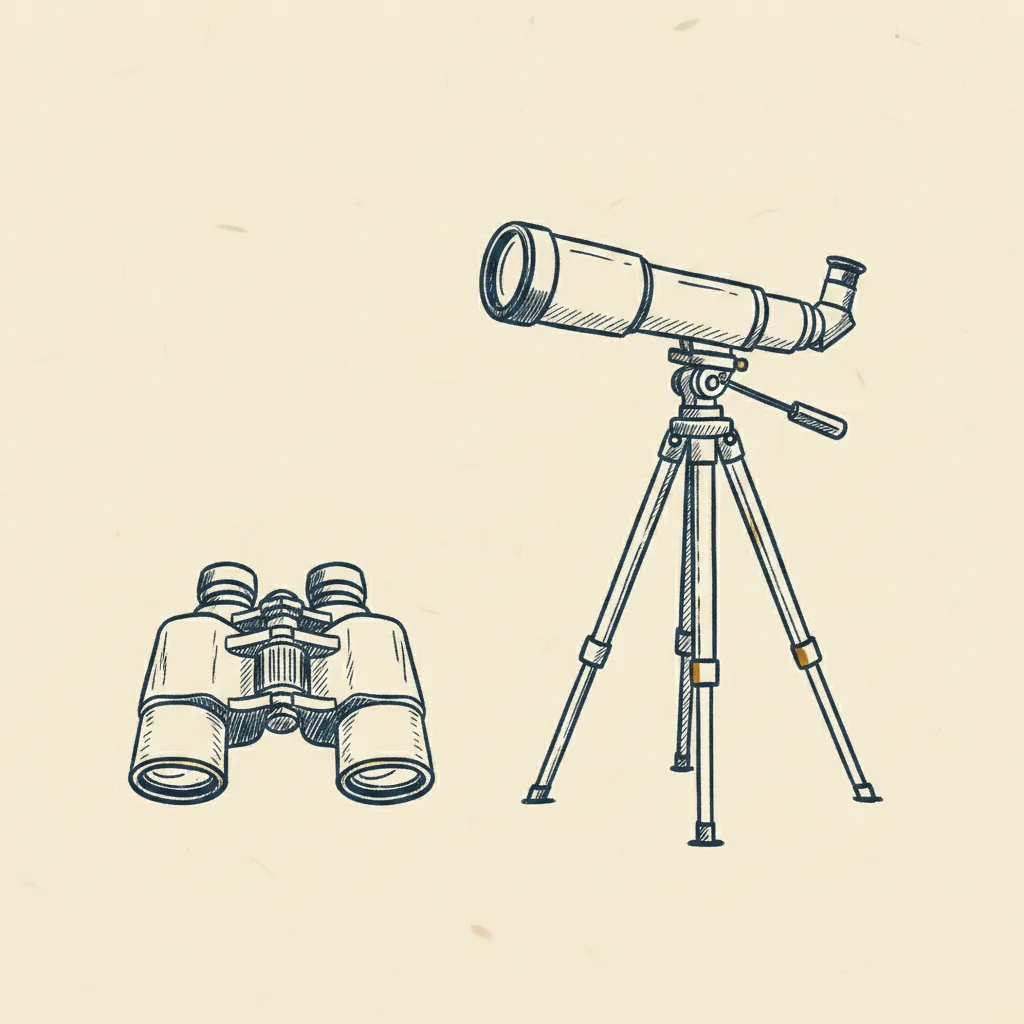
This one isn’t an either or, and framing it as a choice is how people end up with the wrong thing. Binoculars find. The spotting scope confirms. Anybody who spends real time behind glass carries both, and they reach for them at different moments for reasons that come straight out of the specifications.
Here’s the number that settles it. A Vortex Diamondback HD 8x42 binocular shows 393 feet of ground at 1000 yards. A Celestron Regal M2 80ED spotting scope, an 80mm at 20 to 60x, shows 110 feet at its widest setting and 52 feet at 60x, at the same distance.
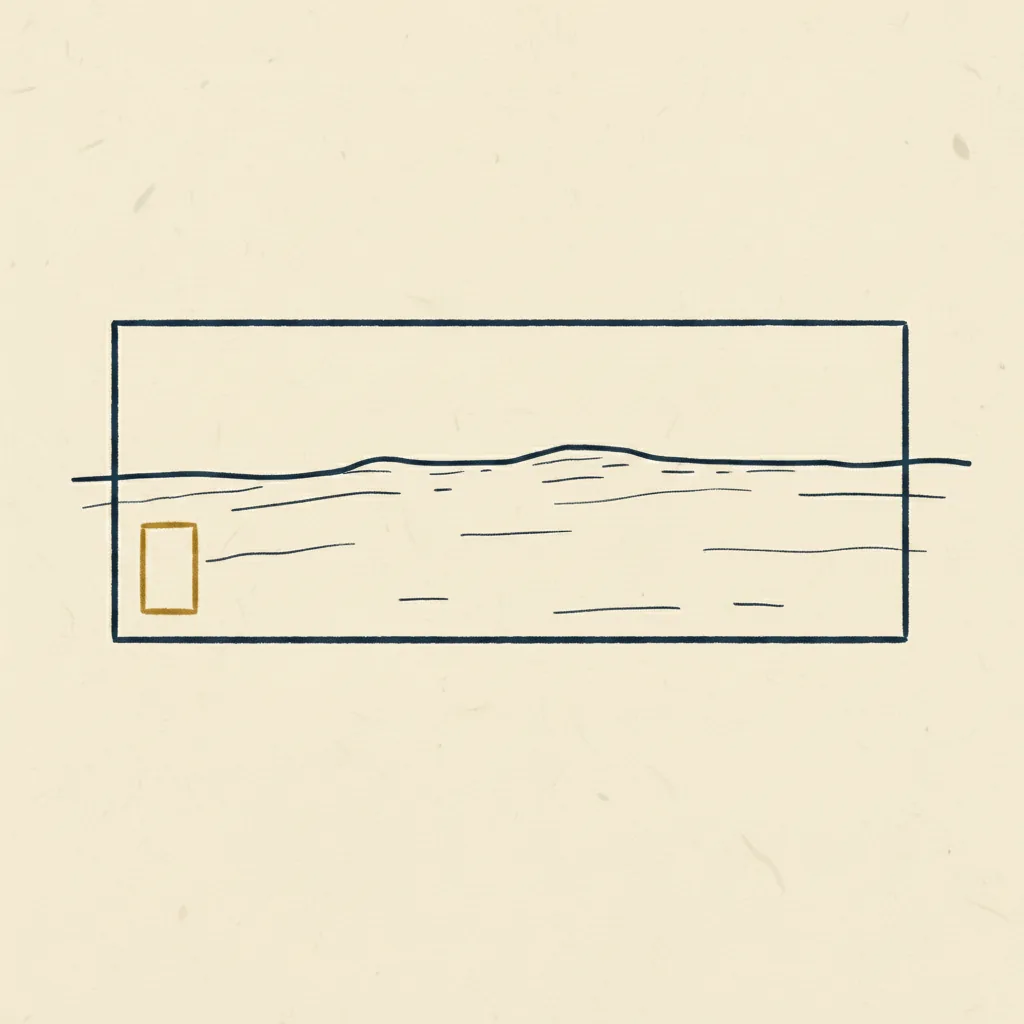
So the binocular shows you three and a half times more ground than the scope at its most generous, and seven and a half times more than the scope at full power. You cannot search a hillside through a keyhole. That’s why the binoculars come up first, always, and it isn’t about them being weaker.
The actual question this page needs to answer is different, then. It’s when a spotting scope earns what it costs you, because it’s heavy, it needs a tripod, and it’s slow.
What's on this page
- Binoculars find, the scope confirms, and that order never changes
- The tripod is not optional, and it is the part people underbuy
- Angled or straight, which is the other question you'll be asked
- The other number that collapses at high power
- When the scope genuinely earns its weight
- When it is dead weight, and this is most of the time
- One eye, for hours
- Astronomy, in one paragraph
- Questions people actually ask
- What I'd tell somebody at the counter
Binoculars find, the scope confirms, and that order never changes
The workflow is simple once you’ve seen it. You glass a slope with binoculars, moving in overlapping sweeps, because you’re covering ground and looking for something that doesn’t belong: a shape, a movement, a colour that’s wrong. That job is entirely about field of view. Magnification barely helps and actively hurts, because more power means less ground per sweep and more sweeps to cover the same hillside.
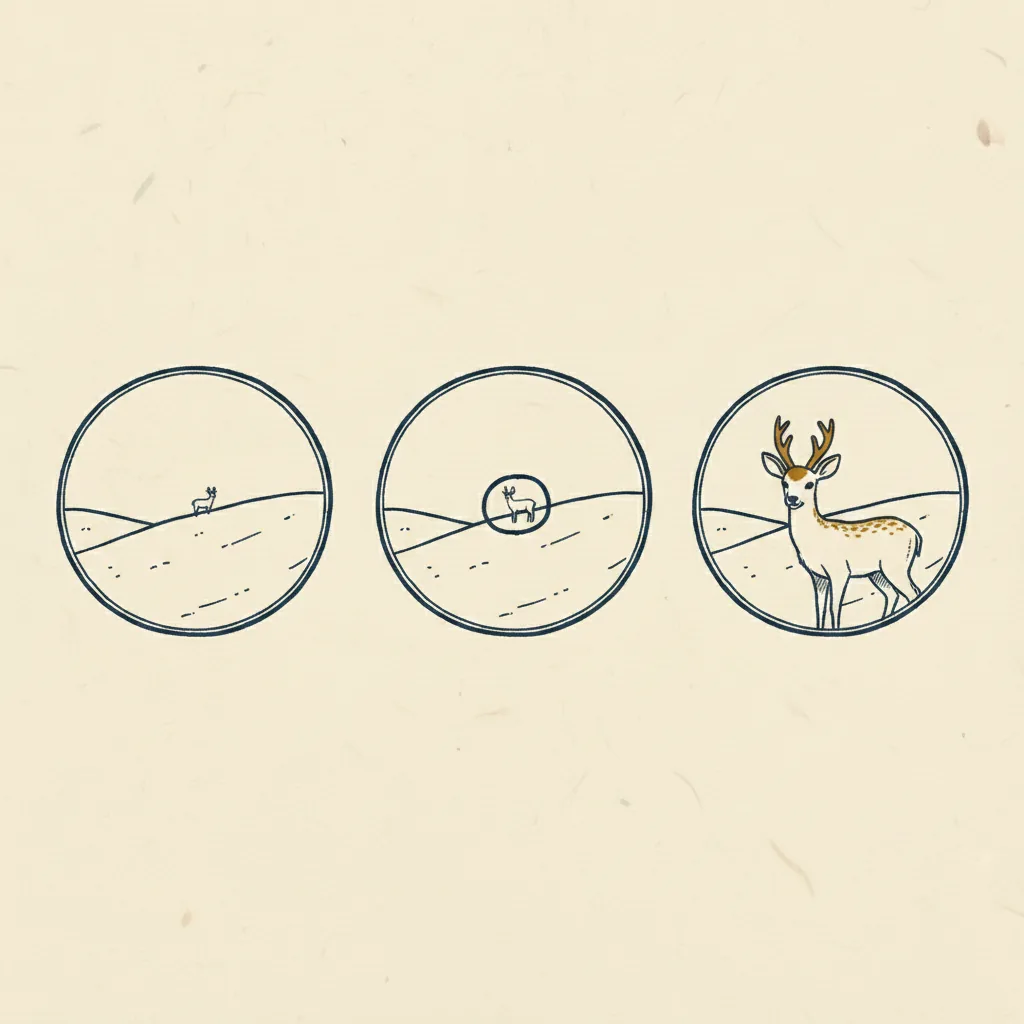
Then you find something. Now you want to know what it is, and that’s a completely different job. You want detail on one small patch you can already point at, and now magnification is exactly what you need and field of view doesn’t matter, because you already know where to look.
That’s it. That’s the whole relationship. The binocular is a search tool, the scope is an identification tool, and asking which is better is like asking whether a flashlight is better than a magnifying glass.
Once you see it as find then confirm, the question “do I need a spotting scope” answers itself. Do you regularly find things you then can’t identify? If yes, the scope is the missing piece. If the things you find are close enough to identify with the binoculars, a scope is a heavy answer to a question you don’t have.
The tripod is not optional, and it is the part people underbuy
This is where the budget goes wrong. People price the scope and then discover the rest of the bill.
Celestron puts it plainly in their own guidance: because high magnification will show even the slightest vibrations, it’s best to mount a spotting scope onto a tripod for stability. That isn’t marketing, it’s arithmetic. Whatever tremor is in your hands gets multiplied by the magnification, and at 60x an unnoticeable movement becomes a picture that won’t sit still long enough to read detail from.
Then there’s the weight, and this is the honest comparison. That 8x42 binocular weighs 21.8 ounces. The Regal M2 80ED weighs 55.5 ounces on its own and 66.6 ounces with the supplied eyepiece attached, which is a bit over four pounds. Then the tripod and head, which for something carrying four pounds steadily is not a light tripod.
So the true cost of a spotting scope is scope plus tripod plus head, and the tripod is the component people cut to afford the scope. That’s the wrong economy every time, because a good scope on a shaky tripod delivers a shaky picture and you’ve spent the money for nothing. If you’re working out where that budget line sits, I’ve gone through it at best spotting scope for the money. And the Regal M2 80ED this page keeps quoting is about $800 before the legs.
Angled or straight, which is the other question you’ll be asked
If you do buy a scope, the shop will ask whether you want the eyepiece straight out the back or angled up at 45 degrees, and it’s worth knowing the answer before you’re standing there.
Celestron’s own comparison makes the case for angled on three counts. You bend at the waist or the neck rather than crouching to eye level, which they note is less tiring over a long session because larger muscles are doing the work. It permits, in their words, the use of a lower tripod position, or a smaller tripod entirely, since the scope no longer has to sit directly in front of your eye. And with a rotating collar you can look into it from beside or even below the scope, which makes it the practical choice for a group of mixed heights and, as they put it, the best choice when the optic is used from a vehicle on a window mount.
The case for straight is simpler and it’s about pointing. When the eyepiece looks the same direction as the objective, aiming the scope at something you can see with your naked eye is intuitive, and getting onto a subject fast is easier. Straight also tends to be the choice for anyone glassing downhill from above, because an angled eyepiece pointed up while the scope points down gets awkward.
Rough rule: angled if you’ll be stationary, sharing, or working from a vehicle, straight if you’re hunting from above and want to get on things quickly.
The other number that collapses at high power
There’s a second thing that happens as you turn the magnification up, and it explains why a scope at 60x often looks worse than you expected rather than better.
Nikon’s guide gives the arithmetic: the width of the light beam reaching your eye is the front lens diameter divided by the magnification. Run it on an 80mm scope. At 20x you get 4mm, which is comfortable. At 60x you get about 1.3mm.
For comparison, the 8x42 binocular gives 42 divided by 8, which is 5.25mm, and Nikon puts the dark adapted human pupil at about 7mm.
A 1.3mm beam is a small, dim, unforgiving thing to look through. It’s why experienced people run their scopes at the bottom of the zoom range most of the time and only wind up to full power for a few seconds on something specific. The top of the magnification range on any scope is a specification, not a working setting, and anybody who tells you they glass all day at 60x is telling you a story. You don’t have to take my word for the arithmetic either; where these answers come from lays out how every claim on this site earns its place.
When the scope genuinely earns its weight
Four situations, and they have something in common: the distance is fixed, you’re not moving, and the detail you need is small.
Judging an animal at distance. Working out whether what you’re looking at is worth a long walk, and doing it from where you already are rather than by getting closer and spooking it. This is the classic case and it’s most of why the hunting market buys these.
Reading detail past what 10x resolves. Band numbers on a bird’s leg, plumage detail that separates two similar species, the exact configuration of something a long way off.
Scoring targets at range, which is the one case where the answer is unambiguous, because you need to see holes in paper at a distance where nothing else will do it.
Digiscoping, meaning putting a camera or a phone behind the eyepiece. That only works on something tripod mounted, so the scope is the only option in the family.
Notice what all four share. You are stationary, you have time, and the thing you’re looking at is either not moving or is far enough away not to care about you. That’s the domain.
When it is dead weight, and this is most of the time
Anything mobile. If you’re covering ground, the four pounds plus a tripod is a genuine tax on how far you’ll walk and how much you’ll enjoy it.
Anything in timber or close cover, where your sight lines are short. At 30 yards the scope is useless and your binoculars are already more magnification than you need. Worse, that Regal M2 won’t focus closer than 21.3 feet at 20x, while the 8x42 binocular focuses down to 5 feet. In close country the scope is physically unable to look at what’s in front of you.
Anything that won’t hold still. A bird working through a hedge, a deer walking a field edge. By the time you’ve got the scope on the tripod pointed at it and focused, it’s somewhere else. This is the failure that turns people off scopes, and it isn’t the scope’s fault, it’s the wrong tool for a moving subject at short notice.
If you’re buying your first serious optic and you’re choosing between a good binocular and a cheap scope, buy the binocular. Every situation uses the binocular. A minority of situations use the scope, and a cheap scope on a cheap tripod at high magnification produces a shaky dim picture that will convince you that you don’t like spotting scopes, when what you don’t like is that particular setup. Concretely: the Vortex Diamondback HD 8x42 used through this page runs about $240.
One eye, for hours
Here’s a cost that never appears in a comparison chart. A spotting scope is a single eyepiece, so behind one you’re using one eye for as long as you’re looking, with the other shut or ignored.
For the two minutes you spend confirming what you found, that’s nothing. For an hour of watching a nest or a distant field, it’s genuinely tiring, and it’s the same fatigue that makes people give up on monoculars. It’s another reason the scope is a confirmation instrument rather than a watching instrument: the binocular is the thing you can comfortably stay behind. I’ve written up why two eyes are less tiring over at monocular vs binocular, and the mechanism is identical here.
Astronomy, in one paragraph
Yes, a spotting scope will show you the Moon in real detail, and Jupiter’s moons, and Saturn’s rings as a shape if the seeing is good. It’s a legitimate dual use and a lot of people are pleasantly surprised. It also runs out of aperture quickly compared with even a modest astronomical telescope, and the correcting prisms that make it useful in daylight cost you light you’d rather have at night. That’s a whole page of its own and it already exists: spotting scope for astronomy. If your question is which instrument to buy for the sky specifically, start at spotting scope vs telescope instead.
Questions people actually ask
Do I need a spotting scope if I have good binoculars?
Only if you regularly find things with the binoculars that you then can’t identify. That’s the test, and it’s a real one. If your binoculars are answering your questions, a scope adds weight and expense without adding information. If you keep finding shapes at distance you can’t resolve, that’s exactly the gap a scope fills.
What magnification spotting scope do I need?
Most scopes are sold as a zoom in the 20 to 60x range, and that range is right for almost everybody. What matters is knowing you’ll live at the bottom of it. At 60x on an 80mm scope the light beam reaching your eye is down to about 1.3mm, which is dim and shaky, so full power is for short looks at specific things.
Can you use a spotting scope handheld?
Briefly, badly, and only at the bottom of the zoom. Celestron’s own guidance is to mount it on a tripod because high magnification shows every slight vibration. Treat the tripod as part of the instrument rather than an accessory.
Is a spotting scope worth it for birding?
For stationary birding at distance, shorebirds on a mudflat, raptors on a far ridge, waterfowl across a lake, yes, and many serious birders own one. For woodland or hedgerow birding where subjects are close and moving, no. Note the near focus limit too: a scope that won’t focus inside 20 feet is useless on anything nearby.
What comes first, better binoculars or a spotting scope?
Better binoculars, nearly always. You use them in every situation and the scope in a few. The upgrade that improves the most minutes of your time outdoors is the one you have around your neck.
Can I mount my binoculars on a tripod instead?
Many full size binoculars accept a tripod adapter, and it’s a real option for long stationary watching, especially at higher magnifications where handheld gets tiring. It doesn’t replace a scope, because you still only have 8x or 10x, but it does take the shake and the arm fatigue out of a long session for very little money.
What I’d tell somebody at the counter
Buy the binoculars first and buy them well, because they do the finding and the finding is most of the work. Carry them on a harness so they’re not swinging off your neck.
Then be honest about whether you have the confirmation problem. If you spend your time in close cover, or on the move, or looking at things that won’t sit still, you don’t, and the scope will live in a closet. If you sit and look at distant country and keep wanting to know what that shape is, you do, and the scope will feel like it unlocked something.
And if you buy the scope, budget the tripod at the same time and don’t let it be the part you economise on. A four pound instrument at 60x is only as good as the three legs holding it.
A few things you’re probably also wondering:
- Working out the scope budget? See best spotting scope for the money.
- Buying for hunting specifically? See binoculars for hunting.
- Wondering how a scope compares with an astronomical telescope? See spotting scope vs telescope.
- Choosing your binocular magnification? See 8x42 vs 10x42.
- Tired of your binoculars swinging while you walk? See binocular harness.
Ray Ostrander
Ray spent three decades explaining the sky to twelve-year-olds and their parents, and every January, hearing which Christmas telescopes ended up in the closet. He doesn't own a wall of gear and won't pretend to. He reads everything, tells you what owners agree on, and flags what's just his judgment. His goal is simple: no more January closets.