
Telescope vs Binoculars: Which Should You Actually Buy First?
For a first instrument, binoculars usually win, and NASA says so too. A 7x35 to 10x50 pair shows the Moon's craters, the Pleiades, Andromeda, and maybe Jupiter's moons. But only a telescope shows Saturn's rings. Buy the scope when you want planets.
 Ray Ostrander · Updated July 24, 2026 · how I decide
If you buy through a link here, the site earns a little. It's never why anything gets picked.
For a first instrument, binoculars usually win, and this isn’t just my opinion: NASA says so too. A 7x35 to 10x50 pair shows the Moon’s craters, the Pleiades star cluster, the Andromeda Galaxy, the Orion Nebula, and on a patient night maybe Jupiter’s moons. But binoculars won’t show Saturn’s rings, and that needs a telescope. So the honest rule is short: buy a telescope when you specifically want the planets, and buy binoculars for everything else, including the Moon, and including the nights you’d otherwise never bother to go outside.
If you’re standing between two boxes with a number in your head, this is the page that decides whether you’ll be glad you spent the money or whether it ends up gathering dust. Let me walk you through the real trade, because the shelf gets the optics right and the actual decision wrong.
A quick note first: if you’re still at the “how do I even start stargazing” stage, that’s a slightly different question, and I answer it over on stargazing for beginners. This page is for when you’ve decided to spend money and just need to know which instrument, and on what.
What's on this page
- NASA's answer, and it's blunt
- The one thing binoculars will never do
- The border between the two instruments, drawn honestly
- At the cheap end, they aren't even the same kind of thing
- The honest catch nobody mentions: the binocular tripod
- The trap that catches the clever reader
- The real question isn't optical at all
- Questions people actually ask
- What I'd tell a parent in the hallway
NASA’s answer, and it’s blunt
Let me put the strongest card face up. NASA’s own skywatching guidance calls binoculars an excellent first instrument, because they’re generally easy to use and more versatile than most telescopes. Not a compromise, not a trainer, a genuinely better first buy for most people. That’s the space agency, on the record, telling beginners to start with binoculars.
Here’s what they say a good pair actually shows you: craters on the Moon around 6 miles across and larger, big open star clusters like the Pleiades, bright galaxies like Andromeda, large nebulae like the one in Orion, and, if you’re patient, Jupiter’s moons. The recommended size is somewhere from 7x35 to 10x50, and the advice isn’t to go bigger than 10x50 to start, because past that the field gets narrow and your hands can’t hold it steady. That’s a real, wide, satisfying slice of the night sky, for the price of the cheapest honest telescope on the shelf.
The one thing binoculars will never do
And now the honest limit, stated just as plainly, because it’s the whole reason the telescope corridor next door exists. Binoculars won’t show you Saturn’s rings. NASA says so outright, and it’s worth knowing before you buy, not after.
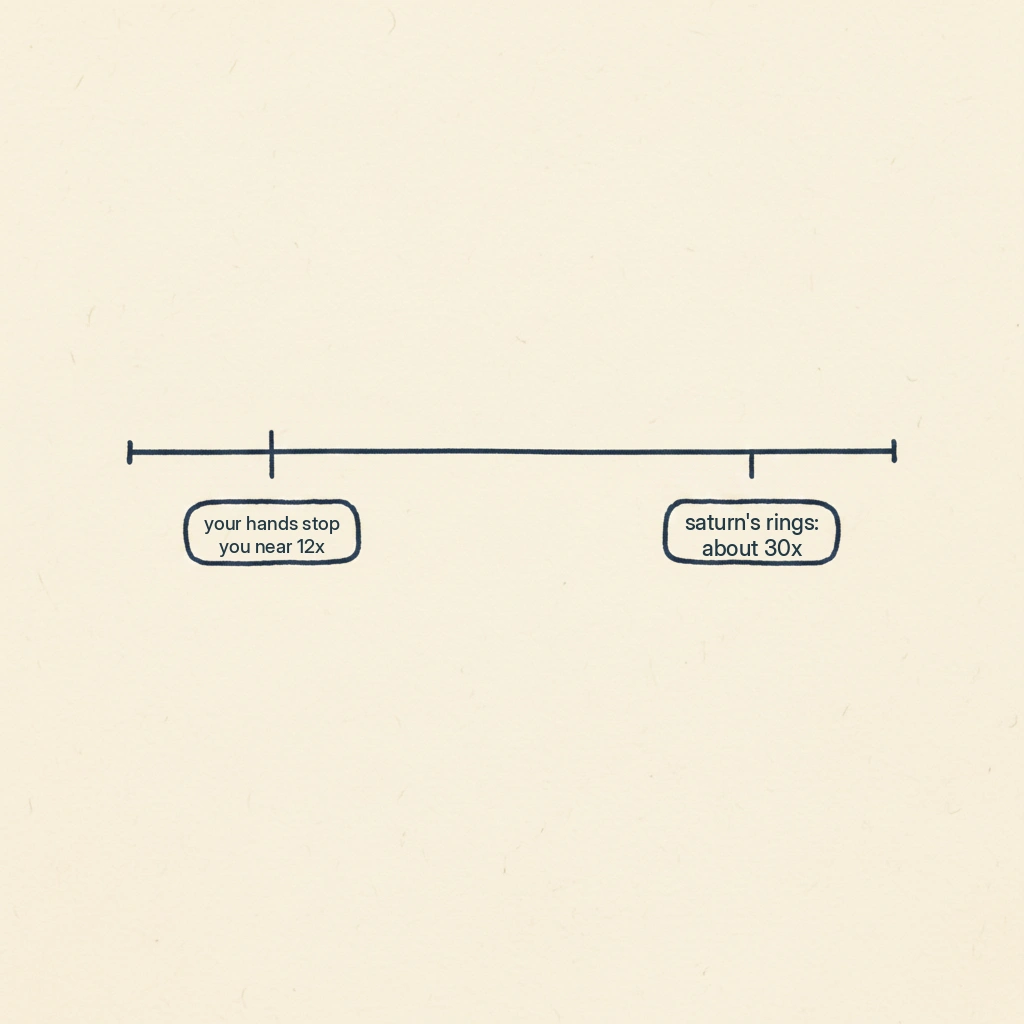
Here’s what’s actually happening, and it comes down to two numbers that refuse to meet. You can only hold binoculars steady up to about 12 times magnification; past that, your own pulse turns the view into a shaking mess, which is why NASA caps the beginner at 10x50. But Saturn’s rings don’t resolve until around 30 times magnification. Twelve and thirty don’t overlap. That gap is the entire answer to “why can’t binoculars show the rings,” and no amount of buying up the binocular ladder closes it. For the rings, you need a telescope. Full stop.
The border between the two instruments, drawn honestly
There’s one object that sits right on the line between the two, and it’s worth being exact, because it’s the cleanest reason to choose a telescope. Jupiter’s four big moons.
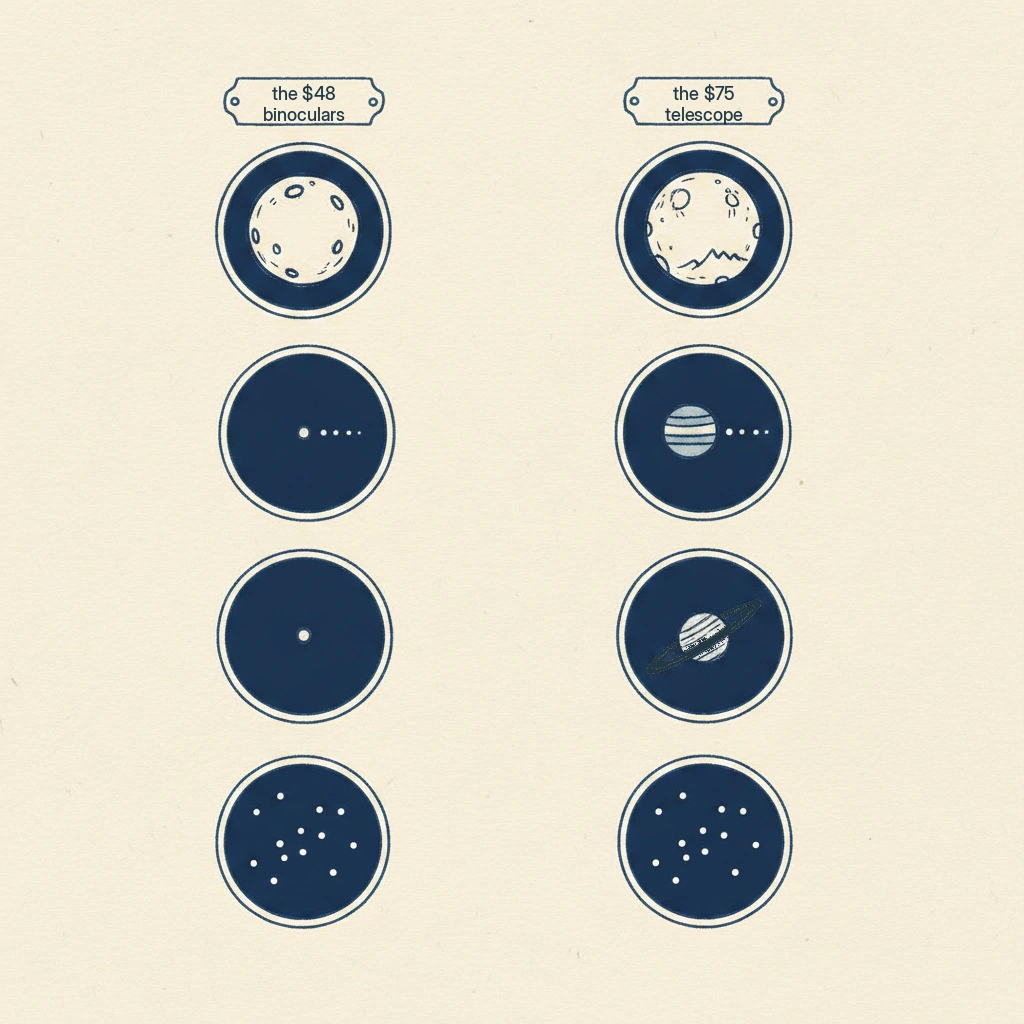
NASA hedges and says binoculars “may” show Jupiter’s moons, and that hedge is earned. I’ve read a careful observer’s night-by-night log comparing binoculars on Jupiter, and here’s the real texture of it. Through a 10x50 pair, he saw Jupiter as a disk with only one moon showing on one night, and three on a better one. Even on his best, clearest night, positively identifying all four took about twenty minutes of watching a “bulge” at the edge resolve into the fourth moon, which he noted was the first time in the whole run he could confirm all four. He was honest enough to retract an earlier cloud-belt glimpse as probably imagined.
Now compare the telescope side. In any 60mm telescope, all four of Jupiter’s moons are simply there, no waiting, plus the two dark cloud belts across the planet, which binoculars won’t show you at all. So the border is this: in binoculars, one skilled observer with a good pair caught all four moons exactly once, after twenty minutes of effort. In a cheap telescope, they’re just there, along with detail you can’t get any other way. That’s the most honest argument for a telescope I can give you, because it doesn’t oversell the telescope. It just tells the truth about the binoculars.
At the cheap end, they aren’t even the same kind of thing
This is where the decision really gets made, and it surprises people. At the bottom of the market, a binocular and a telescope aren’t two versions of the same idea. They’re a good tool and a warning label.
A roughly fifty-dollar pair of binoculars, like a 7x50, is a genuinely good instrument. It’s the same class NASA recommends, it works the night you open it, and it will still be useful in ten years. A roughly fifty-dollar telescope is where the hobby killers live: a flimsy tripod that shakes at a touch (which one veteran writer calls the real killer), an ancient skinny eyepiece, cheap optics, and a giant magnification number on the box that’s actively harmful. Spend $50 on binoculars and you own something good. Spend $50 on a telescope and you mostly own frustration. The genuine floor for an honest telescope is more like $75 for a small tabletop scope, and up from there.
Here’s the money, laid side by side:
| the money | what binoculars get you | what a telescope gets you |
|---|---|---|
| about $50 | Celestron Cometron 7x50, $47.95, right inside NASA’s recommended range | FirstScope 76mm tabletop, $74.95, a real if small scope, genuinely good on the Moon |
| about $50 to $130 | UpClose G2 10x50, $51.95, or SkyMaster 15x70, $129.95 | the sub-$100 shelf is where the hobby killers live |
| about $200 | SkyMaster 20x80, $209.95, which now needs a tripod | AstroMaster 70AZ, priced anywhere from about $150 to a $200 sticker |
| about $355 and up | (binoculars have topped out for astronomy) | Sky-Watcher Heritage 150 tabletop, $355, or an 8-inch Dobsonian from about $600 to $725 |
All researched, none of it looked through by anyone here, which you’ll find said plainly on the About page. Prices are rounded to what I’m seeing as I write this, and where a figure is scattered I give you the spread rather than a made-up middle.
The honest catch nobody mentions: the binocular tripod
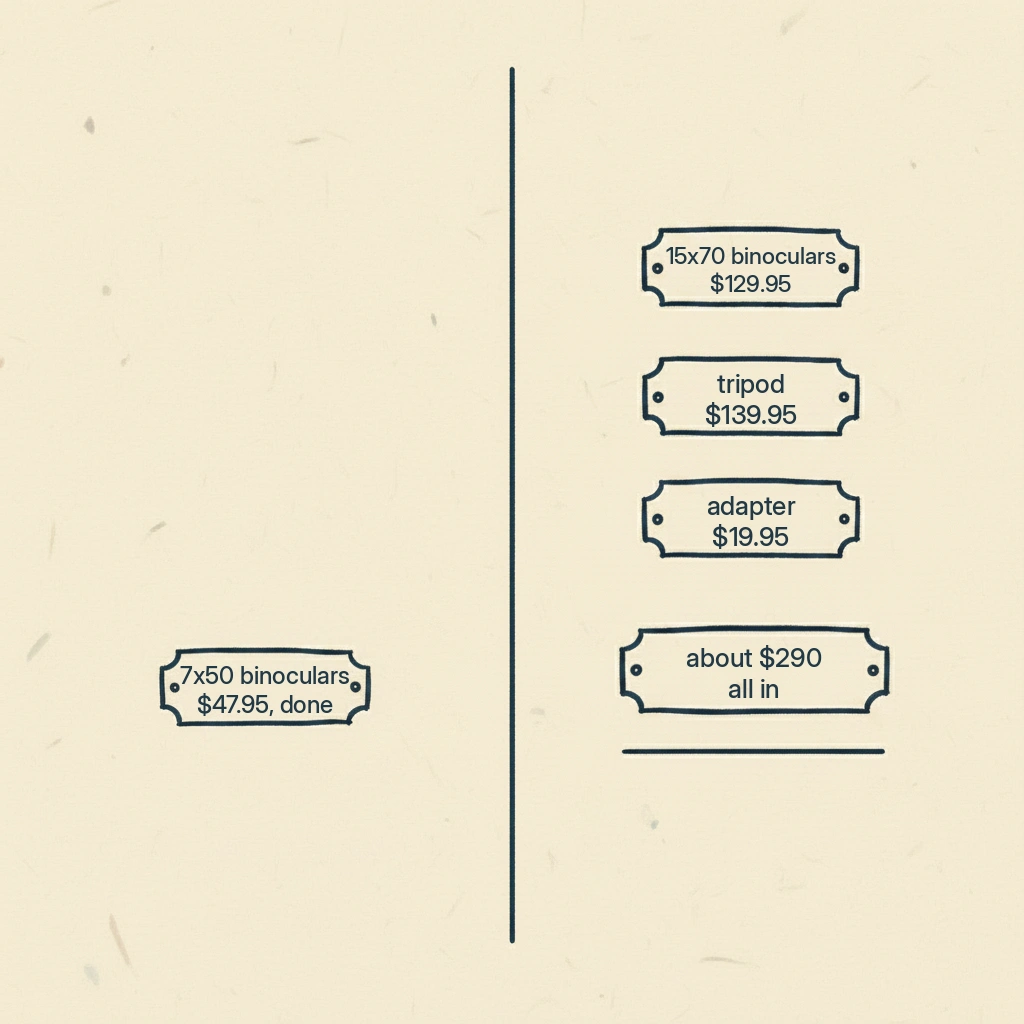
Now let me do the thing a page pushing binoculars is supposed to hide, and not hide it. The small binoculars, the 7x50 that NASA recommends, need nothing else. You buy them, you go outside, done. But the bigger pair that shows Jupiter’s moons well, the 15x70, is too much magnification to hold steady, so it really wants a tripod, which runs about $140, plus a little adapter around $20. Add it up and your “cheap” 15x70 setup is close to $290. That’s telescope money.
So if the small hand-held pair is enough for you, binoculars are genuinely the cheap answer. But if you’re reaching for the big ones to chase Jupiter’s moons, be honest with yourself that you’re now spending what a decent telescope costs, and the decision gets closer. A page that recommends binoculars and quietly leaves the tripod off the receipt is doing exactly what the 600x boxes do.
The trap that catches the clever reader
One warning, because the person who really absorbs “aperture beats magnification” tends to over-correct on binoculars. Having learned that big magnification numbers are a lie on telescopes, they go buy a 25x or 30x binocular, thinking more power is better here too. It isn’t. A hand-held 25x binocular is a shaky, dim, unusable thing, the binocular world’s own version of the 600x box. Both instruments have the same lie printed on the high-power ones. Keep a first pair at or below 10x50, and if you want more than about 15 to 20 times, plan on that tripod.
The real question isn’t optical at all
Here’s what the whole shelf misses, and it’s the part I actually know something about after thirty-one years of watching families try this. The question isn’t which instrument shows more. On paper, for most objects, it’s close. The question is which one you’ll actually carry outside on a cold Tuesday when you’re tired and it’s a little cloudy and the game’s on.
And there, it isn’t close. Binoculars live by the back door. They come out for the Moon in two seconds flat, they ride along on the camping trip and the cruise, and they double as birdwatching glass in daylight, which NASA points out too. A telescope with a mount to set up and align has a friction cost, and friction is what kills this hobby, far more than clouds or optics ever do. The owners who lost interest almost always name the setup, the hauling, the fiddling, not the views. The instrument that gets used is the one that wins, and the one that gets used is almost always the one you don’t have to think about.
Questions people actually ask
Binoculars or telescope for stargazing, if I can only buy one?
Binoculars, for most people, most of the time. They’re easier, more portable, useful in daylight too, and a good $50 pair genuinely outperforms a $50 telescope. NASA recommends them as a first instrument for exactly these reasons. The single exception is if your heart is set on the planets, specifically Saturn’s rings, which binoculars simply can’t show. Then, and only then, start with a telescope.
What can you see with binoculars that you can’t with a telescope, or vice versa?
Binoculars win on wide targets: the full Pleiades cluster, big swaths of the Milky Way, the whole Moon at a glance, plus daytime use. A telescope wins on the planets: Saturn’s rings, Jupiter’s cloud belts, Mars at opposition, none of which binoculars can deliver. Think of it as wide-and-easy versus close-and-detailed, not better versus worse.
Is a telescope or binoculars better for a kid?
For most kids, binoculars, and it’s not close on the thing that matters, which is whether they’ll use it twice. A telescope that needs setup often gets used once and then sits. Binoculars get grabbed on a whim, which is exactly what you want from a curious kid. Buy the telescope later, when they’ve shown you the interest is real and specifically about the planets.
Can binoculars really show galaxies and nebulae?
Yes, the big bright ones. NASA lists the Andromeda Galaxy and the Orion Nebula among the things a modest pair will show, along with the Pleiades and other clusters. They’ll look like faint grey smudges rather than the colored photos, the same as they do in a small telescope, because your eye isn’t a camera. But they’re genuinely there, and finding Andromeda in binoculars is a real thrill.
What I’d tell a parent in the hallway
Buy the binoculars first. A good 7x50 pair for about fifty dollars will show your kid the Moon’s craters, star clusters, and Andromeda tonight, with no setup and no learning curve, and it’ll get used because it lives by the door. Save the telescope for when they specifically ask to see the planets, because Saturn’s rings are the one thing binoculars can’t give them, and that’s the moment a telescope is worth it.
A few things you’re probably also wondering:
- Ready to pick an actual astronomy binocular? See best binoculars for stargazing.
- Wondering if a monocular is the cheaper move? It usually isn’t: best monocular for stargazing.
- Buying binoculars for a kid specifically? See binoculars for kids.
- Decided on the telescope after all? Start at best cheap telescope.
- Want the planets that make a telescope worth it? See best telescope to see saturn and telescope to see jupiter.
Ray Ostrander
Ray spent three decades explaining the sky to twelve-year-olds and their parents, and every January, hearing which Christmas telescopes ended up in the closet. He doesn't own a wall of gear and won't pretend to. He reads everything, tells you what owners agree on, and flags what's just his judgment. His goal is simple: no more January closets.