
The Telescope to See Pluto, and the Honest Truth About That Faint Dot
Honestly, not the way you're picturing. No telescope on Earth shows Pluto as more than an anonymous dot with no disc at any magnification. It takes an 8-to-11-inch scope under a dark sky, and you only know you saw it by watching which dot moves.
 Ray Ostrander · Updated July 24, 2026 · how I decide
If you buy through a link here, the site earns a little. It's never why anything gets picked.
Honestly, not the way you’re picturing. Pluto is so faint and so far that no telescope on Earth shows it as anything but an anonymous dot among the stars, with no disc and no detail, at any magnification, ever. To catch even that dot you need roughly an 8-to-11-inch scope under a genuinely dark sky, and the only way to know you saw it’s to sketch the little field of stars, come back another night, and see which dot moved.
I want to be careful with this page, because I think whoever’s asking is often a kid, and often the kind of kid I liked best in thirty-one years of teaching: the one who picks Pluto on purpose. The far one. The small one. The planet that got demoted and picked last. So I’m not going to tell you to forget it, and I’m not going to pretend it’s easy. I’m going to tell you exactly what’s true, which is more interesting than either.
What's on this page
You don’t see Pluto. You catch it moving.
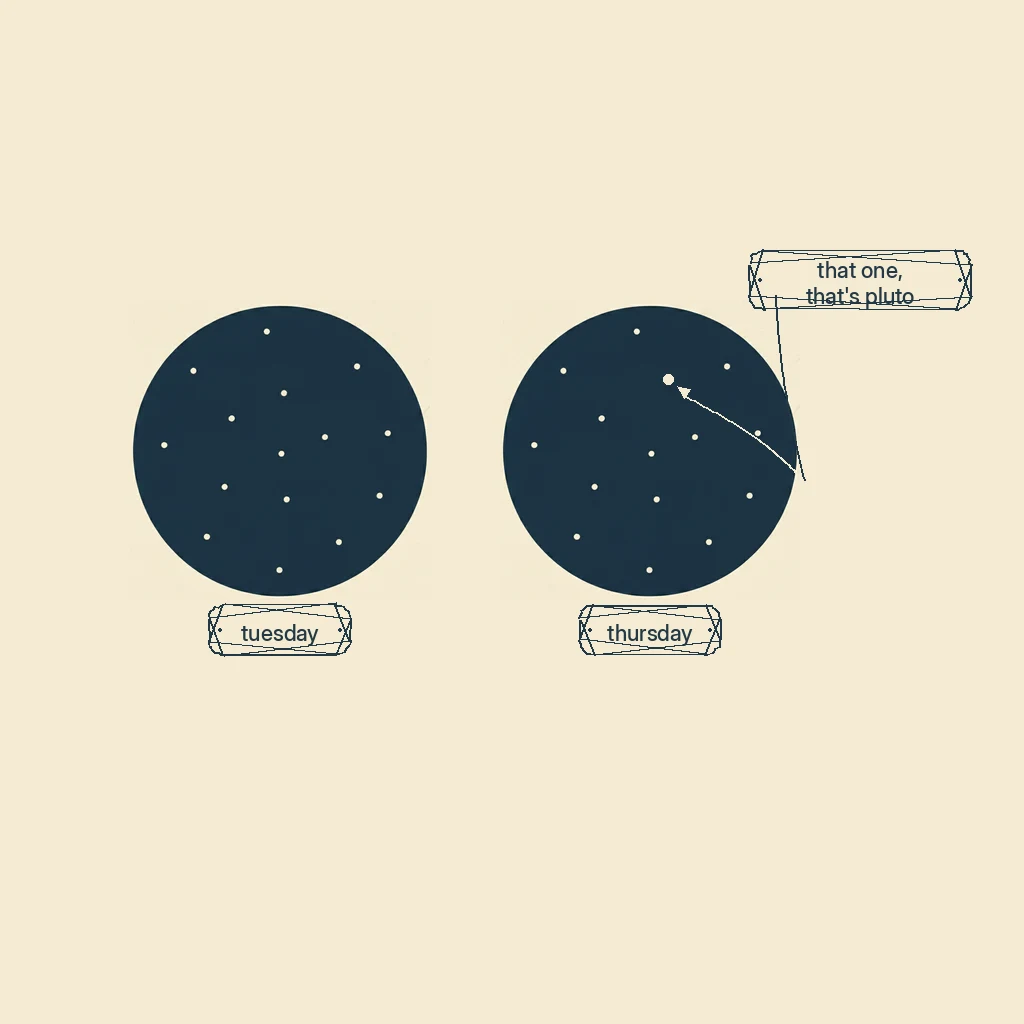
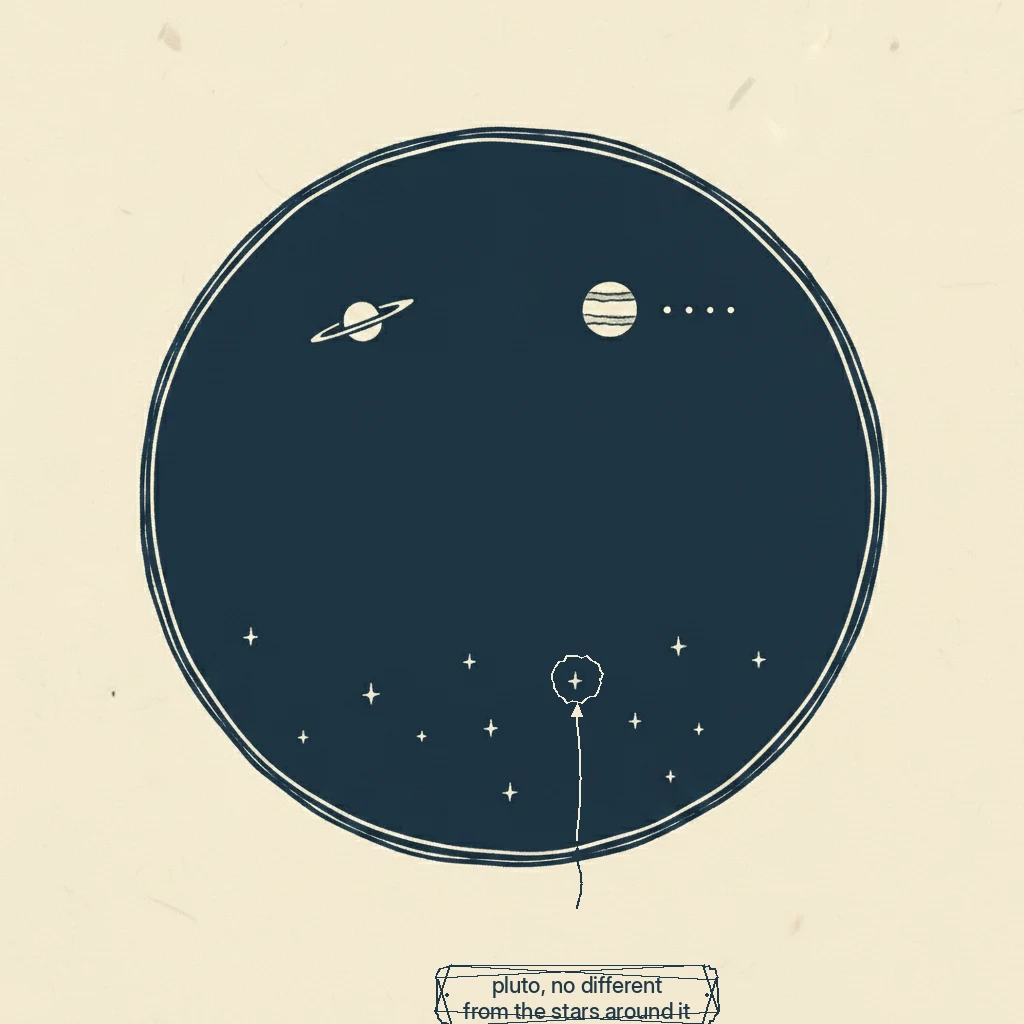
Here’s the thing every other page leaves out. Even through a big telescope on a perfect night, Pluto isn’t a little world you look at. It’s a faint star-like point in a crowded field, one anonymous dot among dozens of identical anonymous dots. There’s nothing to recognize. If someone showed you the eyepiece and said “one of these is Pluto,” you could stare all night and never know which.
So here’s what’s actually happening when someone observes Pluto: they don’t see it, they deduce it. You sketch every faint dot in the field on one night. Then you come back two or three nights later and sketch it again. Everything in the sky has stayed put, except one dot has crept a little to the side. That dot is Pluto. You didn’t spot it. You convicted it, by catching it in the act of moving.
And here’s the part I love, the part that makes this worth doing even though it’s hard. That’s exactly how Pluto was found. Clyde Tombaugh discovered it in 1930 by comparing pictures of the same star field taken on different nights and hunting for the one point that had shifted. A kid in a backyard with a scope and a pencil isn’t doing a lesser version of that. They’re doing the same thing he did, with the same method, for the same reason.
How faint is it, really
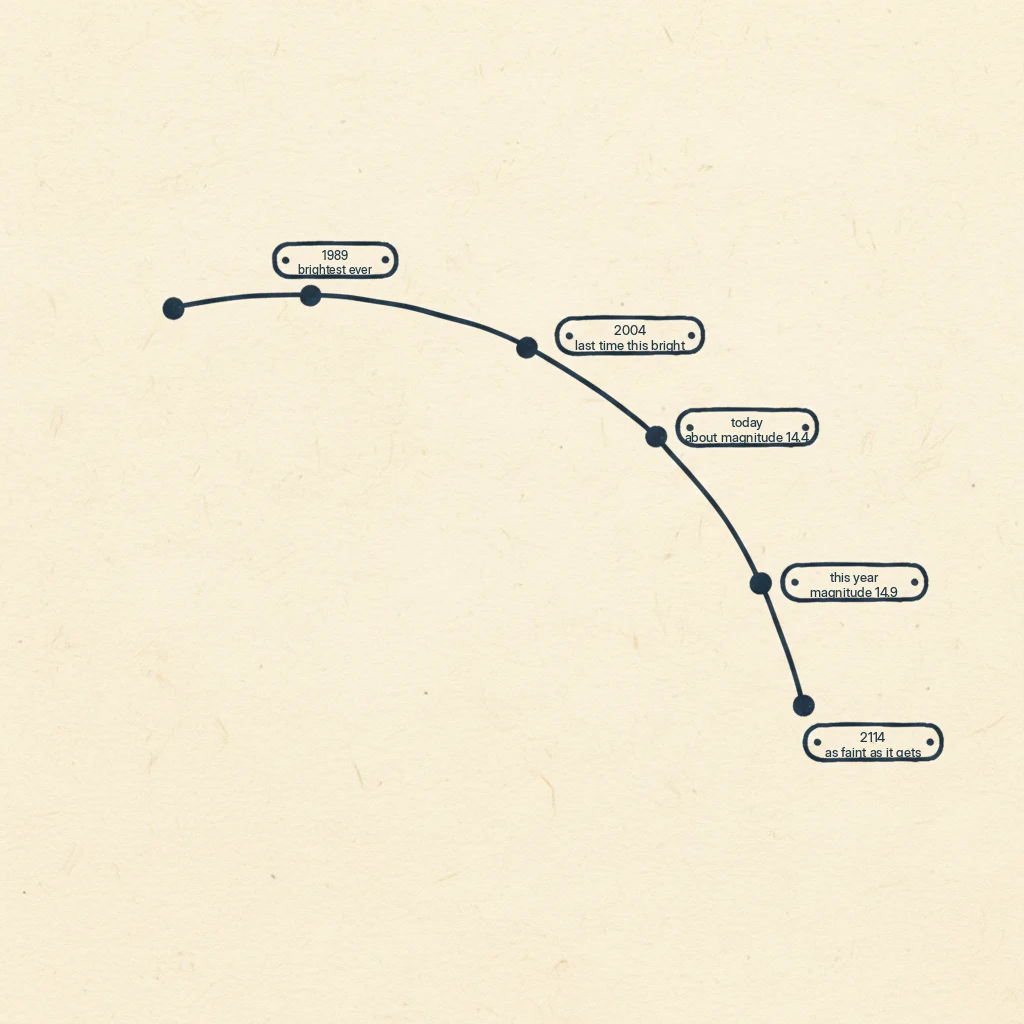
Faint enough that the number tells the whole story. Astronomers measure brightness in magnitudes, where bigger numbers mean dimmer, and Pluto sits at about magnitude 14. One magazine astronomer pins it at 14.4. It comes to its yearly best, called opposition, around late July, and this year an almanac lists that peak at magnitude 14.9, still a faint dot, when it’s as good as it gets all year. That’s far, far below anything your eyes can see on their own. You aren’t straining to see Pluto. You’re using a telescope just to reach the doorstep of seeing it.
Now the quietly remarkable part, and it’s all documented. Pluto is getting fainter, and it will keep getting fainter for the rest of your life. It was at its brightest, magnitude 13.8, back in September of 1989, when it was closest to the Sun. It hasn’t been brighter than 14th magnitude since the fall of 2004. And it will keep dimming, year after year, as it drifts farther out on its long orbit, until it finally bottoms out around the year 2114.
I don’t tell you that to be sad about it. I tell you because it flips the whole question. Pluto isn’t something to get to someday. Someday it will be harder than it’s tonight, and it will never again be as bright as it was the year it was closest. If you’re ever going to chase it, the argument is to chase it soon.
How big a telescope, and why the experts don’t agree
This is where I have to do the thing I promised on the About page: when the experts argue, I tell you they argue, instead of handing you one confident number that isn’t the whole truth.
They genuinely disagree here. A writer for one astronomy magazine says flatly that an 11-inch scope will reveal Pluto, and that a standard 8-inch just won’t do the trick. A detailed observing guide puts a 130-to-200mm scope, which is roughly 5 to 8 inches, as hard but realistic, but only under a truly dark sky. The broader consensus lands around ten inches or more. So the honest range the people who actually try this argue over is something like 8 to 11 inches, and anyone who gives you one tidy number is skipping the argument.
But here’s what’s actually going on underneath the disagreement, and it’s the one thing all of them say: the sky matters more than the telescope. Under bright suburban or city skies, Pluto is usually impractical at any aperture. You can’t buy your way past a bright sky. A modest scope under a genuinely dark, moonless country sky will beat a big scope in a glowing suburb, every time.
I’ll be straight that this is the one place my usual rule breaks. On almost every page here I tell you that city light isn’t a dealbreaker, because the Moon and the planets shrug it off. Pluto is the honest exception. For this one faint dot, the drive out to the dark isn’t an upgrade you can skip. It’s the whole game. A rule that admits where it stops working is a rule you can trust the rest of the time.

The one instinct that makes it worse
Every other page in this corridor fights the same trap, and here it reaches its purest form. Faced with the faintest, most distant thing in the sky, your gut says: turn up the power. Crank the magnification until it’s big enough to see. On Pluto, that’s exactly backwards, and not by a little. Cranking the power darkens the image and shrinks the patch of sky you’re looking at, which makes Pluto harder to find, not easier. The observers reach for medium magnification, not extreme.
This is the whole reason the number on a telescope box is a lie, proven on the one object nobody can sell you a scope for. A box shouting 600x isn’t just useless for Pluto. It’s worse than useless. Aperture, the width of the light-gathering end, and a dark sky are the only two things that help, and neither of them is the number the marketing shouts about.
So can a kid with a starter telescope see it?
In nearly all practical conditions, no, and I won’t dress that up. A small 70mm beginner scope, especially under anything but a black country sky, won’t get you Pluto. That’s not the scope’s failing and it’s not yours. It’s a real limit of a real object, and no purchase this week changes it.
But look at the shape of that “no,” because it matters. It isn’t “no, don’t be silly.” It’s “no, not with this, not tonight, and here is exactly what it would take.” And the same astronomer who says an 8-inch won’t cut it also writes that once you finally do run down that distant dot, time-consuming as it is, you feel a sense of accomplishment for having done it. That feeling is real, and it’s still out there waiting for you. It just isn’t a thing you unwrap on a Tuesday.
Every close-up picture you’ve ever seen of Pluto, the famous heart-shaped plain, the mountains, the blue haze, was made by NASA’s New Horizons spacecraft, which flew past Pluto in 2015, because from here, no telescope will ever show its face. You can’t see it from your backyard. But we went and looked from up close, and now we know what’s there.
That faint dot in the eyepiece is still worth the trip. It’s real light that left an actual, genuine world out at the far edge of the Sun’s family and ended its long journey inside your eye. Small, anonymous, easy to miss, and completely real. Which, if you think about it, is the whole point of looking up.
Questions people actually ask
Can you see Pluto with a backyard telescope?
Not as anything but a faint, anonymous dot, and only with real effort. You need roughly an 8-to-11-inch scope under a dark, moonless sky, and even then Pluto looks identical to the faint stars around it. There’s no disc and no detail at any magnification. You confirm it only by sketching the field and returning a couple of nights later to see which point has moved.
What magnification do I need to see Pluto?
Less than your instinct says, because power works against you here. High magnification darkens the view and narrows the field, making a faint dot harder to pick out, not easier. Experienced observers use medium magnification. What actually determines whether you can reach Pluto is aperture and, far more than that, how dark your sky is. The magnification number on the box is irrelevant.
Why can’t I see Pluto like the pictures?
Because those pictures were taken by a spacecraft that flew right past it. No telescope on Earth, at any price, resolves Pluto into a disc, so it can never look like the famous close-ups. From here it’s a point of light and nothing more. That’s not your telescope falling short. It’s the distance, and it’s the same for every telescope on the planet.
Is it worth trying to see Pluto at all?
If you go in knowing it’s a dot you have to prove rather than a world you get to admire, yes, it can be a real thrill, the same catch-it-moving method that discovered it in 1930. Just don’t buy a telescope this week expecting it. Buy for the Moon and the planets that reward you now, and put Pluto on the list for a future dark-sky trip.
What I’d actually do
If a kid in your life is set on Pluto, don’t rush out and spend a fortune chasing a dot they probably won’t catch this year. Point the scope at Saturn tonight, where the rings are waiting and the win is guaranteed, and keep Pluto as the long game: the trophy you go collect the summer you finally drive somewhere truly dark. Wanting to see the far, forgotten planet is exactly the right instinct. It just keeps a slower appointment than the others.
A few things you’re probably also wondering:
- If you’re buying real aperture and driving to the dark anyway, aim it at what actually rewards you: best telescope for deep space.
- Want a guaranteed win tonight instead? See telescope to see the moon.
- Curious what a telescope honestly shows across the sky? See what can you see with a telescope.
- Wondering about the planet that keeps a two-year appointment? See telescope to see mars.
- Just starting out and not sure what to buy? See best cheap telescope.
Ray Ostrander
Ray spent three decades explaining the sky to twelve-year-olds and their parents, and every January, hearing which Christmas telescopes ended up in the closet. He doesn't own a wall of gear and won't pretend to. He reads everything, tells you what owners agree on, and flags what's just his judgment. His goal is simple: no more January closets.