
What Can You See With a Telescope, Honestly
The Moon is spectacular. Saturn's rings and Jupiter's moons are small but unmistakable. Galaxies and nebulae are faint grey smudges, not the colorful photos, because your eye is not a camera. Here's the whole honest ladder before you spend a dime.
 Ray Ostrander · Updated July 24, 2026 · how I decide
If you buy through a link here, the site earns a little. It's never why anything gets picked.
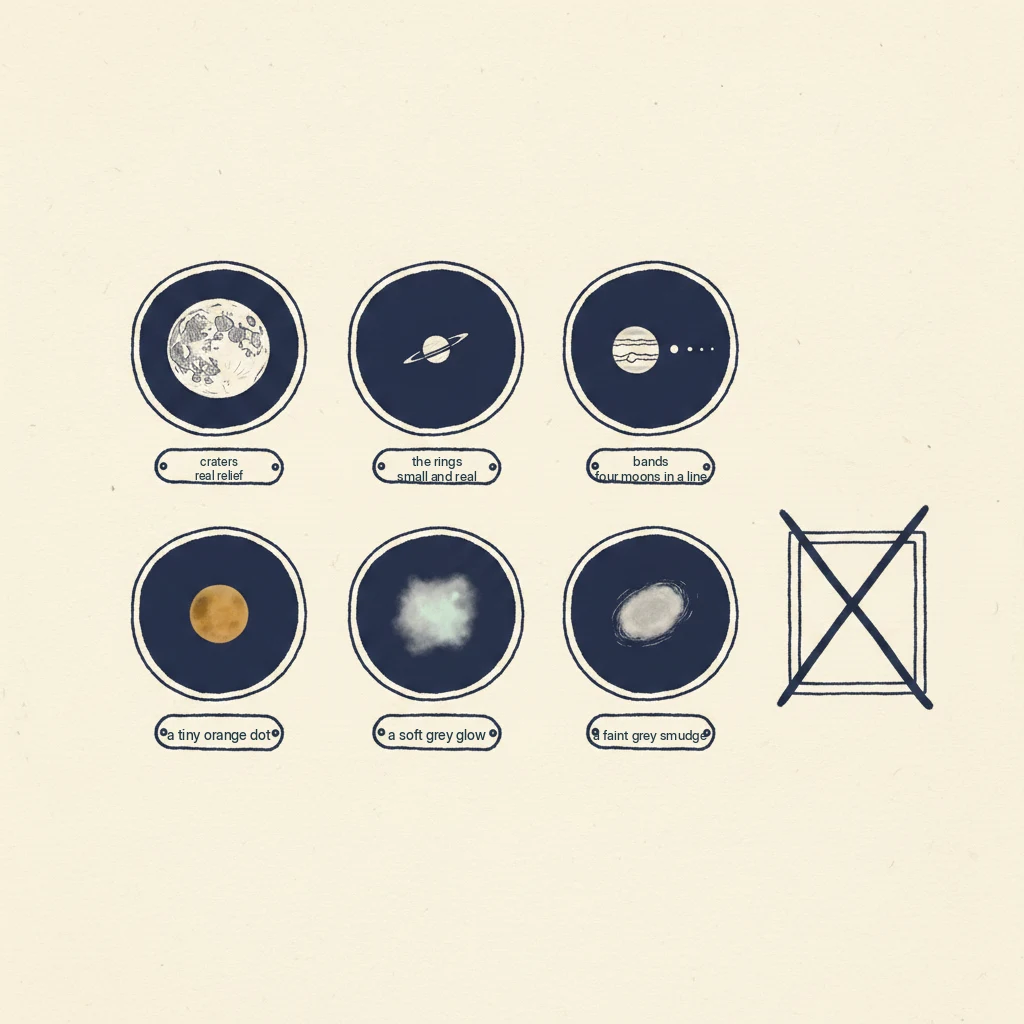
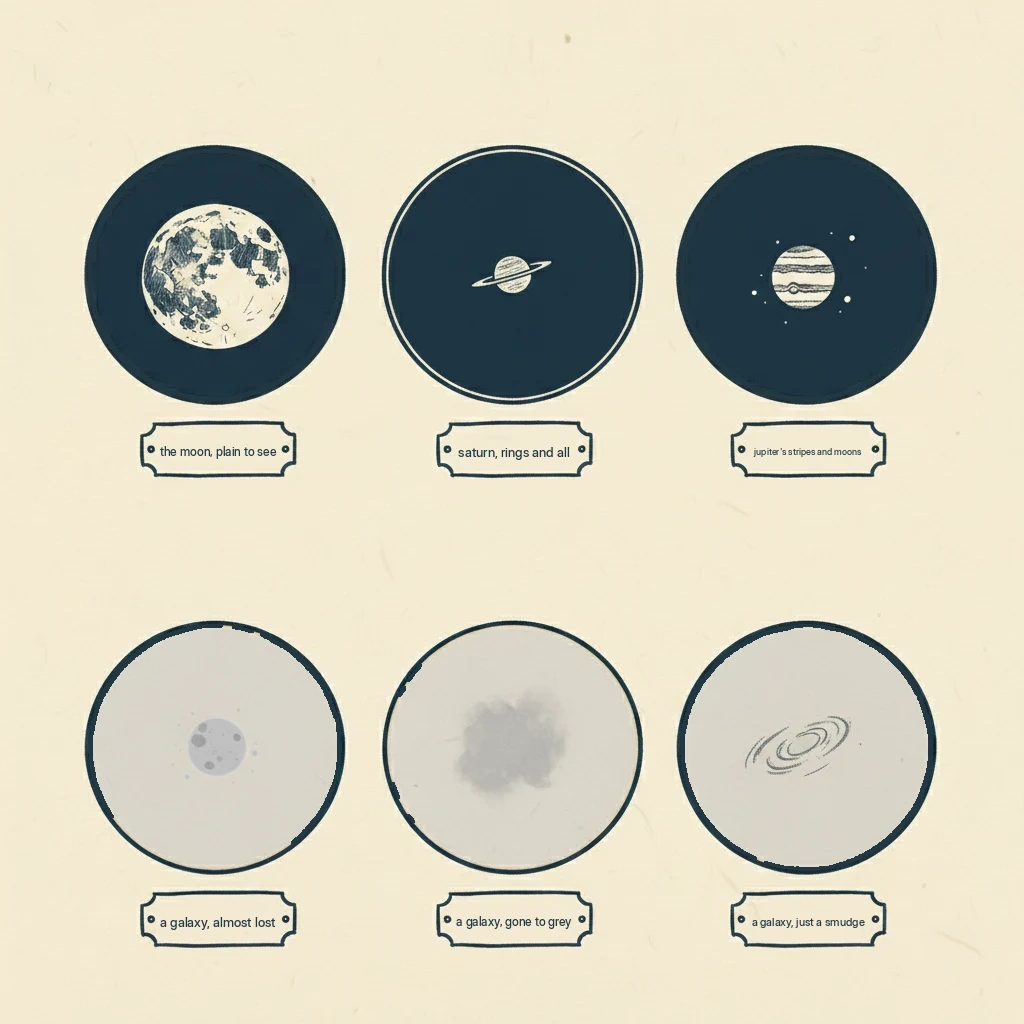
Here’s the honest ladder. The Moon is spectacular: craters, mountains, real relief you can trace with your eye. The planets are small but unmistakable, Saturn’s rings and Jupiter’s bands with its four moons lined up beside it. Galaxies and nebulae are faint grey smudges, not the vivid colored photos, because your eye isn’t a camera. You can’t see the flag on the Moon from any backyard on Earth, and light pollution barely touches the Moon or planets.
That’s the whole truth, and I’m going to spend this page proving that the truth is better than the poster. Because I think the thing that kills more telescopes than any wobbly tripod is the gap between the picture on the box and the thing in the eyepiece. Let me close that gap for you now, before the wonder has a chance to curdle.
What's on this page
- Why the photos and your eye disagree
- The Moon: the one that never disappoints
- The planets: small, but unmistakably real
- Galaxies and nebulae: the grey truth, told straight
- How far can you see, and can you see the flag on the Moon?
- What this means before you spend anything
- Questions people actually ask
- Buy the truth along with the scope
Why the photos and your eye disagree
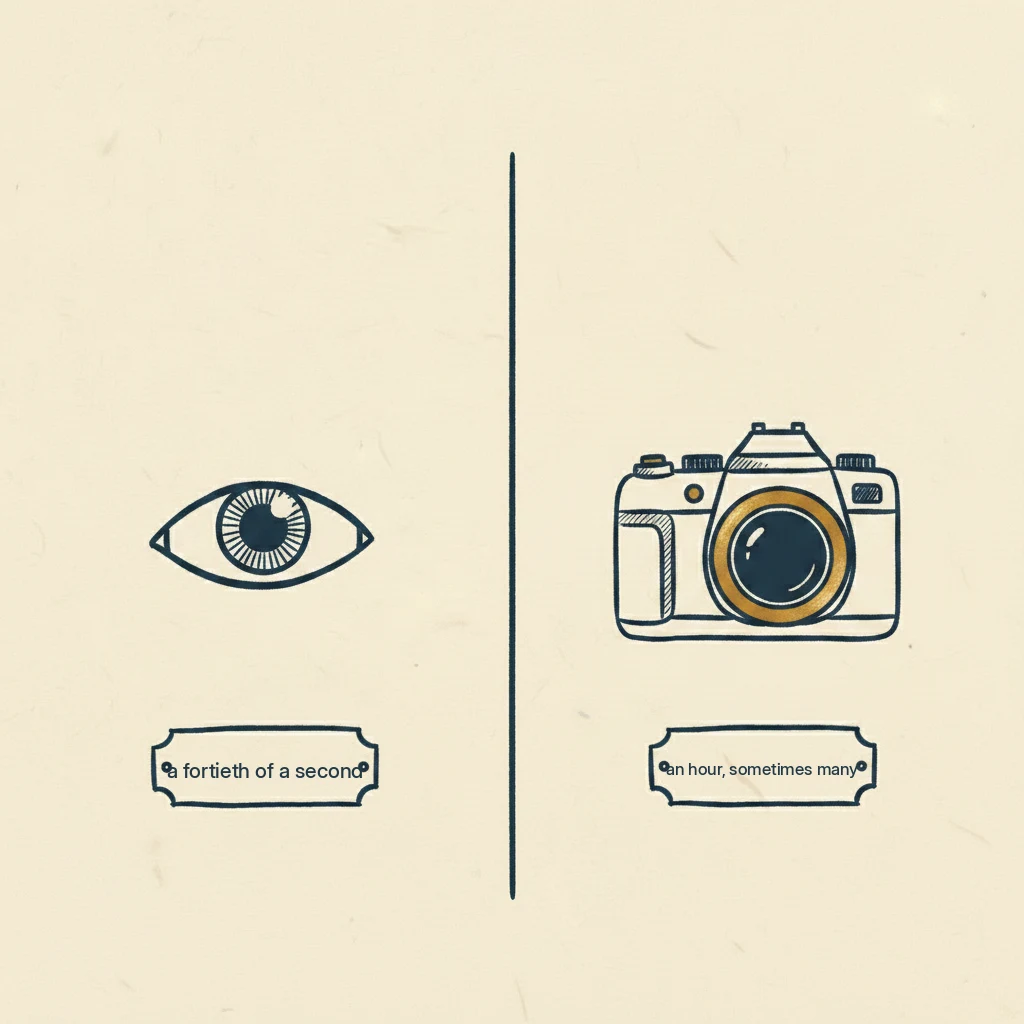
Start here, because everything else on this page hangs on it. Every stunning space photograph you’ve seen was made by a camera that collected light for an hour, sometimes many hours, and then a computer stacked those exposures together and pulled the color out. Your eye can’t do that. Here’s what’s actually happening at the eyepiece: your eye is a live sensor with no shutter, gathering light for about a tenth of a second at a time, maybe a fifth of a second once it’s dark, then throwing away what it caught and starting over. It gets a tenth of a second where the photograph got an hour.
So when a magazine astronomer calls the difference between astrophotography and the way these things actually look to the eye one of the biggest learning experiences for anyone starting out, he isn’t warning you that your gear is weak. He’s telling you the camera and your eye are two different instruments doing two different jobs. The photo isn’t a lie exactly. It’s a lie of omission, and this page is the omitted part.
The Moon: the one that never disappoints
Lead with the Moon, always, because it’s the payoff and it delivers every single time. Craters with real shadows, mountain ranges along the day-night line, a surface that looks carved. One honest observer notes that at the eyepiece the craters are often softer and more subtle than a sharpened photo suggests, and that the Moon seems to gently wobble as the air moves, with the finest detail arriving in brief still moments. That wobble isn’t a flaw. It’s you looking through an ocean of atmosphere at another world.
And here’s the part that rescues every reader stuck under city lights: the Moon is bright enough to punch through even extreme light pollution. Your streetlights, your neighbor’s floodlight, the glow of downtown, the Moon shrugs off all of it. If you own a telescope and you live somewhere bright, the Moon is your guaranteed win on the very first clear night.
The planets: small, but unmistakably real
This is where expectations need the most careful handling, so let me be plain. Through even a good scope, the planets are small. Their angular diameters are genuinely small, and the instinct to crank the magnification to make them bigger backfires, because more power just makes the overall view fainter and mushier. Medium magnification is usually the better bet. What you get is small and sharp and, once you know what you’re looking at, thrilling. Here’s what each one actually shows, drawn from an observer’s honest per-planet account:
- Saturn. The rings show up clearly at only about 25 times magnification in a good small scope, with Titan, its big moon, nearby as a starlike point. Push to about 100x and the Cassini Division, the dark gap inside the rings, comes out. Saturn’s rings in a cheap scope are the best proof on this whole page that you didn’t need to spend a fortune.
- Jupiter. The most interesting and accessible target for a small telescope. Its four big moons are so easy that even binoculars show them. At about 30x you get the disc and one or two brown bands crossing near the equator; at about 100x, the polar regions too. The Great Red Spot takes a mid- to large-sized scope.
- Mars. Worth the wait, because it’s genuinely good only about once every two years when it comes close. At its best, 50 to 100x in a small scope shows dark surface markings and maybe a glimpse of an ice cap.
- Venus and Mercury. Not much detail, but a real reward of a different kind: they show phases, like little moons, Venus best shortly after sunset when it isn’t drowning you in glare.
- Uranus and Neptune. Tiny, featureless discs, findable but faint: Uranus starts to show a disc around 50x, Neptune not until about 150x. Seeing them at all is the accomplishment.
Galaxies and nebulae: the grey truth, told straight
Now the hard part, and I won’t dress it up. Galaxies, in a small telescope, look like faint smudges or spots of grey light. Not the glittering swirls from the Hubble images. A nebula shows no dazzling colours at all; at the very most, on a good night with a practiced eye, you might detect a slight hint of a mint-green hue. That’s it. That’s the real reward.
And I want to make the case that the mint-green hint is better than the poster, not worse. Not because it’s prettier, because it plainly isn’t, but because it’s real light that left a cloud of gas in space and ended its trip inside your own eye. You didn’t download it. You didn’t let a computer build it for you over a weekend. You stood in the cold and earned a faint green smudge that is, unmistakably, another place. I’ve watched that land on a person’s face, and it beats the poster every time, precisely because they had to work for it.
A few deep-sky objects do more than smudge. Andromeda shows as a diffuse ellipse of light crossed by dark dust lanes, with its two main satellite galaxies flanking it. The Pleiades star cluster is a mass of brilliant blueish-white points of light in a low power eyepiece. A bright globular cluster resolves, with enough aperture, into a granular mass of countless stars.
But this is the one place light pollution really does steal from you. A bright sky drowns out the light from faint objects like galaxies and nebulae, and from a genuinely light-polluted sky you may be left with M31 and little else. This is why the serious deep-sky people don’t tell you to buy more telescope. They tell you to drive. Thirty minutes to a darker site does more for a galaxy than adding two inches of aperture, and a 12-inch telescope under suburban skies can be outperformed by a 6-inch under pristine dark skies. I’m not the deep-sky expert here, I taught earth science, not astronomy, and on this part I’m just reporting what the serious observers all say. If chasing those grey smudges is what lights you up, the full case lives on best telescope for deep space.
How far can you see, and can you see the flag on the Moon?
These two questions come up constantly, and they have a clean, honest answer that has nothing to do with your telescope being cheap.
“How far” is the wrong measure, and I say that gently, not to correct you. A backyard scope shows Andromeda, which is 2.5 million light-years away, so distance isn’t really the limit. The limit is how small a thing your instrument can pull apart, and that’s where the flag question gets its real answer.
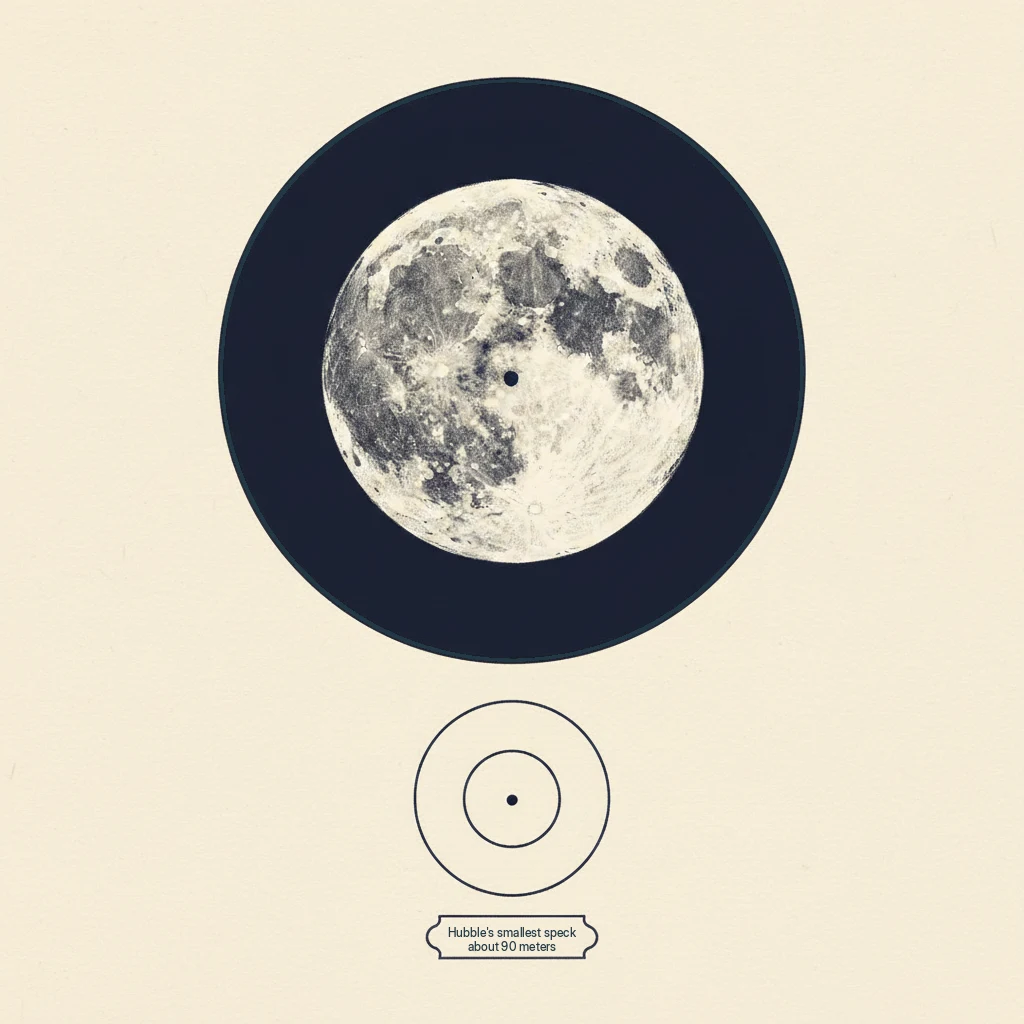
Can a telescope see the flag on the Moon? No, and it isn’t close. Here’s the physics, from an astronomer writing for a science magazine. The Hubble Space Telescope, at its best, can resolve objects no smaller than about 90 meters across at the Moon’s distance. The Apollo landers left down there are only about four meters across. So the most powerful telescope most of us have ever heard of can’t even make out the lander, let alone the flag, which is far smaller still. This isn’t a failing of your scope or Hubble’s. It’s the size of the thing against the distance.
And there’s a lovely ending to that story. We did see them, just not from here. NASA’s Lunar Reconnaissance Orbiter carries a camera with a mirror only about 20 centimeters wide and flies at an altitude of only 50 km, and from up there it photographed the landing sites. In its pictures you can see the Apollo 11 lander and trails of boot prints from the astronauts, still sitting in the dust where they were left. You can’t see them from your yard. But somebody went and looked from close up, and they’re still there.
What this means before you spend anything
I’m not going to hand you a shopping list on a page about truth. But the truth points somewhere useful. The best stuff, the Moon and Saturn’s rings and Jupiter’s moons, needs almost no telescope at all. Saturn’s rings at about 25x and Jupiter’s four moons in plain binoculars means the honest floor of this hobby is genuinely cheap. A little tabletop scope under a hundred dollars, or a modest one around two hundred, already clears the bar for everything that reliably takes people’s breath away.
Money helps most with the faint grey stuff, and even there, past a point, gas in the car helps more than dollars on the tripod. So buy less than the fear is telling you to, aim at the Moon and the planets first, and save the deep-sky chase for later, or never, and that’s fine too.
Questions people actually ask
What planets can you see with a telescope?
All of them, to different degrees. Saturn with its rings and Jupiter with its bands and four moons are the easy, spectacular ones in any small scope. Mars is great about every two years when it’s close. Venus and Mercury show phases but little detail. Uranus and Neptune are findable but featureless. The planets, unlike galaxies, are pretty much completely unaffected by light pollution.
Why does what I see look nothing like the photos?
Because a camera and your eye are different instruments. The photos are long exposures, up to hours if necessary, stacked and color-enhanced by software. Your eye collects light for about a tenth of a second at a time, and the cells that work in the dark, the rods, produce only a grey-scale image without color. What you see is dimmer and greyer, and it’s also real light arriving live, which the print on the box never was.
Can you really not see the Apollo flag or landing sites?
Correct, and it’s about size, not conspiracy. Even Hubble can’t resolve anything smaller than about 90 meters at the Moon, and the lander is about 4 meters. No Earth-based telescope beats that by the margin you’d need. NASA’s Lunar Reconnaissance Orbiter did photograph the sites, including boot prints, because it orbits only about 50 kilometers up. Close beats big.
Is a telescope worth it if the views are that small?
Yes, if you go in knowing what “worth it” looks like. The Moon will genuinely floor you. Saturn’s rings in a cheap scope are a moment people remember for life. What ruins the experience isn’t the small view, it’s the poster-sized expectation nobody corrected first. Correct it, and a modest telescope is one of the best wonder-per-dollar buys there is.
Buy the truth along with the scope
If you’re deciding whether to buy, buy, but buy the truth along with the scope: tell whoever’s looking that the Moon is amazing, the planets are small and real, and the galaxies are faint grey ghosts you have to earn. Set that expectation out loud, and I’ve never seen the real sky lose to the box.
A few things you’re probably also wondering:
- Bought one and it isn’t showing you anything? See how to use a telescope.
- Want the Moon in detail, the guaranteed win? See telescope to see the moon.
- Curious what a small scope does with Jupiter? See telescope to see jupiter.
- Wondering about the one planet you never actually see? See telescope to see pluto.
- Ready to buy less than the fear says? See best cheap telescope.
Ray Ostrander
Ray spent three decades explaining the sky to twelve-year-olds and their parents, and every January, hearing which Christmas telescopes ended up in the closet. He doesn't own a wall of gear and won't pretend to. He reads everything, tells you what owners agree on, and flags what's just his judgment. His goal is simple: no more January closets.