
The Telescope to See Mars, and Why the Date Matters More Than the Scope
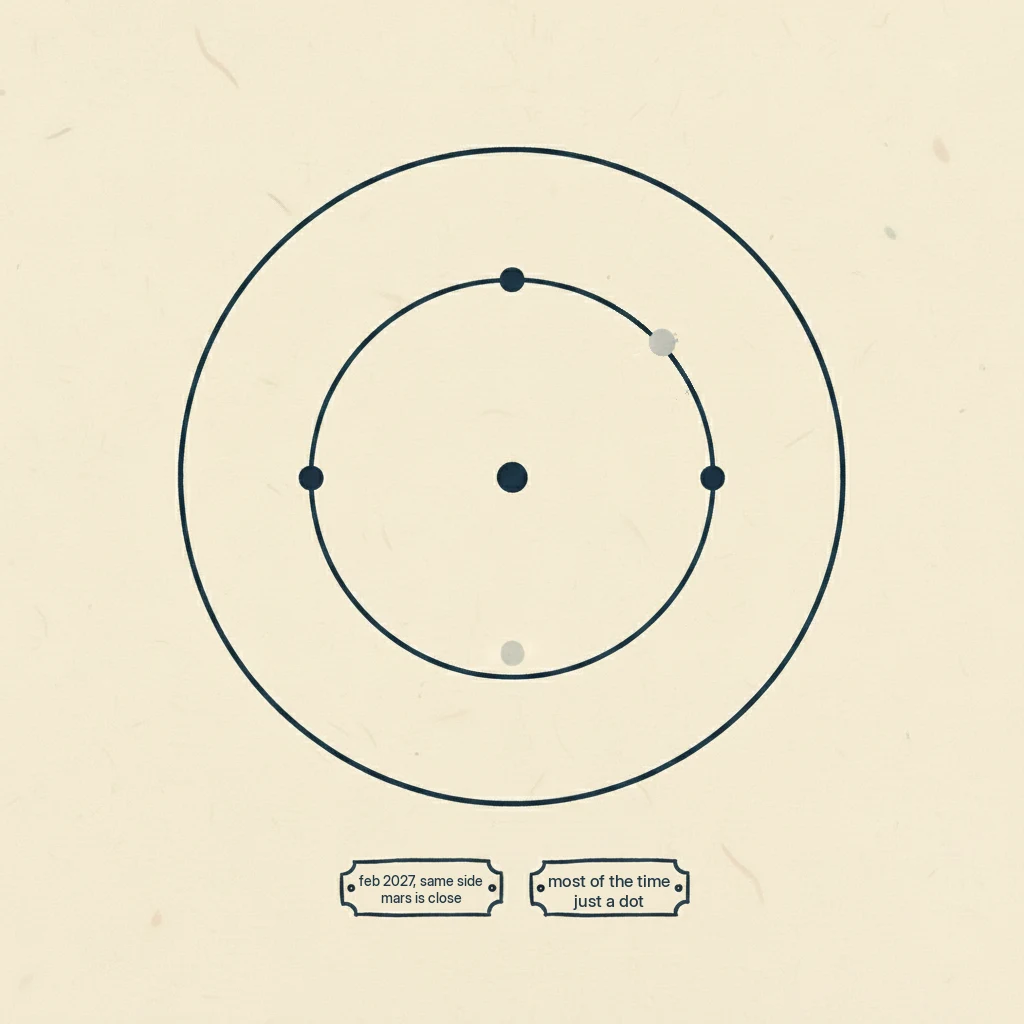
Mars is only worth looking at for a few months around opposition, roughly every two years. The next is February 19, 2027. Any other time it's a tiny dot in any telescope. At opposition a 4-inch scope shows the polar cap and dark markings.
 Ray Ostrander · Updated July 24, 2026 · how I decide
If you buy through a link here, the site earns a little. It's never why anything gets picked.
Here’s the honest answer, and it surprises people: Mars is only worth looking at for a few months around what astronomers call opposition, which comes around roughly every two years. The next one is February 19, 2027. Any other time, Mars is a tiny, featureless dot in any telescope, cheap or expensive, and no amount of money changes that. At opposition, a small scope shows the white polar cap and the dark surface markings, and more aperture brings out the finer detail.
So this is the one planet where the most important thing you own isn’t the telescope. It’s a calendar. Let me explain why, because getting this right is the difference between a kid who’s thrilled and a kid who thinks the telescope is broken.
What's on this page
Why Mars comes and goes
Here’s what’s actually happening up there. Earth runs on a faster, inside track around the Sun, and Mars runs on a slower, outside one. Most of the time we’re on opposite sides of the Sun from Mars, tens of millions of miles further apart, and from that distance even a good telescope shows a small orange point and nothing else. Then, every couple of years, Earth catches up and passes Mars on the inside, and for a few months we’re close enough to actually see the weather on another planet. That catch-up moment is opposition. It’s not a trick of the telescope. It’s the geometry of two racetracks.
That’s why Mars is the only target on this whole site with a failure mode you can’t fix by spending more. Saturn’s rings are there every year. Jupiter’s belts are there every year. Mars is a two-year appointment, and if you show up in the wrong month, the best telescope in the world hands you the same orange dot as the cheapest one.
What you actually see, at opposition and only then
When the timing is right, Mars rewards you, but keep the picture honest. Through the eyepiece it’s a small ochre disc, and careful looking brings out the more prominent dark markings, features with names like Syrtis Major, along with a bright white polar cap. That’s the real prize: an ice cap on another world, from your backyard.
There’s a genuine, useful disagreement about how much scope you need, and I’ll give you both sides instead of splitting the difference into a wrong number. One retailer’s astronomy guide says that even a small scope at 50 to 100x can show the dark markings and maybe an ice cap when Mars is close. Experienced observers set the bar higher for fine detail: one guide notes Mars only becomes a real target for medium and large telescopes once its disc reaches about 6 arcseconds across, and that catching a local dust storm on it takes a 150mm scope or larger. Both can be true at once: a small scope catches the big markings and the cap, while more aperture earns you the finer stuff.

About 2027, told straight
The 2027 opposition is a good one to plan around, and I want to describe it accurately rather than hype it or run it down. Compared with the last one in 2025, Mars in February 2027 will appear a touch smaller, about 0.8 arcseconds less across, and it sits about 9.4 degrees lower in the sky. That lower position matters for a practical reason I’ll come back to. But the observing organization that tracks this closely still says observers will get an excellent view of the prominent north polar cap, with Mars showing a usable disc for nearly nine months around the event. So: not the biggest Mars of the decade, and genuinely worth your February either way.
The trap: the photos you’ve seen are lies of a special kind
Every planet page on this site has to fight the poster, but Mars has the worst version of the problem, so brace for it. The image of Mars in your head is almost certainly a surface photograph, a landscape of red rocks and a dusty horizon, taken by a robot standing on the planet. No backyard telescope on Earth shows anything remotely like that. What you get is a small ochre disc with a white cap and some dark smudges. The gap between those two pictures is the widest of any object in the corridor, and if nobody warns you, a perfectly good view feels like a rip-off. Now you’re warned, and the small disc with the ice cap is genuinely thrilling once you know it’s the real thing.
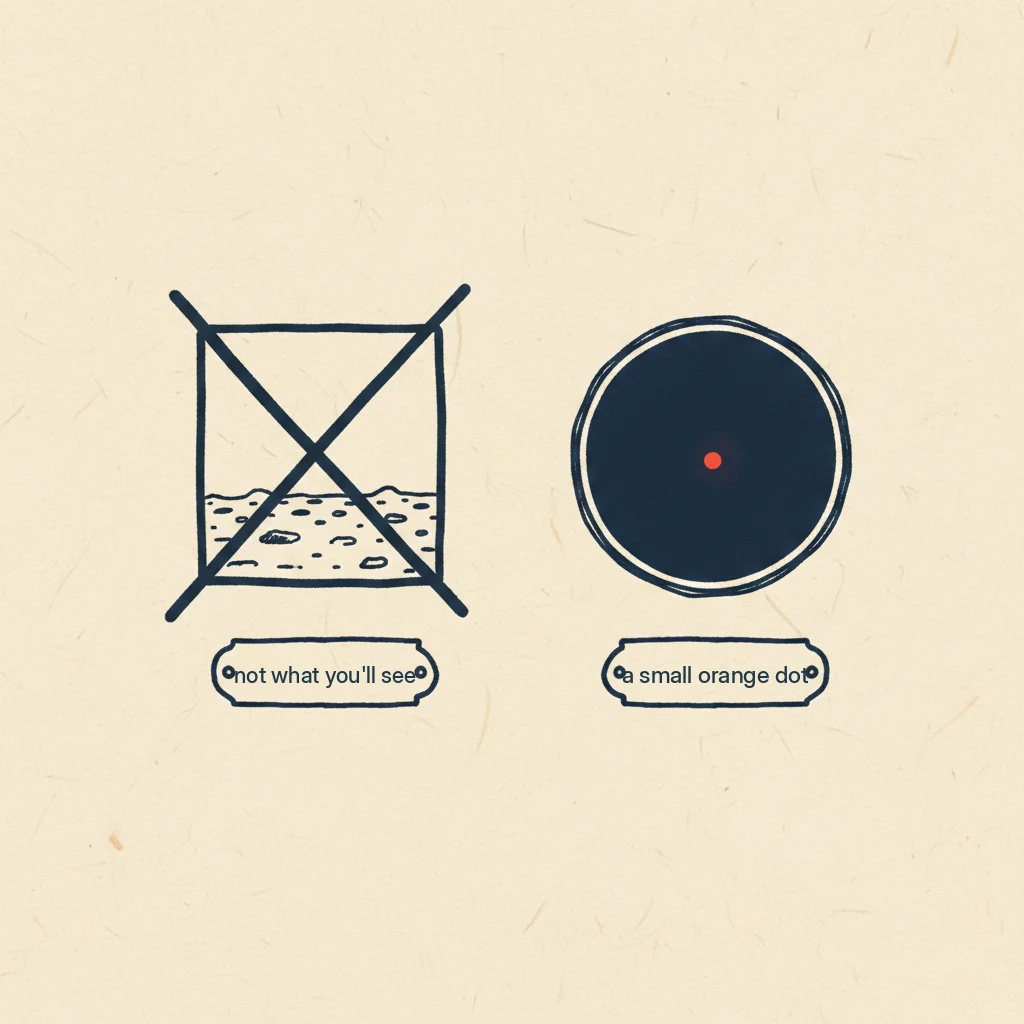
Two more things that aren’t your telescope’s fault. First, you can’t magnify your way to a closer planet. Cranking the power on an out-of-season Mars just makes a dim, blurry, bigger dot, because useful magnification is capped at about 50 to 60 times the aperture in inches, so a small scope runs dry around 120 to 140x. Second, even at opposition, Mars in 2027 sits low in the sky, and low targets shoot their light through more of our turbulent atmosphere, so expect the disc to shimmer and boil at high power on many nights. Wait for a steady one. None of that’s a defect.
The Mars shelf, if you’re buying anyway
Plenty of people will buy a scope for Mars regardless, because it’s a gift-list planet, and that’s fine. All researched, none of it looked through by anyone here, prices rounded to what I’m seeing as I write this, and where a price is scattered I’ll tell you the spread rather than invent a middle.
- Sky-Watcher Heritage 130P, about $230 to $280. Right at the useful floor for real Mars detail.
- Celestron StarSense Explorer LT 114AZ, about $260. Your phone helps you find Mars, which matters more than you’d think when it’s just another orange point in a crowded sky.
- Sky-Watcher Heritage 150 tabletop, about $355. Into the 130 to 200mm range where the finer detail lives.
- Sky-Watcher Skymax 127, about $509. A long 5-inch Maksutov, a natural high-contrast planet tube.
- Celestron NexStar 4SE, about $649, if you want the mount to find and track Mars for you.
- Celestron AstroMaster 70AZ. Prices run from about $150 up to the maker’s sticker near $200. Enough to show a disc at opposition, though this is more a general beginner scope than a Mars specialist.
If you want to reach high power for Mars detail, a quality 5mm eyepiece runs about $110 as I write this, and a wide 32mm for finding your way around is about $50. Cheaper generic eyepieces exist, but I won’t quote a price I can’t stand behind.
The real accessory, though, costs nothing. Circle February 19, 2027, on the calendar, and point the scope at the Moon and Jupiter until then.
Questions people actually ask
What’s the best telescope to see Mars?
The honest answer starts with the calendar, not the catalog. If you’re looking around the February 2027 opposition, a scope of about 100 to 130mm shows the polar cap and dark markings well, and a 5-inch does even better. Outside that window, any telescope shows the same small orange dot, so buy for Jupiter and Saturn now and treat a good Mars as a bonus that arrives on schedule.
Can you see Mars with a small telescope?
Yes, when Mars is close. Around opposition, a small scope at 50 to 100x can show the dark surface markings and, on a good night, the white polar cap. It will always be a small disc, never a rover’s-eye landscape. The bigger factor by far is timing: a small scope at opposition beats a large scope in the wrong month, every time.
Why does Mars just look like a dot in my telescope?
Almost certainly because Mars is currently far away on the other side of its two-year cycle, not because your telescope is bad. When Earth and Mars are on opposite sides of the Sun, there’s simply nothing more to see than a bright orange point at any magnification. Check when the next opposition is, and in the meantime turn the scope on the Moon, which never disappoints.
Can I see Mars from the city?
Yes. Like the other bright planets, Mars shrugs off light pollution almost entirely, so a city backyard shows the same disc as a dark rural site. City light steals the faint galaxies, not the planets. Your limiting factors for Mars are the calendar and the steadiness of the air, not your streetlights.
The honest bottom line
If a kid wants to look at Mars, don’t rush out for a telescope this week and hand them an orange dot. Point them at the Moon and Jupiter now, circle February 19, 2027, and buy the scope with that date in mind. Event-driven curiosity is real curiosity, and Mars is one of the few wonders in the sky that actually keeps an appointment. The date is the gear.
A few things you’re probably also wondering:
- Want a planet that delivers every single year instead? See telescope to see jupiter and best telescope to see saturn.
- Wrong month for Mars? The Moon is always in season: telescope to see the moon.
- Wondering what a telescope really shows across the board? See what can you see with a telescope.
- Curious about the planet you can never actually see? See telescope to see pluto.
- Working out the budget? See how much does a telescope cost.
Ray Ostrander
Ray spent three decades explaining the sky to twelve-year-olds and their parents, and every January, hearing which Christmas telescopes ended up in the closet. He doesn't own a wall of gear and won't pretend to. He reads everything, tells you what owners agree on, and flags what's just his judgment. His goal is simple: no more January closets.