Binocular Harness: Open Strap or Closed Pack, and What Each One Costs You
A harness moves your binoculars off your neck and onto your shoulders, and stops the swinging. The real decision isn't the brand, it's open harness versus closed pack: one is faster to your eyes, the other protects the glass. Here's the trade, and how to size one to the binoculars you already own.
 Ray Ostrander · Updated July 25, 2026 · how I decide
If you buy through a link here, the site earns a little. It's never why anything gets picked.
Buy a harness, not a better neck strap, because the harness moves the weight off the back of your neck and spreads it across both shoulders. That’s the whole mechanical point, and padding never fixes it. But once you’ve decided on a harness, there’s a second choice nobody on the shelf explains, and it matters more than the brand on the label: an open strap harness gets the glass to your eyes fastest and leaves it exposed to rain, brush and dust, while a closed pack stops the swinging completely and protects the optics, at the cost of one extra step before you can look at anything.
That’s the trade. Everything else is straps and pockets.
I should say plainly what kind of question this is, because Google has already decided. Search for a bino harness and you’ll get hunting gear: FHF Gear, Badlands, Vortex, and a stack of Western hunting articles. That’s not an accident. Hunters glass for hours from a hillside, so they solved this problem first and they buy the most of these. If you’re a birder or a hiker, the answer is mostly the same and I’ll get to where it differs, but the market you’re shopping in was built for somebody sitting on a ridge at first light.
What's on this page
- The problem isn't your neck, it's where the weight hangs
- Open harness or closed pack, and this is the actual decision
- Will it even fit the binoculars you already own? Three makers, three different rules
- Magnetic or zippered, and the noise nobody mentions
- Fit over layers is the thing people get wrong
- What a harness does to the rest of your gear
- If you're birding or hiking rather than hunting
- Questions people actually ask
- What I'd tell somebody at the counter
The problem isn’t your neck, it’s where the weight hangs
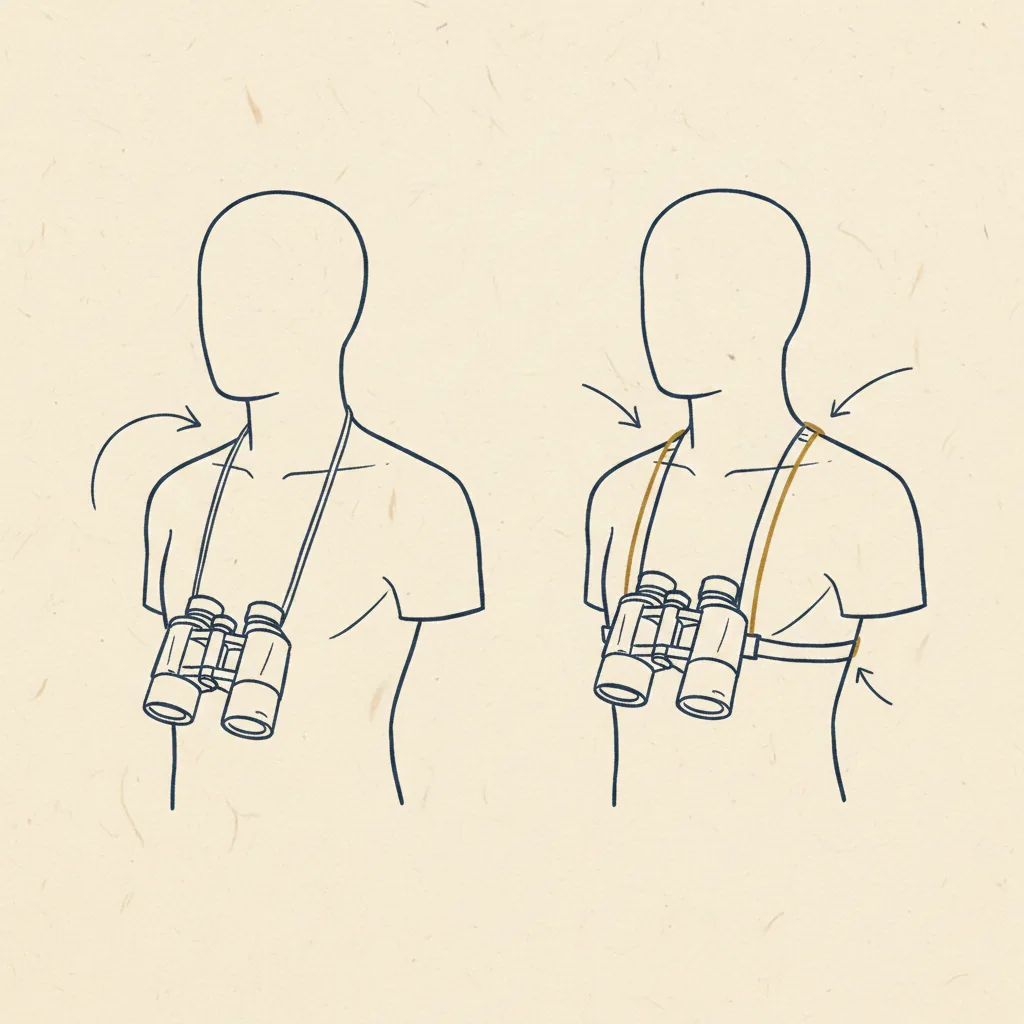
A neck strap hangs a pound and a half from the small bones at the top of your spine, in front of your body, on a lever arm. Your neck muscles hold it there all day. A harness runs the load over both shoulders and takes it into your back, which is built to carry things, and it keeps the binoculars pinned against your chest instead of swinging on a hinge.
That’s why a harness works, and why padded straps sold as an upgrade answer the wrong question. Padding spreads pressure. It doesn’t change where the load goes. If your neck aches after a morning out, the fix is a different load path, not softer contact.
The swinging is the other half of it, and it’s the part that damages things. Binoculars on a neck strap swing forward when you bend over, bang into rocks when you crawl, and knock against a rifle or a trekking pole with every step. Both harness types stop that, which is genuinely the biggest single reason to buy one.
Open harness or closed pack, and this is the actual decision
An open strap harness is a set of straps that clip to your binocular’s own strap lugs. Nothing covers the glass. You reach up, the binoculars are already in your hands, and you’re looking. It weighs almost nothing and it costs the least.
A closed pack is a small box on your chest with a lid. The binoculars sit inside it. Some of them are genuinely both: Vortex ships its GlassPak as a harness strap plus a binocular case with a full coverage lid held shut by a bungee and a nylon tab, two mesh side pockets, a zippered back pocket, and two tether straps that keep the binoculars attached to the harness even when the lid is open. The whole thing weighs 8 ounces and lists at $44.99.
Here’s what you’re actually choosing between.
| open strap harness | closed pack | |
|---|---|---|
| speed to your eyes | fastest, nothing to open | one step: open the lid first |
| rain, snow, dust | lands on your lenses | kept off entirely |
| brush and branches | drags across the glass | protected |
| crawling and climbing | objectives face out | body of the pack takes the hit |
| noise | quiet, no closure to work | depends on the closure |
| bulk on your chest | almost none | a real box, and you’ll notice it |
| extra storage | none | rangefinder, wind meter, tags, spare batteries |
If you glass in short bursts and the weather is fine, the open harness is the better tool and it’s cheaper. If you’re in timber, on your belly, or out in weather, the pack pays for itself the first time you skid down a slope.
The one thing I’d push back on is the idea that the pack is slow. It’s one motion, and you learn it in a day. What it genuinely costs you is the moment where you’re already looking through your binoculars before you’ve consciously decided to, and if you’re the kind of person who catches movement out the corner of your eye and wants glass on it in half a second, you’ll feel that.
Will it even fit the binoculars you already own? Three makers, three different rules
This is where people get burned, and it’s the part the round-up pages skip entirely, because it requires reading three sizing charts that don’t agree with each other.
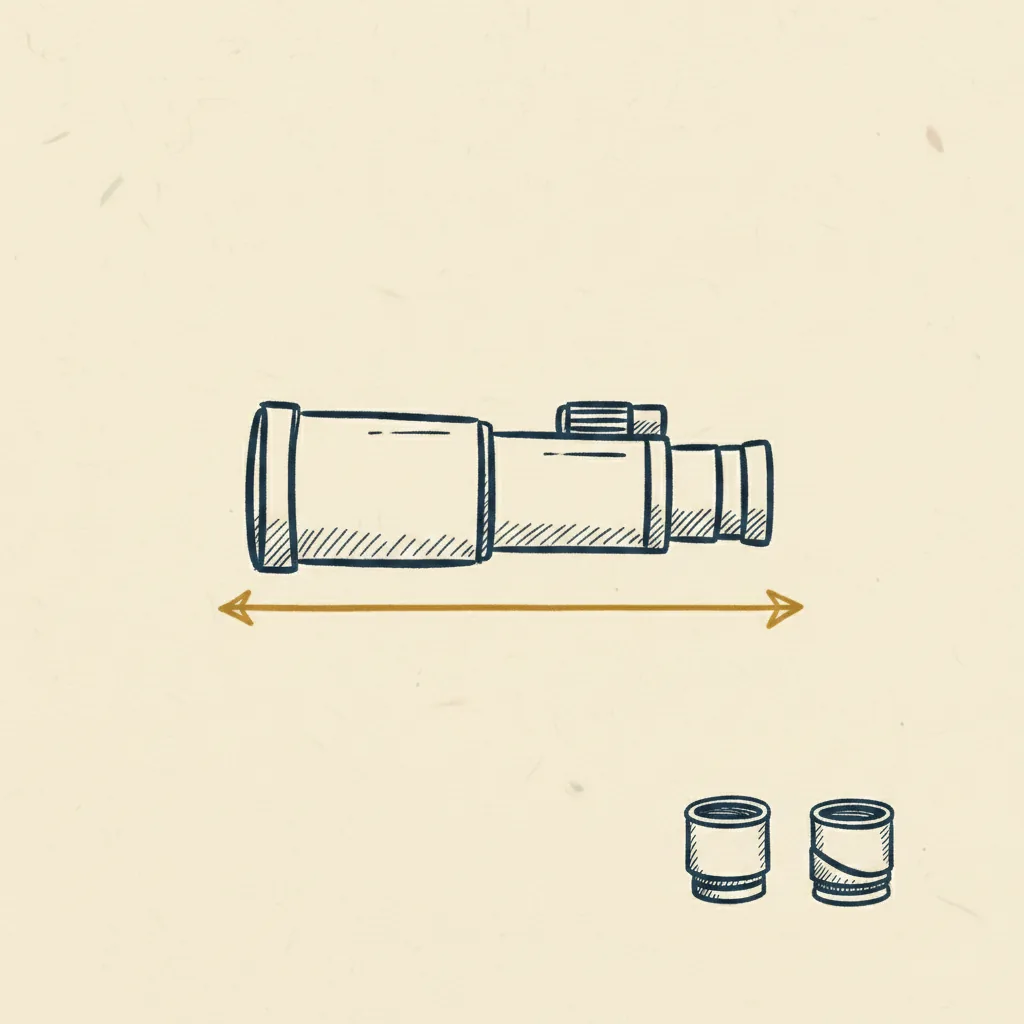
FHF Gear says the length of the binocular is the most important factor, because the lid has to make a tight seal over the lenses, and they tell you to measure your binoculars after you’ve adjusted the eyecups to the position you actually use.
Badlands does something different: they publish the usable internal space of each harness, height by width by depth in inches, measured with the eyecups down. Their Bino MAG 2 runs from 6.125 by 5.25 by 2.75 inches in Small up to 8.25 by 6.5 by 3 inches in Large.
Vortex takes the third road and just tells you the GlassPak carries a full range of full size binoculars, with the case dimensions given as 6.75 by 6.25 by 3.75 inches.
Read those two sizing rules again, because together they’re a trap. Badlands measures with the eyecups down. FHF tells you to measure with the eyecups where you keep them. If you wear glasses, your eyecups live in the down position and the charts agree with your life. If you don’t wear glasses, your eyecups are twisted out, which makes your binocular meaningfully longer than the number on any chart, and a harness sized off the chart may not close over them. Measure your own pair, eyecups set where you genuinely use them, before you order anything.
The practical version: put a tape on your binoculars from the front of the objective lens to the back of the eyecup, in your normal eyecup position, and buy for that number plus a little. If you’re between sizes, go up. A harness slightly too big is a minor annoyance. A harness that won’t close is a return.
Objective diameter is the other half of fit, and it’s the second number on your binocular. A 42mm pair is the mainstream size and nearly everything fits it. A 50mm or 56mm pair needs a specifically larger harness, and that’s the most common sizing mistake I see. If those two numbers on the box are a mystery, I’ve written out what they mean over on the number on the box.
Magnetic or zippered, and the noise nobody mentions
Closures sort cleanly by what they cost you.
Magnets are the fastest and the quietest to open, and that quiet matters if you’re trying not to announce yourself to something with better ears than you. What they don’t do is hold under real force. Push through brush hard enough and a magnetic lid can gap.
Zippers hold absolutely and they’re the most secure thing on your chest. They’re also the slowest, they need two hands often enough to be irritating, and a cold zipper with gloves on is a genuine fight.
Bungee and tab arrangements, which is the route Vortex went on the GlassPak, split the difference: fast, one handed, quiet enough, and they hold better than a magnet without the fuss of a zip.
If I had to pick a default for somebody who hasn’t done this before, I’d take the bungee and tab style, because the failure mode of a magnet is your binoculars ending up somewhere you didn’t want them. That’s a judgment call rather than a spec, and I’ve written out how I keep those two separate.
Fit over layers is the thing people get wrong
Adjustment range matters more than anyone expects, and here’s why: you size and fit the harness at home over a t-shirt in a warm room, and then you wear it in November over a base layer, a fleece and a shell. That’s easily three or four inches more chest and shoulder girth. A harness with a narrow adjustment range will bind, ride up, or sit too high on your chest to be usable.
So check it at home over the jacket you’ll actually wear, and confirm there’s slack left at that setting. A harness at the end of its adjustment over a shell is the wrong harness for winter, however well it fit in the store. Look for straps that adjust without unthreading, because the ones needing a rethread never do get adjusted in the field.
What a harness does to the rest of your gear
The chest is crowded. A backpack’s sternum strap wants the same real estate as the harness, and together they add up to a lot of webbing across your ribs. Most decent harnesses either sit under a pack’s shoulder straps cleanly or offer a way to detach quickly so you can drop the pack without a wrestling match.
That’s the case for quick detach buckles rather than a fixed loop. If you regularly take a pack on and off, or you carry a rifle on a sling that crosses your chest, being able to unclip one side of the harness in a second is worth real money.
Tether straps are the small feature I’d insist on. The Vortex arrangement keeps the binoculars physically attached to the harness even with the lid open, which means the thing you just spent several hundred dollars on cannot fall out on a slope. Once you’ve watched a pair tumble, you’ll never buy a harness without them.
One more: if you also run a spotting scope, note that a bino harness and a tripod compete for your hands and your back on the same trip. That’s a whole separate calculation about what’s worth carrying, and I’ve worked it through on best spotting scope for the money.
If you’re birding or hiking rather than hunting
The mechanics don’t change. Your neck still hurts for the same reason, and the binoculars still swing.
What changes is the weighting of the trade. Birders raise their glass constantly and often at a moving target, so the argument for the open harness is stronger: seconds count more, and you’re generally not crawling. The counter is that birding happens in wet places at dawn, and an open harness means dew and drizzle land on your objectives all morning.
Hikers mostly want the swinging to stop and don’t glass often, which is the clearest case for a closed pack. It’s also the case for a smaller harness sized to a compact binocular rather than a full size pair, and if you’re still choosing the glass itself, compact binoculars for bird watching and binoculars for hiking both cover that ground.
The one group I’d steer firmly toward the open harness is anyone with a bad shoulder or limited reach, because the extra motion of a lid is a real cost when raising your arms is already work.
Questions people actually ask
Do binocular harnesses work with any binoculars?
Almost, with two limits. The straps clip to your binocular’s own strap lugs, and nearly every full size and mid size binocular has them, so attachment is rarely the problem. Fit is. A closed pack has a fixed internal space, so a 56mm pair will not go into a harness cut for a 42mm pair. Measure the length of your binoculars with the eyecups in the position you actually use, then buy to that number.
Chest pack or strap harness for hunting?
Closed pack, for most hunting. You’re in brush, you’re crawling, you’re out in weather for hours, and the protection plus the extra pockets earn their keep. The exception is a fast, mobile, fair weather hunt where you want glass up instantly, which is exactly where the open harness wins.
Will a harness stop my binoculars bouncing when I hike?
Yes, and that’s the single most reliable thing a harness does. Both types pin the binoculars against your chest instead of letting them swing from your neck. A closed pack is the more complete fix because the binoculars are held inside a structure rather than just pulled in by tension.
Can I use a bino harness with a backpack?
Yes, and it’s the normal setup, but check two things. First, that the harness sits comfortably underneath or alongside your pack’s shoulder straps rather than fighting the sternum strap. Second, that you can get the harness off without removing the pack, or the reverse, which is what quick detach buckles are for.
Do I still need a neck strap?
No, take it off. Leaving both attached gives you a loose loop to snag on branches for no benefit. Keep it for the day you sell the binoculars.
What I’d tell somebody at the counter
Get a harness, take the neck strap off, and let your shoulders carry the thing. That much isn’t a close call.
Then pick your side of the one real trade. If you’re mostly in the open, in decent weather, and you want the glass at your eyes the instant something moves, buy the open strap harness and enjoy how little it weighs. If you’re in brush and weather, or you crawl, or you’d simply rather not think about your optics getting wet, buy the closed pack and accept the extra second. Start with the Vortex GlassPak Sport, small at about $59, sized for 42mm pairs and under.
And measure your own binoculars before you order, eyecups set where you actually keep them. That one step prevents almost every harness that gets sent back.
A few things you’re probably also wondering:
- Still choosing the binoculars themselves? See best binoculars for the money.
- Buying specifically for hunting? See binoculars for hunting.
- Wondering what 8x42 actually means? See the number on the box.
- Weighing 8x42 against 10x42 while you’re at it? See 8x42 vs 10x42.
- Thinking about a spotting scope as well? See binoculars vs spotting scope.
Ray Ostrander
Ray spent three decades explaining the sky to twelve-year-olds and their parents, and every January, hearing which Christmas telescopes ended up in the closet. He doesn't own a wall of gear and won't pretend to. He reads everything, tells you what owners agree on, and flags what's just his judgment. His goal is simple: no more January closets.